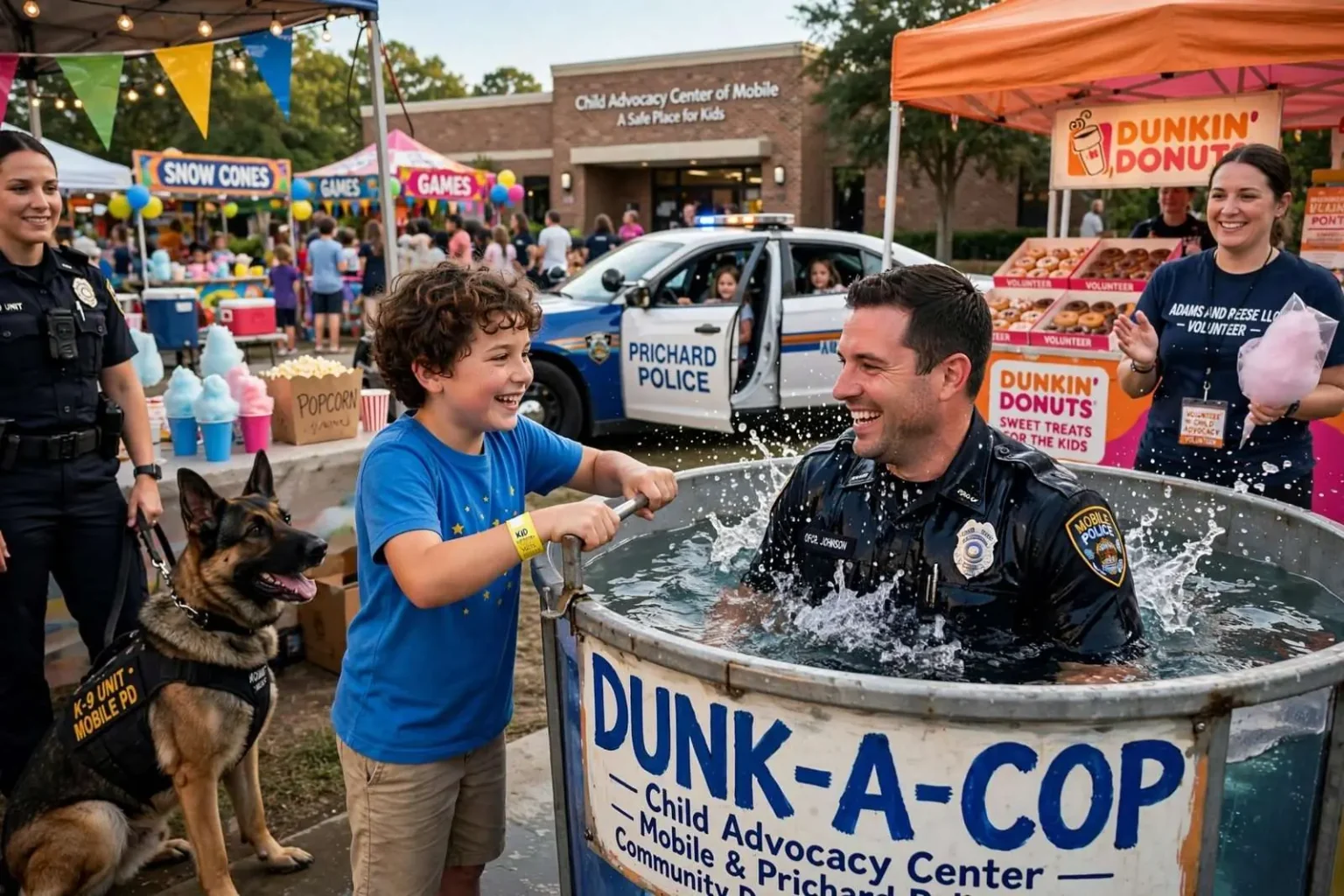
The Child Advocacy Center is giving young victims of sexual and physical abuse a chance to see Mobile and Prichard police officers in a friendlier light — by dunking them in a tank. The Dunk-A-Cop event is designed to help children who have worked with the officers on their abuse cases overcome fear of law enforcement, and organizers said children get to dunk the officers and laugh along with them, seeing a fun, approachable side of the people who investigated their cases.
The premise is simple and, advocates say, effective. Many of the children served by the center met police officers for the first time on the worst days of their lives — during forensic interviews, investigations, and court proceedings in which an officer’s questions helped bring their abusers to justice. For a child, that association can leave a lasting imprint: the sight of a uniform becomes a reminder of a frightening time. Dunk-A-Cop inverts the relationship, putting the officer on the hot seat and the child in control of the lever.
The Child Advocacy Center’s grounds were set up for a festival, with snow cones, cotton candy, popcorn and games filling the space alongside the dunk tank. The carnival atmosphere is deliberate: organizers want the children to remember the center as a place of laughter, not only a site of interviews and difficult conversations.
Sweet Treats and a K-9 Visit
Dunkin’ Donuts is providing donuts for the children, and volunteers from the center along with the law firm Adams and Reese LLC are helping run the event. Corporate and professional volunteers have long played a role at the center, filling the gap between what public funding provides and what a child-centered operation actually requires — extra hands for events, supplies, and the thousand small tasks that make a day like this run smoothly.
A member of the Mobile Police Department’s Canine Unit will visit with the children, and a police car will be on site for kids to explore inside. Both gestures are staples of community policing done well. A police dog that greets children gently, and a cruiser with its lights and doors open for climbing, are invitations to curiosity — letting children satisfy their questions about police work in an environment with no pressure and no fear attached.
For the officers themselves, the day serves its own purpose. Officers who spent months building cases alongside investigators and counselors rarely get to see the children they helped in any context but an interview room. Events like this one let them witness what the work was for: kids being kids, eating snow cones, and dunking a police officer into a tank of water to the laughter of everyone watching.
How a Child Advocacy Center Works
The Child Advocacy Center of Mobile operates on a model that has spread across the country since the first children’s advocacy centers opened in the 1980s: a single, child-friendly location where law enforcement investigators, child protective services caseworkers, prosecutors, therapists, and medical professionals coordinate around a child instead of sending the child from office to office.
Before the model existed, an abused child might have to describe the same painful events repeatedly — to a patrol officer, then a detective, then a social worker, then a prosecutor’s investigator — in settings as intimidating as police stations and courthouse back rooms. The advocacy center approach centers on one forensic interview, conducted by a trained specialist in a room designed for children, with the professionals who need the information observing from another room and feeding follow-up questions through the interviewer. The result is fewer retellings, better evidence, and less additional trauma.
The center’s work does not stop at investigation. Counseling services help children and non-offending family members process what happened, and victim advocates guide families through a court system that can otherwise feel incomprehensible. It is within that longer arc of care that relationships between children and the officers who investigated their cases are formed — the same relationships Dunk-A-Cop works to soften and repair.
Mobile and Prichard Officers in the Fold
The participation of both Mobile and Prichard police departments reflects the geography of the center’s caseload. Mobile is the region’s largest city, and Prichard sits just to its north — a smaller municipality with its own police department and its own share of the cases the center serves. Children from both cities pass through the center’s doors, and investigators from both departments are regular partners in its multidisciplinary team.
That team approach is the invisible foundation of an event like Dunk-A-Cop. The officers willing to sit in a dunk tank are the same officers who spent hours building trust during investigations, and the rapport that makes a child willing to dunk a police officer is evidence of something earned: the child’s sense that these particular adults are safe, honest, and on their side.
The Community Role of Adams and Reese
The involvement of Adams and Reese LLC, a law firm with a longstanding Gulf Coast presence, is part of a broader tradition of professional volunteerism around the center. Firms and businesses that support child advocacy organizations often do so for years, and their volunteers learn quickly that the work is unlike any other kind of community service: modest tasks — running a popcorn machine, handing out snow cones, helping a shy child up the dunk tank ladder — in service of children recovering from experiences most adults struggle to imagine.
For the center, volunteer-supported events also stretch resources. Every dollar not spent on catering or staffing for a festival day is a dollar available for therapy sessions, forensic interview equipment, and family support services. The model has allowed child advocacy centers nationwide to serve large caseloads with lean budgets, and Mobile’s center has been part of that story for decades.
Why Play Matters in Recovery
The therapeutic logic behind an afternoon of games is well established. Children who have experienced abuse often carry hypervigilance — a persistent sense of threat — and places associated with their trauma can trigger it long after the danger has passed. Rebuilding positive associations takes deliberate experiences in which the child feels safe, empowered, and simply allowed to play.
Dunk-A-Cop layers on a specific form of empowerment: the child controls the outcome. The officer is the one in the vulnerable position, and the child’s own action — hitting the target, sending the officer into the water — produces the laughter. Therapists and child-life specialists note that agency is one of the most important elements in recovery from abuse, and a dunk tank is agency made physical and hilarious.
The K-9 visit extends that logic to animals. Children who have been harmed by adults often trust animals more readily than people, and a well-trained police dog offers a bridge: an officer’s partner, and by extension the officer, introduced through a creature that asks nothing of the child but a friendly hand.
Beyond the Tank: The Center’s Everyday Work
While the dunk tank draws the cameras and the crowds, the Child Advocacy Center’s daily operations are quieter: scheduled forensic interviews, therapy appointments, team case reviews where investigators and caseworkers coordinate on active files, and courtroom preparation for children whose cases go to trial. The center serves children across Mobile County, and its staff includes interviewers, counselors, and advocates who specialize exclusively in child victims.
Community education is another strand of the mission — training teachers, coaches, and parents to recognize signs of abuse and to respond in ways that protect children and preserve evidence. Prevention, center leaders often note, depends on adults who know what to look for and who are willing to make the call that brings a child into safe hands.
A Different Picture of the Police
For the officers of Mobile and Prichard, the day ends wet and hoarse, and that is the point. Community policing advocates have long argued that the visibility of officers in relaxed, human settings — coaching youth sports, visiting classrooms, sitting in dunk tanks — does more for public trust than any campaign slogan. For children who associated the uniform with the hardest chapter of their young lives, the image that rides home is different: an officer soaked, grinning, and asking for another turn on the platform.
The center’s organizers measure success not in headlines but in the small things: a child who waves at a police car instead of hiding from it, a family that knows where to turn, a laugh that belongs to a kid and not to anyone else. On this day, the snow cones melted, the donuts disappeared, the K-9 handler made the rounds, and a police cruiser’s driver seat was claimed by a string of delighted visitors. The officers went home dry eventually. The children went home with something better — a memory that puts the people who helped them, and the institution they represent, on the side of fun.