
Christ United, One of Mobile’s Largest Churches, Formally Splits From United Methodist Denomination
Christ United, a nearly 5,000-member Mobile church, formally disaffiliated from the United Methodist Church after its request was ratified Nov. 12.
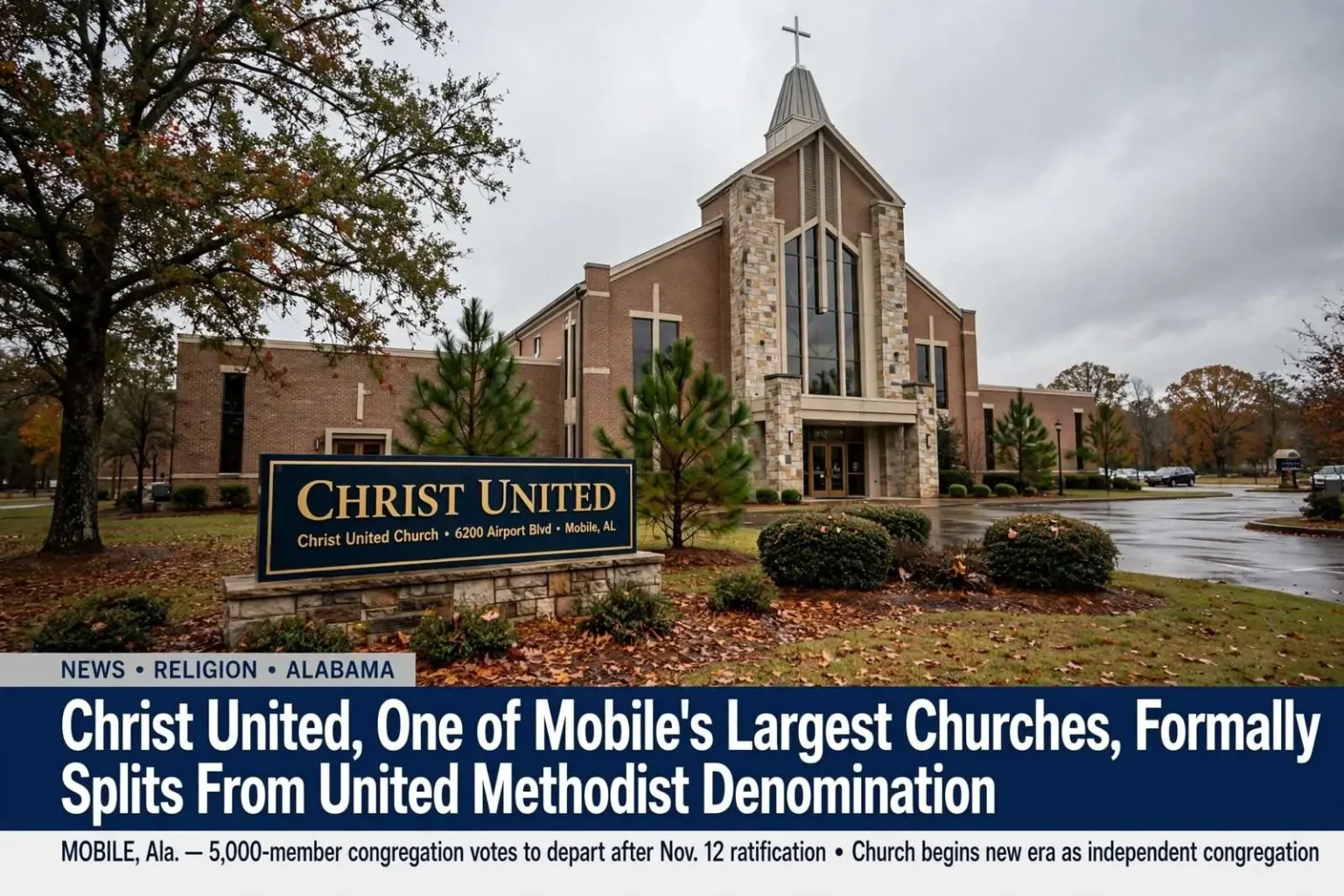
MOBILE, Ala. — Christ United, a west Mobile congregation with a membership approaching 5,000 people, has officially ended its affiliation with the United Methodist Church after its request was ratified during a special conference session. The vote makes the west Mobile church one of the largest congregations in the region to formally walk away from the denomination, closing a chapter that began decades ago when the church was founded and opening an uncertain but deliberately chosen new season as an independent congregation.
Bishop David Graves, serving the Alabama-West Florida Conference as bishop in residence, presided over the Sunday, Nov. 12 ratification. The vote made Christ United one of eight churches in the conference — which counts 311 congregations — approved to depart the denomination this round. The special session format, which gathers conference delegates for a single purpose rather than a full annual meeting, has become the standard mechanism by which United Methodist churches in the region have processed disaffiliation requests since the denomination created a formal pathway out for congregations caught in its long-running disputes.
“Today is another somber day in the life of the Alabama-West Florida Conference,” Graves said in a statement, adding that he wished the departing churches well as they “navigate ministry in a new season.” He also thanked congregations that chose to remain United Methodist and held off on departure discussions pending more information. The bishop’s language reflected the tone that has come to mark these proceedings — procedural on the surface, grieving underneath — as one of the nation’s largest denominations continues to shed congregations from every region and every theological corner.
A long-running denominational fight
The split traces back to a dispute that has roiled the denomination since 2019, when United Methodist delegates reaffirmed church positions opposing gay clergy and same-sex marriage. The repeated battles over human sexuality have strained congregations on both sides of the issue, and in the years since, general conferences, court rulings within the church and regional negotiations have repeatedly delayed, amended and extended the terms under which local churches could leave with their property and their pension obligations settled.
For congregations like Christ United, the question was never simply theological. Disaffiliation requires a congregation to weigh its financial obligations to the denomination’s pension program, the terms under which it keeps its buildings and property, and the practical realities of operating without a denominational safety net — appointment systems for clergy, insurance pools, mission structures and a connectional network that United Methodist churches have relied on since the tradition’s founding. Approaching 5,000 members, Christ United carries the institutional weight of a mid-sized denomination all by itself, with programs, staff and facilities scaled to one of the largest Protestant congregations in the Mobile area.
The Rev. Dr. Robert Couch, lead pastor of Christ United, said the constant fighting had taken a toll. “The issues of human sexuality, for too long, have distracted and divided the United Methodist denomination and, in turn, our local church,” Couch said. He noted that each round of debate had also caused harm to LGBTQ persons as the church restated its positions. Couch said the congregation requested disaffiliation so it could move past the controversy — a framing that placed the decision less on any single disputed question and more on the cumulative exhaustion of a congregation caught in a fight it could not resolve from the pew.
What the conference vote means
The Alabama-West Florida Conference, which spans congregations across the southern half of Alabama and the Florida Panhandle, has been among the most affected regions in the denomination’s unfolding realignment. Its special sessions have processed departures in waves, with each vote formally severing a congregation’s connectional ties and settling the financial terms of its exit. The eight churches approved this round join a steadily lengthening list, and each departure reshapes the conference’s budget, its appointment calculus and its identity a little further.
Under the denomination’s disaffiliation provisions, a departing church typically owes a final payment covering its share of pension liabilities and any remaining apportionments — the connectional giving that funds denominational ministries. For a congregation the size of Christ United, those figures are substantial, but the church’s scale also means it has the resources to absorb them, which is not true of every small congregation that has considered the same path. Smaller churches facing the same decision have often had to choose between financial strain and staying in a denomination they no longer feel at home in.
The ratification also ends a formal relationship that, for most of the church’s history, was simply part of its identity. United Methodist congregations operate within a structured connection: pastors are appointed rather than called, budgets flow upward to district and conference levels, and doctrine is set by a global general conference. Stepping out of that structure means Christ United’s leadership now owns all of it — clergy recruitment, doctrine, governance, missions — without a denominational framework to fall back on.
Independence, and the question of what comes next
For now, Christ United will operate as an independent congregation for one to two years while its leadership discerns whether to affiliate with another denomination or network. That deliberation period has become a familiar pattern among departing United Methodist churches, many of which have eyed newly formed Methodist denominations organized around more traditional positions on sexuality, while others have considered evangelical networks, non-denominational association or remaining fully independent. For a church of Christ United’s size, the decision carries significant consequences: denominational affiliation affects everything from pastoral placement to mission partnerships to the borrowing terms a church can get on construction projects.
The interim arrangement also gives the congregation’s members their own period of discernment. Churches that leave a denomination do not lose members on the day of the vote, but the months that follow — with changes in worship style, governance and identity — tend to test loyalties in quieter ways. Some members who valued the United Methodist connection will choose to follow the denomination to another nearby congregation; others will stay and help define what the independent era looks like.
“Christ United will continue our focus on loving God, loving people, and changing the world as we have for nearly 45 years,” Couch said, pointing the congregation’s attention past the vote itself. The church’s nearly five decades of ministry in west Mobile have included large-scale community programs, youth ministries and missions that operate at a scale few local congregations match, and leadership has been explicit that those operations are meant to continue uninterrupted regardless of what denominational decision follows the two-year window.
The wider landscape in Mobile and beyond
Christ United’s departure lands in a Mobile-area religious landscape already reshuffled by the Methodist disputes. Congregations across the city and surrounding counties have taken different paths — some have voted to stay and remain publicly committed to the denomination’s future, others have joined the departure waves, and still others have sat through years of congregational meetings waiting for clearer terms. The result is a new geography of Methodism in South Alabama, one in which churches that once shared a denominational identity now sit in separate camps, and in which some congregations that left have already affiliated with new Methodist bodies while others remain independent.
The disaffiliation wave has also drawn attention to how differently the split lands on congregants. For members who supported the denomination’s traditional positions, departure resolves a long tension. For members who favored full inclusion, the vote reads differently — a moment Couch himself acknowledged when he noted the harm caused to LGBTQ persons through each round of the church’s restated positions. Congregations leaving the denomination carry both groups through the door, and how they minister afterward becomes one of the defining questions of the independent era.
Regional observers are watching what the departures mean for the conference’s capacity. Each church that leaves takes its giving with it, and the conference’s connectional ministries — camping programs, campus ministries, disaster response, appointments to smaller churches — are funded by that pooled giving. Eight departures in one round, with more expected, force the conference to plan for a leaner structure, even as the bishop and cabinet continue ministering to the 311 congregations that remain, at least for now, part of the United Methodist connection.
A congregation’s next chapter
For Christ United’s members, the immediate future looks much like the recent past. Sunday services, weekly programs and the church’s community ministries continue without interruption, and the practical changes that come with independence — governance documents, banking relationships, pastoral staffing decisions — will unfold mostly out of public view over the months ahead. The congregation’s leadership has framed the transition as a reset of focus rather than a reinvention, pointing to the church’s long-running mission statement as the through line that survives the denominational break.
The two-year discernment window will decide the rest. If Christ United affiliates with a new Methodist denomination or an evangelical network, it will trade one set of connections for another, gaining shared resources and accountability at the cost of some independence. If it stays standalone, it will remain one of the largest independent congregations in the Mobile area, entirely self-governed and self-funded. Either way, the vote ratified on Nov. 12 closed a denominational relationship nearly half a century old, and the congregation now enters a season its bishop described — in words meant for all the departing churches — as ministry in a new one.
What happens at Christ United will also be watched across the region as a case study. With its size, its facilities and its decades of established ministry, the church has more institutional depth than most congregations confronting the same decision, and the choices it makes during its independent period may shape how other large congregations approach the same crossroads. For a denomination still working through departures across the Alabama-West Florida Conference, and for a Mobile community watching one of its largest churches chart its own course, the ratification vote is less an ending than the beginning of an open question.