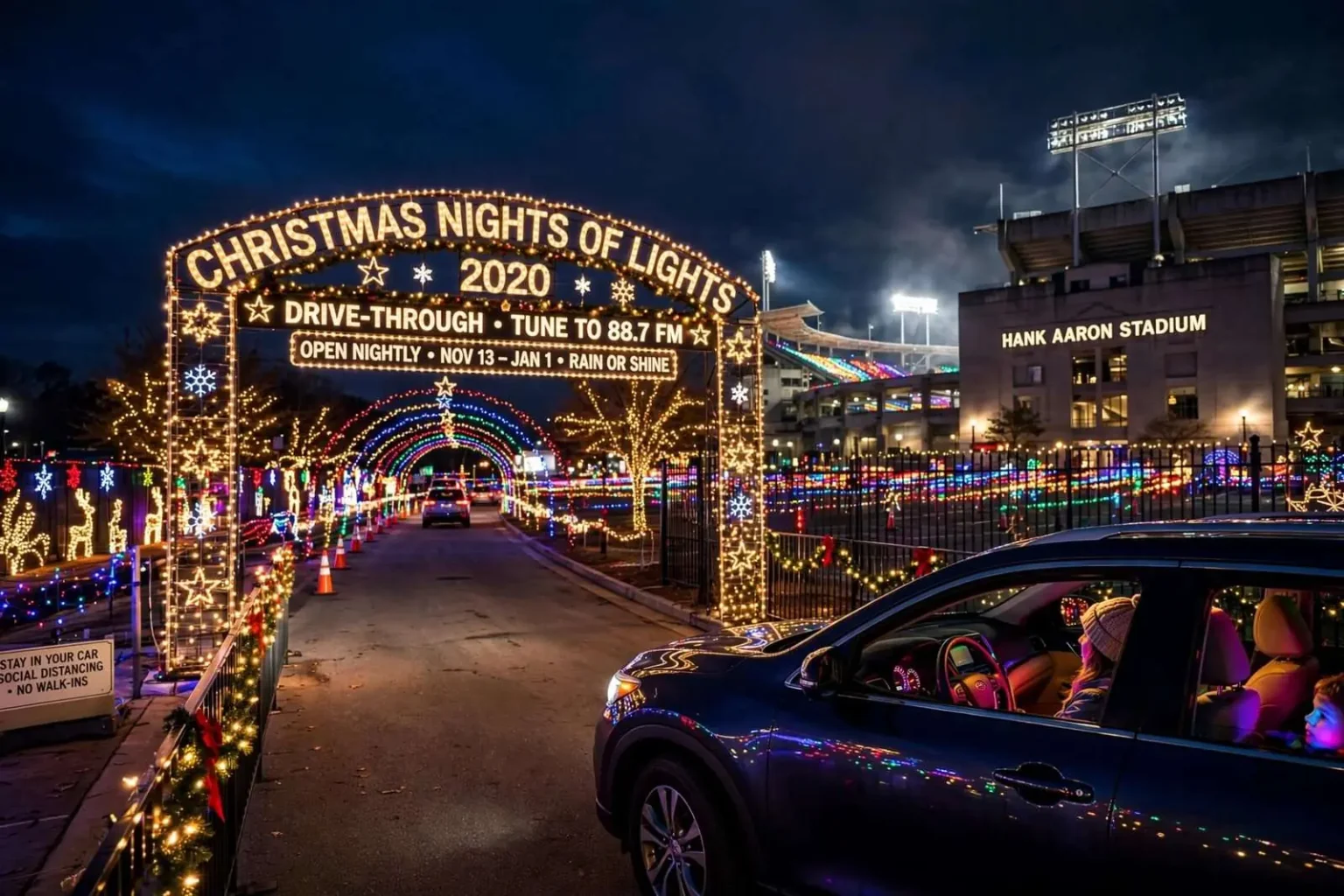
The Christmas Nights of Lights drive-through light show was back at Mobile’s Hank Aaron Stadium for the 2020 holiday season, with the Mobile Sports & Entertainment Group once again transforming the ballpark into a glowing nighttime attraction. In a year when nearly every tradition on the Gulf Coast calendar had been questioned, canceled or reworked, the return of the lights gave families a way to celebrate that required nothing more than a car, a radio and an evening free.
Gates opened Friday, November 13, at 5:30 p.m., and the show ran every night, rain or shine, through New Year’s Day — a seven-week run that stretched across Thanksgiving, Christmas and the turn of the calendar, giving families across the Gulf Coast a socially distanced way to celebrate a holiday season upended by the pandemic. The every-night schedule was itself a departure from older holiday attractions that operated only on selected weekends, reflecting both the demand of 2020 and the drive-through format’s ability to operate continuously with a lean staff.
Visitors drove through miles of synchronized light displays choreographed to music, all visible from the comfort and safety of their own vehicles. The formula that has made drive-through light parks a national phenomenon was on full display: tunnels of dancing bulbs, themed scenes timed to a soundtrack broadcast through the car radio, and a route that wound through the stadium’s grounds at slow speed so that no family had to leave its vehicle at any point.
A holiday season reworked
The event became one of the few large-scale holiday traditions able to proceed in 2020, when parades and gatherings across Mobile and Baldwin counties were being canceled or reworked because of COVID-19 concerns. The losses that season were extensive and familiar: the region’s cherished Mardi Gras organizations were already watching their winter season come into doubt, municipal Christmas parades went dark one after another, tree lightings moved online, and school holiday performances were shuttered along with so much else.
Against that backdrop, a drive-through format checked every box public health guidance required. Visitors stayed inside their vehicles from ticket booth to exit, no shared surfaces were touched in a crowd, and families could enjoy the show at their own pace without mingling with other households. The format’s pandemic suitability was no accident — drive-through light shows were already growing nationally before 2020, but the pandemic turned them from a novelty into one of the few ways a community could hold anything resembling a shared seasonal event.
For the Mobile Sports & Entertainment Group, the organization behind the show, the 2020 run represented both a business and a civic undertaking. The group, which specializes in sports and entertainment events around the Gulf Coast, had transformed the ballpark’s parking lots and concourses into a light park the year before, and bringing it back — with the operating adjustments a pandemic demanded — kept a young holiday tradition alive when older ones could not proceed.
The ballpark dressed for the holidays
Hank Aaron Stadium offered an unusual and fitting canvas. The ballpark at the corner of the Mobile cityscape is named for the town’s greatest sports figure — Henry Louis Aaron, the Mobile-born slugger who rose from a sandlot career in the city to break baseball’s most storied record — and for years it hosted minor-league baseball each summer. A venue built to draw thousands of cars and families for night games converts naturally to a drive-through attraction: paved loops for traffic flow, ample parking for queuing, concession infrastructure, and the kind of sightlines that light designers can work with.
The transformation reimagined nearly every corner of the grounds. Displays lined the entry drive and wound through the lots, with the stadium structure itself serving as a backdrop for larger scenes. The route’s pacing — crawl-speed, windows up, radio tuned in — meant the experience ran on the family’s own clock: kids unbuckled as far as safety allowed, faces lit by the shifting colors, and the soundtrack doing the work that walking a downtown parade route does in a normal year.
The choreographed soundtrack gave the show its signature. Synchronized to a mix of classic Christmas music and contemporary favorites broadcast on a designated radio frequency, the displays pulsed, chased and danced in time — millions of bulbs flickering in patterns engineered to the beat. For families with young children, the show’s appeal was obvious: no parking hunt, no ticket lines, no cold walk back to the car, and the option to loop the route again on a busier night’s exit.
What the season looked like in 2020
The 2020 holiday season along the Gulf Coast tested how flexible old traditions could be. Events that depended on crowds — the parades, the downtown tree lightings, the crowded shopping weekends — either canceled or reinvented themselves with masking, distancing and virtual components. Attractions that could be consumed from a private vehicle had their moment, and Christmas Nights of Lights was the region’s most prominent example, running nightly from mid-November through the first of the year regardless of weather.
The rain-or-shine commitment mattered more than usual in a season when families were planning around unpredictable schedules. Coastal December weather swings between warm humid evenings and cold fronts, and the drive-through format shrugged off both: visitors controlled their own climate, and the show went on. The nightly schedule also spread attendance across the calendar, easing the crowding that a weekends-only attraction would have created in a year when families were actively avoiding crowds.
The pandemic’s effect on the wider holiday calendar gave the show particular weight for families with children. School parties, church pageants, mall visits with Santa and extended-family gatherings — the staples of a Gulf Coast December — had all been curtailed or reimagined, and parents were searching for anything that felt like a normal celebration. An evening drive through the lights required no difficult risk calculus, no tickets bought weeks in advance for a specific time slot, and no exposure decisions beyond the family’s own front door. In a season defined by what families could not do, the show’s straightforward appeal — come any night, stay in the car, enjoy the lights — explained the lines that formed at the gate.
For the businesses around the ballpark and along the corridors families drove to reach it, the show’s nightly run brought a modest but welcome boost in a hard year. Restaurants picked up takeout orders from arriving families, and the tradition of pairing the light show with dinner or hot chocolate became the small-scale version of the economic activity larger holiday events normally generate. After a year in which the region’s tourism and hospitality sectors had absorbed enormous losses, any dependable nightly draw carried weight.
The show’s run through New Year’s Day also filled a gap in the post-Christmas calendar. The week between Christmas and New Year’s is traditionally a dead zone for attractions — schools are out, visitors are in town, and little is scheduled — and a nightly drive-through attraction gave visiting relatives and restless families a destination during exactly that stretch, extending the season’s value past the holiday itself.
A tradition’s second year and what it signaled
That 2020 marked the show’s return — its second year at the ballpark — mattered for its future. Holiday attractions rarely survive on a single season; they become traditions through repetition, the families who come back and the rituals that form around them. By operating through the most disrupted holiday season in modern memory, Christmas Nights of Lights established itself as one of the region’s dependable annual events, with a format naturally suited to the times.
The broader lesson of the 2020 season was not lost on event organizers along the Gulf Coast: the drive-through model worked, and not merely as a pandemic compromise. The format extended attendance across the week, held down operating costs, suited the region’s car-centered geography, and drew audiences from across the two-county metro and beyond. What began as an adaptation of a national concept had become part of Mobile’s holiday calendar — staged, fittingly, in a ballpark named for a man whose own story began a few miles away.
For the families who wound through the lights that season, the details that mattered were simpler: a Friday night in mid-November when the gates opened at 5:30, a radio station playing the soundtrack, and miles of synchronized color after a year when so much had gone dark. The show ran through New Year’s Day, and when the last bulbs came down, the 2020 holidays along the Gulf Coast had at least one tradition that arrived as planned — every night, rain or shine, from the safety of the family car.