Citronelle Angler Smashes 38-Year-Old Alabama Amberjack Record With 132-Pound Catch
Brian Andrews of Citronelle landed a 132-pound amberjack in the Gulf, shattering Mobile angler Marcus Kennedy's 1981 state record by five pounds.
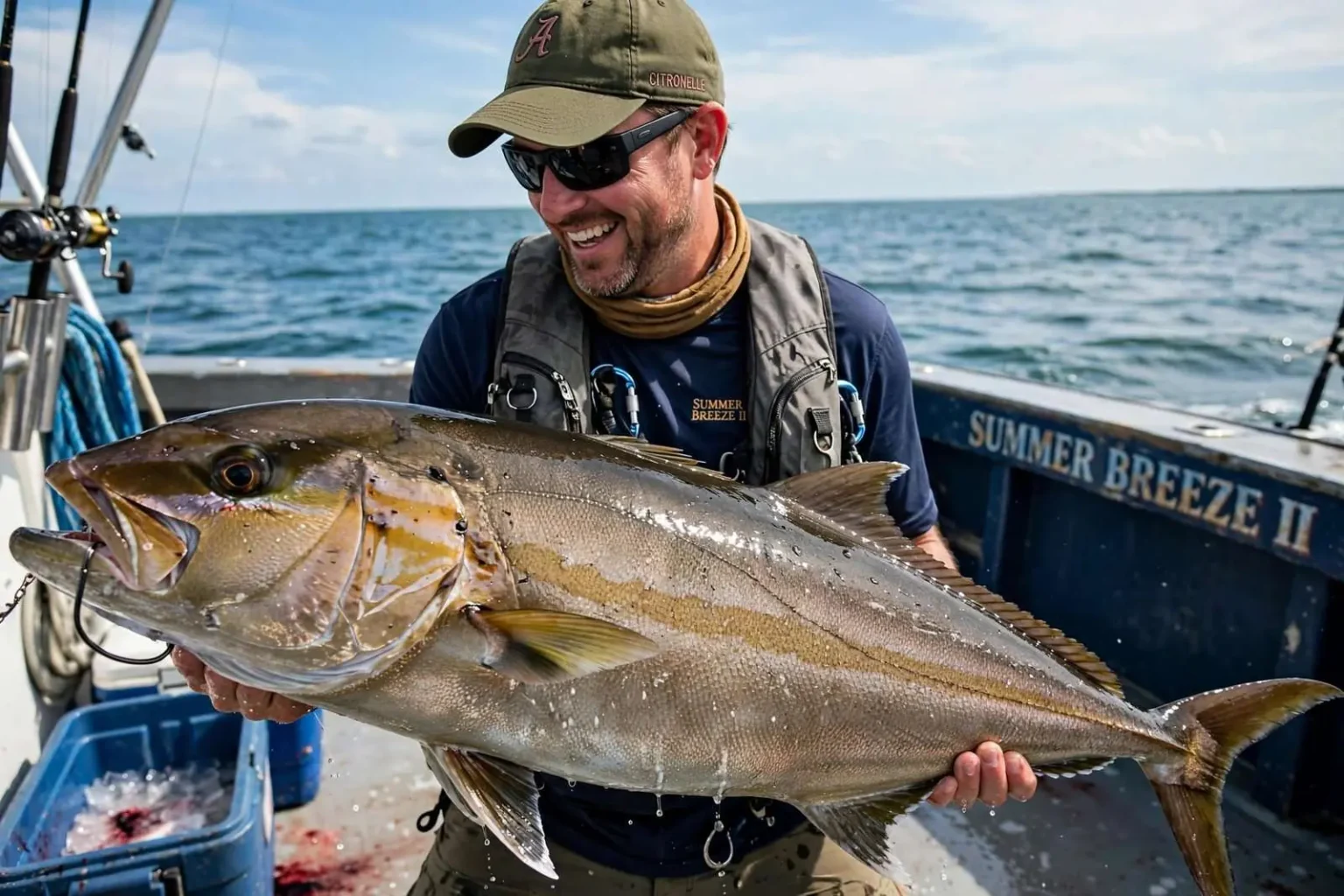
MOBILE, Ala. — A Citronelle man has rewritten the Alabama record books, landing a 132-pound, 12.8-ounce greater amberjack in the Gulf of Mexico and breaking a mark that had stood for 38 years.
According to the Alabama Department of Conservation and Natural Resources, Brian Andrews was fishing aboard the vessel Summer Breeze II earlier this month when he hooked into the giant. The fight lasted at least half an hour, with the fish making three big runs that had others on the boat wondering if Andrews had actually hooked a shark.
Once it hit the scale, the amberjack measured 65 inches long with a 40-inch girth. Andrews’ previous personal best was a 70-pounder — less than half the size of his new record fish.
State record fish are the rarest entries in Alabama’s angling annals, and a record that survives 38 years takes on a life of its own. Generations of Gulf anglers have chased the mark, weighing suspicions against certified scales, and the Department of Conservation and Natural Resources maintains the official list across freshwater and saltwater divisions. Breaking one requires not just an extraordinary fish but the documentation to prove it — measurements, witnesses and a certified weight.
The Fish That Rewrote the Book
The greater amberjack is the largest of the jack family in the Gulf of Mexico, a deep-water bruiser that patrols wrecks, rigs and rocky bottom from nearshore out to the shelf edge. Adults commonly run 20 to 40 pounds, with true giants — the fish that make record lists — living deeper and older than the average angler ever sees. Their powerful bodies, built in amber and olive tones with a dark stripe through the eye, are made for sustained, punishing runs that test tackle and angler alike.
That fighting reputation is why the moments after Andrews set the hook carried so much doubt. Amberjack make repeated, stubborn runs, but the three long surges that had the Summer Breeze II crew questioning whether a shark had taken the bait point to something exceptional even by amberjack standards. Fish of this size find deep water fast, and landing one is as much about the boat’s positioning and the crew’s work as it is about the angler holding the rod.
The measurements tell the story of the fish’s bulk: 65 inches from nose to tail, with a 40-inch girth. Amberjack are dense, muscular fish, and a body that long and that round translates into the kind of scale weight that separates record fish from merely memorable ones. A 70-pounder had been Andrews’ previous best — respectable by any standard, and eclipsed by nearly double.
A Legacy Handed Down
The old record belonged to Marcus Kennedy of Mobile, who caught a 127-pound, 12-ounce amberjack on June 19, 1981. With his nearly four-decade run at the top over, Kennedy joked that his son will now have to fight to win the family’s legacy back.
Kennedy said any future record attempt for him would target smaller species — leaving the amberjack and blue marlin chase to his son Tyler and nephew Ryan. The family’s fishing lineage spans the years between the two record fish, a stretch during which Gulf anglers chased Kennedy’s mark with better boats, better electronics and better tackle, and still came up short.
Citronelle’s Deep Fishing Roots
Citronelle, in north Mobile County, sits far from the saltwater — a small town of forests and rolling terrain better known for its hunting camps than its fishing reputation. But the drive south to the Gulf is a familiar one for anglers across north Mobile and Washington counties, who trailer boats to the coast or book offshore trips out of the area’s many launches, chasing the same snapper, triggerfish and amberjack grounds that draw boats from the beach communities.
Offshore fishing out of Mobile County’s ports follows a rhythm shaped by the Gulf’s structure. Amberjack gather around wrecks and artificial reefs miles offshore, spots marked by coordinates passed among crews and charted by those who run offshore regularly. A trip that finds a productive wreck can produce multiple hookups in an hour — which is what makes a fish of record size stand out even among a full box of good ones.
The Summer Breeze II’s crew witnessed exactly that contrast. In a fishery where a solid amberjack might run 30 pounds and a great one 50, a fish that pushed past 132 pounds rewrote expectations for everyone aboard — and, once verified, for the state’s entire record book.
How a Record Becomes Official
The Alabama Department of Conservation and Natural Resources verifies state records through a process designed to withstand exactly the scrutiny a 38-year-old record’s fall attracts. The fish must be weighed on certified scales, identified by species experts and documented with measurements and witnesses before the department certifies the entry and updates the official list.
For saltwater species like greater amberjack, the Marine Resources Division oversees the record program, maintaining the standards that have kept Alabama’s list credible for generations. The 12.8 ounces in Andrews’ fish matter as much as the pounds — the margin over Kennedy’s 1981 mark is slim, which is precisely why the certified weight process exists. A record broken by less than five pounds can be contested, re-measured and re-litigated for years if the documentation is not airtight.
Records of this kind also ripple outward through the angling community. Tackle manufacturers, boat captains and fishing forums track the state lists closely, and a new record fish becomes part of the local lore — the story retold at marinas and tackle shops with each retelling adding a foot to the fish. The verified numbers keep the legend honest.
The Amberjack Fishery Today
The record fish arrives during a complicated era for greater amberjack in the Gulf. The species has faced management measures in recent years as federal regulators work to rebuild the stock, with seasons, size limits and bag rules adjusting as assessments change. Anglers who target the fish now plan their trips around openings and closed seasons in ways their counterparts in 1981 never had to consider.
Those rules exist because amberjack are both popular and vulnerable. Their habit of schooling around structure makes them easy to find and catch, and their slow growth means big fish represent many years of Gulf life. Fishery managers, charter captains and recreational anglers have shared the work of conservation, with release gear, descender devices and careful handling becoming standard practice on boats that fish the offshore wrecks.
Against that backdrop, a 132-pound specimen carries a second significance: it is proof of the Gulf’s continued capacity to produce fish of a lifetime. In a fishery managed carefully enough to persist, the giants still grow somewhere in the deep water — and a record fish like Andrews’ demonstrates what the habitat can support when conditions align.
Chasing the Next Mark
Every state record reset starts a new clock. Kennedy’s 1981 amberjack stood for 38 years; Andrews’ fish now becomes the target for a new generation of Gulf anglers, among them Tyler and Ryan — the son and nephew of the previous record holder, who inherit the family chase along with the rest of the Kennedy legacy.
The blue marlin ambition Kennedy passed down carries its own weight. Blue marlin are the Gulf’s most storied big-game species, the fish that headline the major billfish tournaments out of Panama City, Orange Beach and Destin each summer, and a record chase for one is a commitment measured in fuel, tournament entries and years of offshore time. That the Kennedy family conversation now includes both the amberjack and the marlin says something about the family’s place in Mobile’s offshore tradition.
For his part, Kennedy’s move toward smaller species reflects a practical truth of record fishing: the record list holds categories across many fish, and a smaller-species attempt is a more attainable — and often more fun — pursuit than repeatedly hunting fish that weigh more than some adults. Plenty of Alabama anglers hold multiple state records across species, built on exactly that strategy.
A Story Worth the Scale
Half an hour of fight, three runs that looked like a shark, and a fish that measured 65 inches by 40 inches of girth — the details of Andrews’ catch read like the outline of a story Gulf anglers will retell for years. The certified weight of 132 pounds, 12.8 ounces is what turns the story into history.
It also closes one chapter of Alabama angling and opens another. Marcus Kennedy’s 1981 amberjack defined the state record for nearly four decades, surviving countless challenges from anglers with better equipment than he ever had. Andrews’ fish now inherits that burden — and somewhere in the deep water off the Alabama coast, the fish that will eventually beat it is already swimming.
Until then, the record belongs to a Citronelle angler whose personal best more than doubled in a single morning aboard the Summer Breeze II, and whose name now sits atop the greater amberjack line in the Alabama record book.