Citronelle Man, 65, Dies After SUV Leaves Beverly Jeffries Highway and Strikes Trees
ALEA says 65-year-old Bruce E. Roberts of Citronelle died after his Toyota 4Runner left Beverly Jeffries Highway and struck several trees.
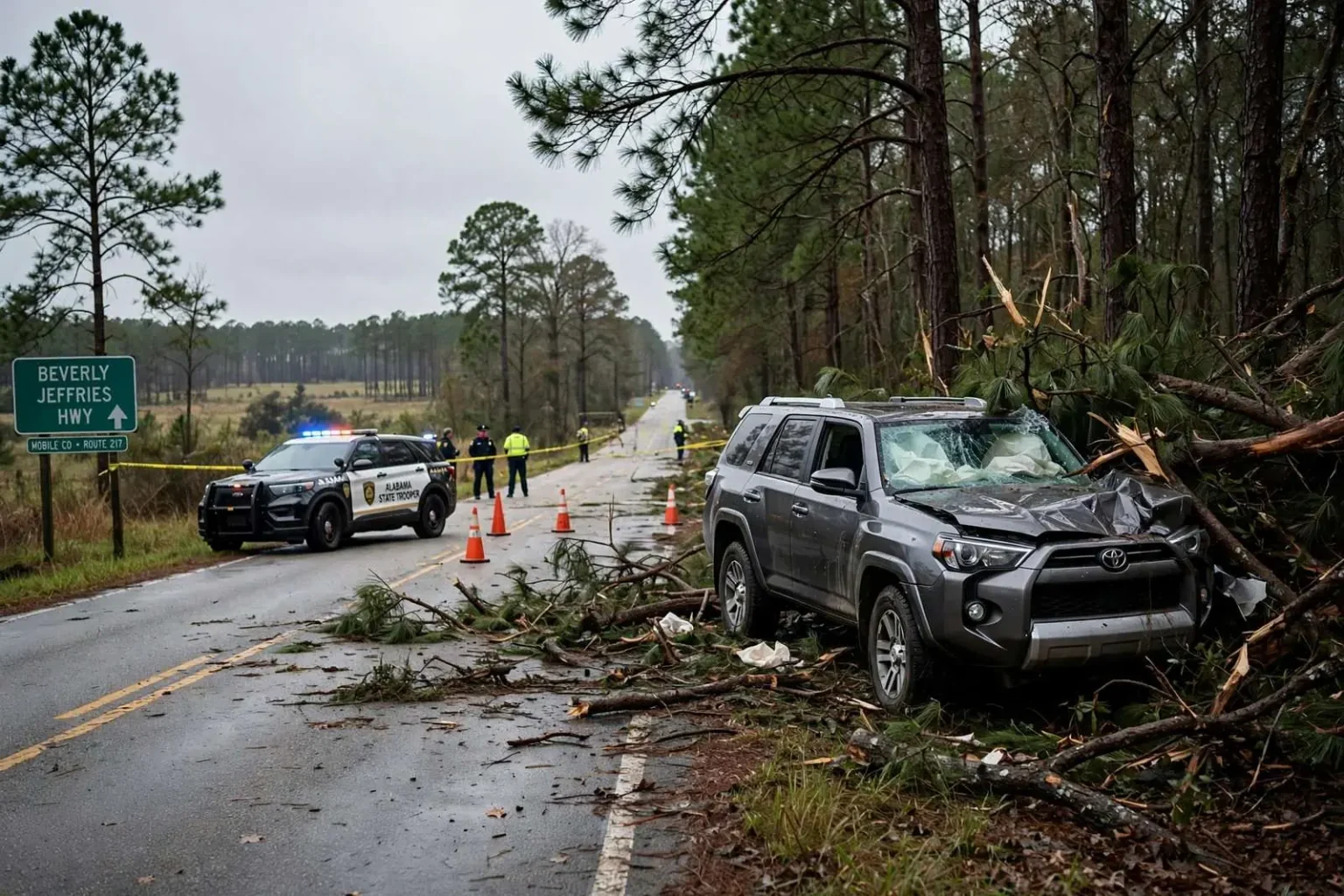
MOBILE COUNTY, Ala. — A 65-year-old Citronelle man died after his SUV ran off a north Mobile County highway and crashed into a cluster of trees, according to state troopers. The Alabama Law Enforcement Agency identified the victim as Bruce E. Roberts, who was driving a 2018 Toyota 4Runner along Beverly Jeffries Highway near Citronelle on Jan. 10 when the vehicle left the roadway and struck multiple trees.
Roberts was pronounced dead at the crash site. Troopers with ALEA’s Highway Patrol Division responded to the scene along with local first responders, closing the affected stretch of the highway while investigators documented the wreckage and crews worked the site. ALEA continues to investigate the wreck.
Fatal crashes on rural two-lane roads remain among the most persistent dangers on Alabama’s highway network, and the stretch of Beverly Jeffries Highway where the 4Runner left the road is characteristic of the roads where they happen most often: two lanes, no median, wooded shoulders, and long stretches between intersections where speeds stay high and a single moment of inattention or a medical event can send a vehicle into the tree line.
What Troopers Know So Far
According to the information ALEA released, the 4Runner was traveling on Beverly Jeffries Highway near Citronelle when it departed the roadway and struck several trees. Troopers have not said what caused the vehicle to leave the road, and their investigation — standard in all fatal crashes — will examine speed, roadway conditions, seatbelt use, possible medical impairment, and any mechanical factors before a final determination is made.
In rural crashes like this one, investigators rely on physical evidence because there are rarely other witnesses: skid marks or their absence, the path the vehicle took through the shoulder, the points of impact on the trees, and the vehicle’s onboard data when it is recoverable. The results of that analysis determine what, if anything, appears in ALEA’s final crash report.
The Road and the Community
Citronelle is a small city in far northern Mobile County, near the Washington County line, roughly 40 miles north of downtown Mobile. The area around it is classic South Alabama upland — pine and hardwood stands running close to the pavement, rolling terrain, and farm roads that feed a handful of highways connecting the community to Saraland, Mount Vernon, and the broader Mobile region.
Beverly Jeffries Highway serves as one of those connectors, carrying local commuter and farm traffic through country where roadside trees leave little margin for error. Safety officials have long noted that Alabama’s rural highways account for a disproportionate share of the state’s traffic deaths even though they carry far less traffic than urban interstates. Vehicles leave the roadway at highway speed, and the first thing they meet is often an unforgiving line of timber rather than an open shoulder.
Alabama’s Rural Crash Problem
The circumstances of the Citronelle crash fit a pattern documented year after year in Alabama fatality data. The state’s annual highway safety plans identify lane-departure crashes — run-off-road collisions and head-on events caused by a vehicle drifting from its lane — as a leading cause of death on rural roads, and initiatives such as rumble strips, high-friction surface treatments, and targeted speed enforcement have been deployed around the state in response.
Drivers in Citronelle, Mount Vernon, Chatom, and the other small communities of north Mobile and Washington counties know the reality firsthand: emergency response times are longer when the nearest ambulance is stationed 20 miles away, and crashes that might be survivable closer to a trauma center can be fatal in the country. That arithmetic is part of why troopers and local sheriffs’ deputies repeatedly pair crash announcements with the same core reminders — buckle up, reduce speed on rural two-lanes, and never drive impaired or distracted.
How Alabama Investigates Fatal Crashes
In Mobile County, fatal crashes outside city limits are investigated by ALEA’s Highway Patrol Division, with assistance from the Mobile County Sheriff’s Office, volunteer fire departments, and county coroner’s staff. The sequence is methodical. Troopers secure the scene and manage traffic; the coroner handles identification and pronouncement; a crash reconstruction team may be called for serious collisions; and the vehicle is examined for mechanical defects.
Once the investigation concludes, ALEA compiles a final report that may be requested by family members, insurers, and courts. While the agency releases basic facts publicly in the days after a fatal wreck — as it did here — the detailed findings on causation typically take weeks, because toxicology results and reconstruction analysis move on their own timelines.
The Toyota 4Runner on Alabama Roads
The 2018 Toyota 4Runner Roberts was driving is a body-on-frame SUV popular in rural Alabama, where its durability and ground clearance suit unpaved driveways, hunting leases, and farm work. The model has a solid safety record in moderate crashes, but like any vehicle, its protection depends on restraint use and on the severity of the impact. A high-speed collision with multiple trees concentrates enormous forces on a single point of the vehicle, and forest impacts are among the most lethal fixed-object crash types because the impact is neither wide nor forgiving.
Safe-screening agencies note that mature trees close to the pavement are a known risk factor on rural corridors. Clear zones — the shoulder space a driver has to recover after leaving the road — are narrow on older highways like many in north Mobile County, which is why roadside trees are among the objects highway engineers rank most dangerous when struck.
Losing a Neighbor in a Small Community
In a city the size of Citronelle, a fatal crash is a community event. The victim is usually known personally to a large share of residents, and news of the wreck moves through churches, schools, and the stores that serve as the town’s gathering places. Roberts’ death was announced through the standard channels — a state trooper’s release, then local coverage — and members of the community responded with condolences for a family that suddenly and unexpectedly lost one of its own.
That local dimension is worth noting because it defines how small-town Alabama processes highway fatalities. There is no anonymity in a community of a few thousand people. A crash on a road that neighbors drive daily becomes a fixture of local memory, and it often produces renewed attention to the road itself — requests to county and state officials for speed studies, warning signage, or shoulder improvements along the corridor where the death occurred.
What Drivers Along This Corridor Should Know
Troopers who work the rural corridors of north Mobile County describe a handful of habits that matter most in preventing run-off-road fatalities. Speed that feels comfortable on a straight rural highway can exceed what a driver can recover from when a wheel drops off the pavement edge, where the drop-off itself can pull the vehicle away from the road. Overcorrecting — yanking the wheel back toward the pavement after a shoulder drift — is a common final action in rural rollover and fixed-object crashes, and the recommended response is to ease off the accelerator and steer gradually back onto the road.
Seatbelts remain the single most consequential factor. In rural Alabama crash statistics, unrestrained occupants are consistently overrepresented among fatalities, and the difference between a walk-away and a death in a tree impact often comes down to whether the driver and passengers were buckled in. Fatigue and medical events also matter on long rural drives, and troopers encourage drivers who feel drowsy to stop — the region has no shortage of small stores and church lots along its highways where a ten-minute break costs nothing.
ALEA’s Role Across the Gulf Coast
The Alabama Law Enforcement Agency, formed in 2015 by consolidating the former Department of Public Safety and other state enforcement functions, handles traffic enforcement and crash investigation on Alabama’s highways through its Highway Patrol Division. In the Gulf Coast region, troopers patrol interstates 10 and 65, U.S. 43, U.S. 45, and the rural state routes that connect communities like Citronelle to the rest of Mobile County.
Beyond responding to crashes, ALEA compiles the state’s annual crash statistics, participates in federal highway safety programs, and runs campaigns such as “Drive Sober or Get Pulled Over” and “Click It or Ticket” with local partners. The agency’s troopers are often the only uniformed traffic presence on remote stretches of rural highway, which places a premium on their visibility in deterrence work as well as their investigative role after a fatality.
The Days After a Fatal Wreck
For the Roberts family, the weeks following the crash will involve the procedural steps that follow every fatal collision in Alabama: the coroner’s report, the wait for ALEA’s final crash documentation, and the arrangements that small communities make for their own. Funeral services in Citronelle for victims of highway deaths routinely draw crowds that fill local churches, a measure of how personally these losses land.
For the wider community, the crash is a reminder that the drive between home and town — a route taken without thought hundreds of times a year — is the most dangerous routine many rural Alabamians have. State safety officials have made reducing rural roadway departures a central goal of Alabama’s highway safety plans precisely because crashes like the one near Citronelle, in which a single vehicle leaves a two-lane road and strikes trees, account for a meaningful share of the state’s deaths each year.
Anyone with information about the crash has been encouraged to contact ALEA’s Highway Patrol post, which continues to investigate. Until that investigation concludes, what is known is what troopers released in the immediate aftermath: a 65-year-old Citronelle man, driving a 2018 Toyota 4Runner on Beverly Jeffries Highway, left the road, struck multiple trees, and died at the scene on Jan. 10 — one more name in the long Alabama ledger of rural highway losses, and one more reason the warnings to buckle up and slow down on the state’s two-lane roads continue.