Citronelle Mayor Suspends Homecoming Activities After Teen Injured
Mayor Jason Stringer suspended Citronelle homecoming activities after a teen was injured, saying student safety comes first.
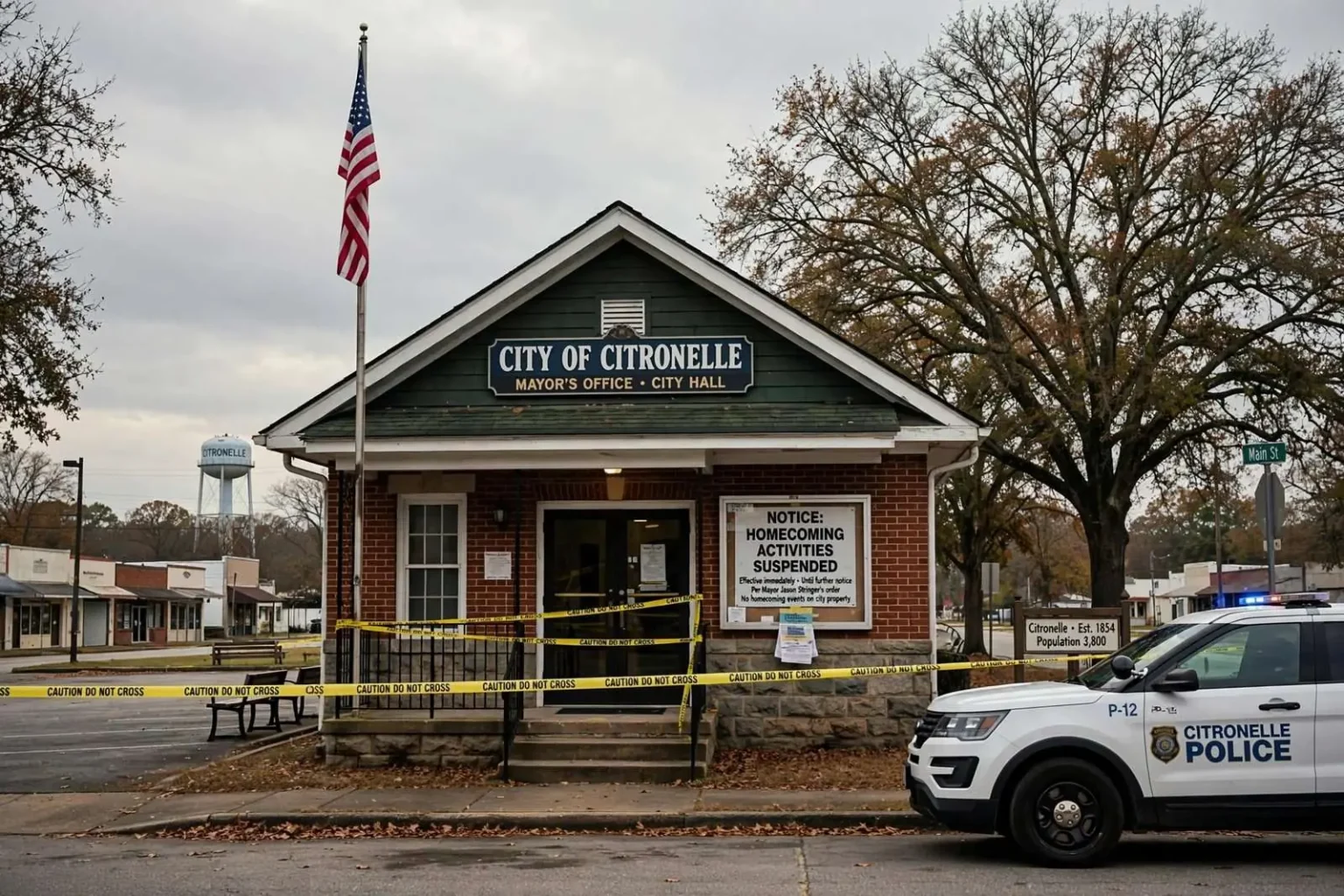
Citronelle Mayor Jason Stringer says the city is putting a stop to homecoming traditions this year after a teenager was hurt Monday night. In a Facebook post, Stringer did not describe how the teen was injured, but said he met with the police chief Tuesday to discuss action — and the action the city chose was to suspend the traditions that have grown up around Citronelle High School’s homecoming week.
“It is never ok for one of our kids to be injured and if this is what it takes to keep them safe, that is what we will do,” Stringer wrote, addressing Citronelle High School parents and students directly. The message, posted from the mayor’s personal platform rather than an official city channel, carried the tone of a small-town executive making an unpopular call in real time rather than a prepared statement drafted for distribution.
Stringer noted that he had tried from the beginning to allow homecoming traditions to continue. That admission framed the announcement as a last resort: a mayor who had preferred to let the week’s rituals proceed, driven to suspension by an injury he considered serious enough to justify shutting them down.
No further details about the incident or how long the suspension will last have been announced. The absence of specifics has left room for the community to fill the gap with speculation, frustration and — in the way of small Alabama towns — a steady stream of comment under the mayor’s post arguing about what happened Monday night and whether the city’s response fits it.
Citronelle and its homecoming week
Citronelle sits in the far northern reaches of Mobile County, a city of a few thousand residents whose high school functions as the center of community life in a way that larger towns can hardly imagine. Friday night football, homecoming week and the traditions attached to it are not merely school events — they are the social calendar of the town itself, drawing alumni, grandparents and neighbors who have no students in the building anymore.
Homecoming traditions in small Alabama towns tend to grow up outside the official program. Beyond the sanctioned pep rally, the game and the dance, the week accumulates its own unofficial rituals — class pranks, property decorating, late-night gatherings, and dares that students pass down from one graduating class to the next. Schools and cities tolerate some of it, police the rest, and every few years an injury or a property incident forces the conversation about where the line sits.
That is the conversation Stringer’s announcement has now forced in Citronelle. The mayor’s decision treats the traditions not as school matters but as city matters — a distinction that matters in a town where the police department, the streets and the liability questions all run through City Hall. By acting through the city rather than the school system, Stringer signaled that what happened Monday night crossed from student misbehavior into public safety.
The mayor’s choice
Small-town mayors in Alabama hold a kind of authority that has no exact equivalent in bigger cities. They know the families involved personally, they run into parents at the grocery store, and their decisions are judged by neighbors with long memories. Stringer’s Facebook post reflects that reality: he addressed parents and students directly, explained his reasoning in plain language, and accepted in advance the criticism that a suspension of beloved traditions was bound to draw.
The meeting with the police chief on Tuesday suggests the city wanted law enforcement’s read on Monday night’s incident before acting. Police chiefs in towns Citronelle’s size typically brief the mayor directly on incidents involving minors, and the decision to suspend traditions rather than simply add patrols indicates the chief’s assessment was sobering enough to justify the stronger step.
The mayor’s framing — that the city will do what it takes to keep kids safe — sets the terms of the debate he now faces. Critics will argue the suspension punishes every student for one incident; supporters will answer that the alternative, waiting for a worse injury, is a risk the town cannot take. Both arguments will be made in living rooms and comment threads across Citronelle while the suspension stands.
What the city can and cannot do
A municipal suspension of homecoming traditions raises practical questions about enforcement and scope. The city controls its police force, its streets, its parks and its permits — which means it can direct patrols to the places where unofficial gatherings happen, break up crowds that form after dark and respond quickly to the property incidents that homecoming week sometimes produces. What it cannot do is govern the school’s own pep rally or dance, which belong to the Mobile County Public School System.
In practice, though, the line blurs in a town Citronelle’s size. The school’s official events draw on the same students, the same police presence and the same community mood as the unofficial ones, and a city’s visible stand against homecoming traditions inevitably changes how the whole week unfolds. Students read the mayor’s announcement as a message about where the boundaries now sit, and parents read it as guidance about what their children will be permitted to attend.
The duration question — how long the suspension lasts — will shape whether the move reads as a cooling-off period or a permanent change. Cities that suspend traditions for a season often restore them the following year with new conditions, sometimes negotiated with student leaders, sometimes simply imposed. Stringer has not said which model Citronelle is following, and the absence of an announced endpoint is itself part of the deterrent.
When traditions and safety collide
Citronelle’s dilemma is not unique. Communities across Alabama have periodically suspended or restricted long-running student traditions after injuries — from Bonfire-related accidents to homecoming pranks that damaged property or hurt students. Each instance follows the same arc: an incident, an official response that outrages students, a season of enforcement, and eventually a set of revised traditions that the community accepts.
Research on adolescent risk consistently identifies the same dynamic that drives these traditions: teenagers take risks in groups, in rituals framed as tradition, and in settings where adults are deliberately absent. The traditions that cause injuries are almost never the official ones — they are the shadow events that students organize themselves, which is why municipal governments end up holding the authority to shut them down.
Safety advocates argue that the most effective responses combine enforcement with redirection: giving students sanctioned outlets for the energy and identity that homecoming week carries, rather than simply canceling. Schools that involve student councils and senior classes in redesigning traditions tend to see less pushback than those that impose bans from above. Whether Citronelle takes that path will depend on the conversations that follow Stringer’s meeting with the police chief.
What happens next
The immediate test comes with the rest of homecoming week. If the suspension holds and the unofficial gatherings move or shrink, the mayor’s decision will have passed its first practical evaluation. If students defy it and another incident follows, the city will face calls for the stricter measures Stringer has so far avoided naming.
The injured teenager’s condition — which the mayor’s post did not describe — remains the human center of the story, and the community’s sympathy is visibly with the family even among students frustrated by the suspension. That sympathy is part of Stringer’s calculation: an announcement made the day after a child was hurt reads differently than one made a month later, and he chose to make it while the injury was still fresh.
For now, Citronelle has a mayor who has traded popularity for what he calls his city’s obligation to its kids, a police department tasked with enforcing a suspension of traditions, and a high school preparing for a homecoming that will look different than any in recent memory. The details the city has not released — how the teen was hurt, and how long the suspension will last — will ultimately tell the community whether Monday night was an accident to be waited out or a warning that changed the town’s calendar for good.
The community reaction
Reaction across Citronelle has followed the pattern every parent of a small town knows: relief from the adults who remember worse incidents, and outrage from the students whose week has been curtailed. The comments beneath Stringer’s post ran the full range, from thanks for acting quickly to complaints that one injury — details of which the city has not shared — should not erase traditions that generations of Citronelle students have passed down.
Parents of Citronelle High School students find themselves in the middle, enforcing at home a decision they may not fully support while explaining to their teenagers why the mayor’s word governs where they can go this week. In a town the size of Citronelle, the mayor’s post travels faster than any official notice — parents show it to their children, students screenshot it, and by Tuesday evening the whole community knew where the city stood.
Local business owners and alumni have largely stayed quiet publicly, watching to see how the week unfolds before taking sides. The high school itself has not issued a statement on the city’s action, keeping the announcement a municipal matter — a choice that preserves the school district’s distance from the enforcement question while leaving the mayor to carry the controversy alone.
What the community agrees on is the sentence at the center of the mayor’s post: it is never okay for one of the city’s kids to be hurt. The argument is over everything that sentence permits — and over how a town that loves its traditions decides what safety requires.