Citronelle Rape Case Heads to Grand Jury; Victim Learned of Assault From Videos, Chief Testifies
A Citronelle rape case heads to a grand jury after testimony that the victim learned of the assault from cellphone videos weeks later.
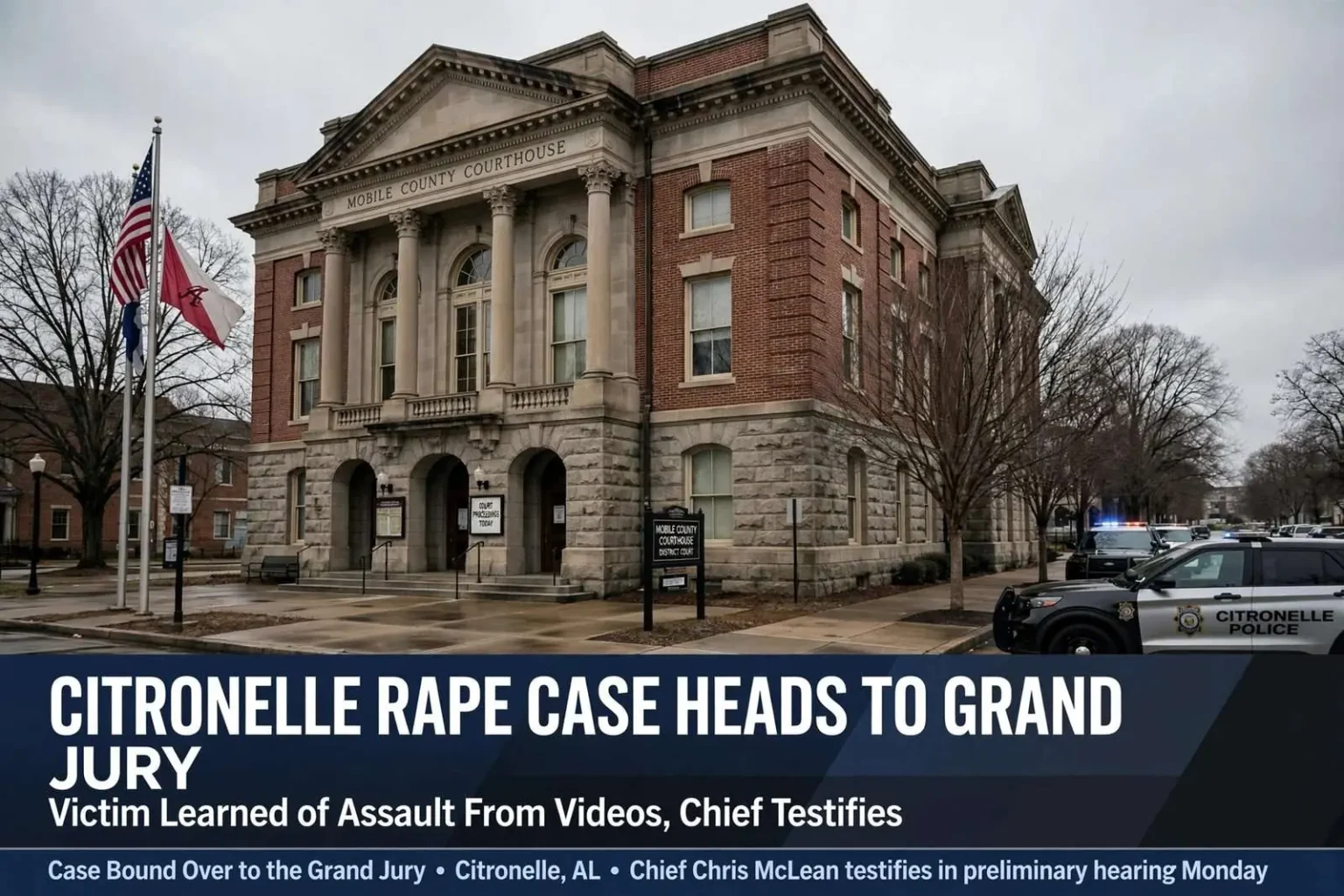
Case Bound Over to the Grand Jury
A Citronelle man accused of raping an incapacitated woman on Christmas will have his case considered by a Mobile County grand jury after a preliminary hearing Monday. The hearing, held in district court, is not a trial and determines no guilt; its narrow question is whether prosecutors presented enough evidence of probable cause to send the charge forward. The judge found that they had and bound the case over.
Citronelle Police Chief Chris McLean testified during the hearing, laying out the account that investigators have assembled. Stanley Brown is accused of sexually assaulting a woman at a home on Augusta Street while a friend of Brown’s, Jamarcus Edwards, recorded video on the victim’s own cellphone. The allegation places the events in a residential neighborhood of the north Mobile County city, where the municipal police department carried the initial investigation.
Under Alabama procedure, a preliminary hearing screens felony cases before they reach the grand jury, the body that formally issues indictments. Grand jury proceedings in Mobile County are conducted in secret, and prosecutors will now present the evidence to the panel. If the grand jury returns an indictment, the case proceeds to circuit court for arraignment and, eventually, trial.
What the Police Chief Told the Court
According to the chief’s testimony, the victim was so incapacitated that she did not learn what had happened until she discovered videos of the assault on her phone weeks later, on Jan. 18. That discovery, rather than an immediate report, is what set the criminal case in motion — and it shaped much of the argument at Monday’s hearing.
McLean testified the victim and a female friend had used drugs and passed out at the home where Brown was also staying. The videos showed the victim was clearly unconscious and could not give consent, the chief said. In Alabama law, a person who is mentally incapacitated or physically helpless cannot legally consent to sexual contact, and evidence that a victim was unconscious goes directly to that element of the offense.
The chief also noted the victim and Brown knew each other previously but were not in a dating relationship, and had gone shopping for Christmas toys for the victim’s son the day before the alleged assault. That detail established familiarity between the two, which investigators said explained how the victim came to be at the home that night, while the absence of a romantic relationship forecloses one common defense theory in acquaintance cases.
Edwards, who allegedly recorded the video, was named in the chief’s testimony as the person who operated the victim’s phone during the encounter. His role in the events described at the hearing, and what charges if any he may face, was not laid out in detail during the proceeding.
The Defense Argument
The defense noted that no rape kit was performed and pointed to the gap between the assault and the police report. Those two points framed the defense’s challenge to the case: the absence of physical evidence collected in the immediate aftermath, and the weeks that passed before authorities learned of the allegation.
Both arguments are common in cases where a victim is unaware an assault occurred. Forensic examinations are most valuable within hours of an assault, and if no one knew to seek one, the medical evidence simply was never gathered. The delay between Christmas and the Jan. 18 discovery of the videos likewise meant investigators started with a significant gap in time, though the recorded videos themselves became the central evidence in the state’s presentation.
The judge nonetheless found sufficient probable cause and bound the case over to the grand jury. The standard at a preliminary hearing is deliberately low — whether reasonable grounds exist to believe a crime was committed and the accused committed it — not the beyond-a-reasonable-doubt standard a jury would later apply. The judge’s ruling means the evidentiary weight of the defense arguments will be tested again, and more fully, in the grand jury process and any subsequent trial.
How These Cases Move Forward
If the Mobile County grand jury indicts, the case will move to circuit court, where felony cases in Alabama are tried. Prosecutors would then be required to share evidence with the defense, including the videos, phone records and witness statements, through the discovery process. Plea negotiations or a trial would follow, and scheduling would depend on the circuit’s docket.
Cases involving recorded evidence of incapacitated victims present distinctive questions for prosecutors: authentication of the recordings, chain of custody for the phone, and expert testimony on incapacitation and consent. The fact that the recording device belonged to the victim adds a further step, since investigators recovered evidence from her own property rather than from a suspect’s possession.
Advocates for survivors note that delayed reporting is common among sexual assault victims and does not by itself undermine credibility. Research cited by national organizations consistently finds that many victims delay disclosure for weeks, months or longer, particularly when the assault occurred while they were incapacitated. Prosecutors in Mobile County have in recent years emphasized specialized handling of sexual assault cases within the district attorney’s office.
A Small City, A Serious Case
Citronelle, a city of roughly 3,900 people near the northern edge of Mobile County, is served by a small municipal police force, and felony cases arising inside the city limits are prosecuted through the county system. The department’s investigation — led by its chief, who personally testified at the hearing — will now be folded into the work of the district attorney’s office, which handles all felony prosecutions in Mobile County.
The case has drawn attention in the community not only for its disturbing allegations but for the way the evidence emerged: recordings made on the victim’s own phone, discovered by the victim herself weeks afterward. For investigators, the videos removed the dispute from competing accounts to documented images; for the court, they carried the preliminary hearing through the probable-cause standard.
The holidays frame the timeline of the allegations. The assault is alleged to have occurred on Christmas at a gathering where the victim and a friend had used drugs and passed out, one day after the victim and Brown had shopped together for Christmas toys for her son. The contrast between those two days — a shopping trip for a child’s presents, and what the chief described in testimony — underlies the account the state presented.
What Happens at the Grand Jury
The Mobile County grand jury will hear the case in the coming weeks under the usual secrecy of that process. Only prosecutors present evidence; the accused has no right to appear, and defense arguments such as those raised Monday are not part of the session. The panel’s question is whether there is sufficient evidence to indict, not whether the accused is guilty.
If an indictment is returned, an arrest warrant or summons follows, and the case will be arraigned in circuit court. If the grand jury declines, the state could present the case again to a later panel. Either way, the preliminary hearing record — the chief’s sworn testimony and the ruling on probable cause — now forms the public foundation of the case as it advances through the county’s court system.
No trial date exists, and none can until the grand jury acts. What Monday’s hearing established is the shape of the state’s evidence — the videos, the timeline, the chief’s testimony — and the shape of the defense’s challenge: no rape kit, and a delayed report. Both will now be tested in the forum built for deciding such questions.
Preliminary hearings also serve a transparency function in small communities. Testimony given in open court, as the chief’s was Monday, creates a public record of what investigators say happened, at a stage before indictments are returned and before either side has fully presented its case. That record is what residents of Citronelle will rely on as the case moves through the Mobile County courts, and it is why the details laid out Monday — the videos, the dates, the testimony — matter beyond the four walls of the district courtroom.
For the victim, the process will take months at minimum. Victim advocates with the district attorney’s office typically assist survivors through interviews, hearings and trial preparation, and Alabama’s crime victims’ laws guarantee notice of proceedings and the right to be heard at key stages. Those protections now attach to a case that began, uniquely, with the victim discovering the evidence of the crime against her on her own phone.
The grand jury’s decision is the next milestone, and until it acts, the charges remain allegations tested only at the level of probable cause.