City Investigates Firefighter’s Complaint That She Was Inappropriately Touched by a Captain
The city of Mobile and the DOJ's OPR are investigating a Mobile Fire-Rescue firefighter's allegation she was touched inappropriately by a captain.
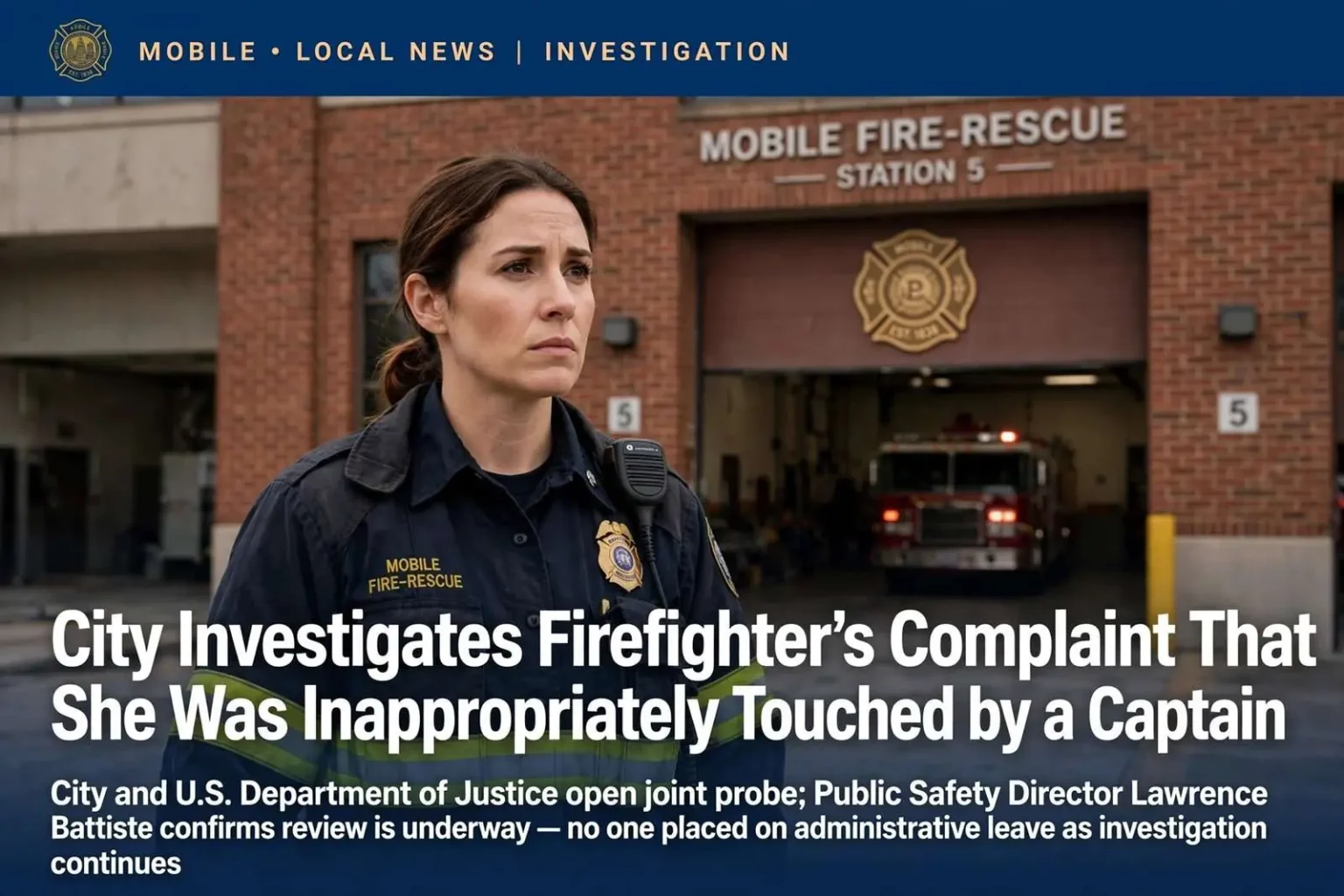
The city of Mobile has opened an investigation into a Mobile Fire-Rescue firefighter’s allegation that she was inappropriately touched by a fire captain while the two were working at a station. The complaint, reported in December 2021, set in motion a review that reaches beyond City Hall: the matter is being examined both by the city itself and by the Office of Professional Responsibility, a branch of the U.S. Department of Justice. Public Safety Director Lawrence Battiste, who oversees the city’s public safety departments, confirmed the investigation and said officials are treating the claim with the seriousness it demands.
According to Battiste, no one had been placed on administrative leave in the early stages of the inquiry, a detail he offered as investigators worked to establish the facts. He emphasized that the absence of a suspension at that point should not be read as a judgment about the credibility of the complaint. Internal investigations of this kind typically move in stages — the complaint is documented, the parties and witnesses are interviewed, and any personnel actions are taken only after the findings are complete.
Battiste was blunt about the department’s position on conduct of the kind alleged. “Sexual harassment, whether it’s between two equals or whether it’s between someone that is superior to the other, is unacceptable,” he said. The remark underscored the posture city leaders describe as standard for a uniformed service where rank structures are pronounced and where crews live and work in close quarters for twenty-four-hour stretches at a time.
The dynamics of a fire station make harassment complaints there different in character from those in a typical office. Crews eat together, sleep in shared quarters and depend on one another in life-or-death situations, which can make reporting a supervisor feel especially fraught. City officials familiar with the case have not identified the station involved, and they say the location is not being disclosed in order to protect the privacy of the firefighter who came forward.
The path such a complaint travels is typical of how these reports move through municipal government. Once it was reported in December 2021, it went to the public safety director’s office, which provides civilian oversight of fire and police operations on behalf of the mayor. From there it was routed into formal channels — the city’s own personnel investigation and the federal review — rather than being handled informally within the fire department itself, a sign that the complaint was escalated quickly once it arrived.
A two-track investigation
What sets this inquiry apart from many municipal personnel cases is its second track. Alongside the city’s own review, the Office of Professional Responsibility — an arm of the U.S. Department of Justice charged with investigating official misconduct — is examining the allegation. Federal involvement gives the inquiry a layer of independence from the government that employs both the firefighter and the accused captain, and it signals that the claim is being reviewed outside ordinary internal channels.
Officials said investigators were still working to interview the firefighter as the inquiry got underway, and they expected the work to wrap up within a few weeks. Any disciplinary action would follow based on the findings, meaning the firefighter, the accused captain and the department could all be waiting before the next step becomes clear. The city has not said what range of outcomes it is considering, but discipline in cases of this kind can run from a written reprimand to termination, depending on what the evidence supports.
The investigation has unfolded against a backdrop of talk inside the department about other consequences. Battiste pushed back on suggestions that some firefighters had resigned over the complaint, calling that an unfounded allegation. He acknowledged that the department may have had resignations — departures are ordinary across a workforce of the Fire-Rescue Department’s size — but said that, as far as he knew, none were tied specifically to sexual harassment.
The distinction mattered to city leadership for more than optics. Rumors that employees were walking out over an unaddressed complaint cut directly against the message Battiste was trying to send: that the city responds to allegations like this one, and responds through its established process. He also dismissed concern that the case would damage the department’s ability to recruit, arguing that what matters to prospective firefighters is not whether allegations arise but how they are investigated and acted upon once they do.
“Every allegation of sexual harassment will always be investigated with the vigor that it should be,” Battiste said. “We treat it as though it happened until we are able to disprove it did not happen.” That framing — presumption in favor of investigating rather than dismissing — is the posture the city says it applies across its public safety departments, and it is the approach workplace-conduct specialists generally recommend: document the complaint, protect the parties involved, and let the evidence determine the outcome rather than reputation or rank.
Battiste’s comments also reflect the reality that fire departments occupy a particular place in public trust. Firefighters rank among the most visible employees a city has, appearing at emergencies, schools and neighborhood events, and internal conduct disputes can reverberate through a community that counts department members as neighbors. By addressing the complaint publicly and describing the process, city officials effectively acknowledged that a matter handled quietly in most workplaces carries broader weight when it involves a public safety agency.
The department and its chain of command
Mobile Fire-Rescue is one of the largest fire departments on the Gulf Coast, operating stations across the city and responding to a heavy volume of emergency calls each year, the majority of them medical. Like most urban departments, it is organized around a chain of command that runs from frontline firefighters through engineers, lieutenants and captains to battalion chiefs and the chief of department, with the public safety director’s office providing civilian oversight on behalf of the mayor.
That structure is part of why an allegation against a captain carries weight. Captains are company officers — the supervisors responsible for a station’s crew on a given shift — and they set the tone for how subordinates are treated on the job. A claim that a captain inappropriately touched a firefighter therefore touches the department’s chain of command directly, which is one reason city officials have stressed that rank offers no insulation from accountability and that the allegation is being pursued without regard to the supervisor’s position.
The December 2021 timing of the complaint also placed the matter in a period of heightened national attention to workplace conduct in the fire service. Departments across the country have faced renewed scrutiny over harassment and discrimination within their ranks in recent years, and many have updated policies, expanded training and created clearer reporting channels in response. Mobile’s decision to open a formal, documented review that includes a federal component fits that broader pattern of treating such complaints as matters for investigation rather than informal resolution.
For the firefighter who filed the complaint, the coming weeks carry real stakes. Individuals who report harassment in uniformed services often worry about whether their careers will suffer for coming forward, and city officials have been careful in this case to avoid identifying her or the station where the incident allegedly occurred. Privacy protections of that kind are standard practice, designed both to shield complainants from retaliation and to protect the integrity of an investigation while interviews are still underway.
The city has also not publicly identified the captain accused in the complaint, and no criminal charges had been announced in connection with the matter. It is possible for a workplace harassment investigation and a criminal investigation to run in parallel, and it is equally possible for an internal inquiry to end in administrative discipline without any criminal referral. What happens next will depend entirely on what investigators conclude and what the findings support under the city’s personnel rules.
Why process matters as much as outcome
For Mobile residents, the case is a window into how the city handles complaints that rarely become public. Most internal personnel matters are resolved without public comment, and it is unusual for a public safety director to discuss an open investigation in as much detail as Battiste did here. The disclosure reflects a calculation that transparency about process — not about unproven details — serves both the department and the public it answers to.
How a city handles a single complaint also shapes whether others come forward. Fire service researchers and labor advocates have long noted that firefighters who experience harassment hesitate to report it when they believe nothing will be done, and that departments signal their seriousness most clearly through the handling of the first cases that surface. The city’s approach here — a formal investigation, a federal second track, and public assurances that rank will not shield anyone — is intended to establish that reporting is safe and consequential.
The markers to watch are straightforward: whether the investigation concludes on the timeline officials described, whether its findings become known to the degree personnel law allows, and whether discipline follows. Officials have said the review is expected to wrap up within a few weeks, with any action to follow based on the findings. Until then, the city’s stated position, as Battiste put it, is that every allegation is treated as though it happened until it is disproven — an inversion of the skepticism harassment complaints often face, and one the city says it will apply to every case that comes through its doors.