
City of Mobile begins towing abandoned cars to fight blight
The City of Mobile has begun tagging and towing abandoned vehicles, giving owners 30 days to remove them before impoundment as part of an anti-blight push.
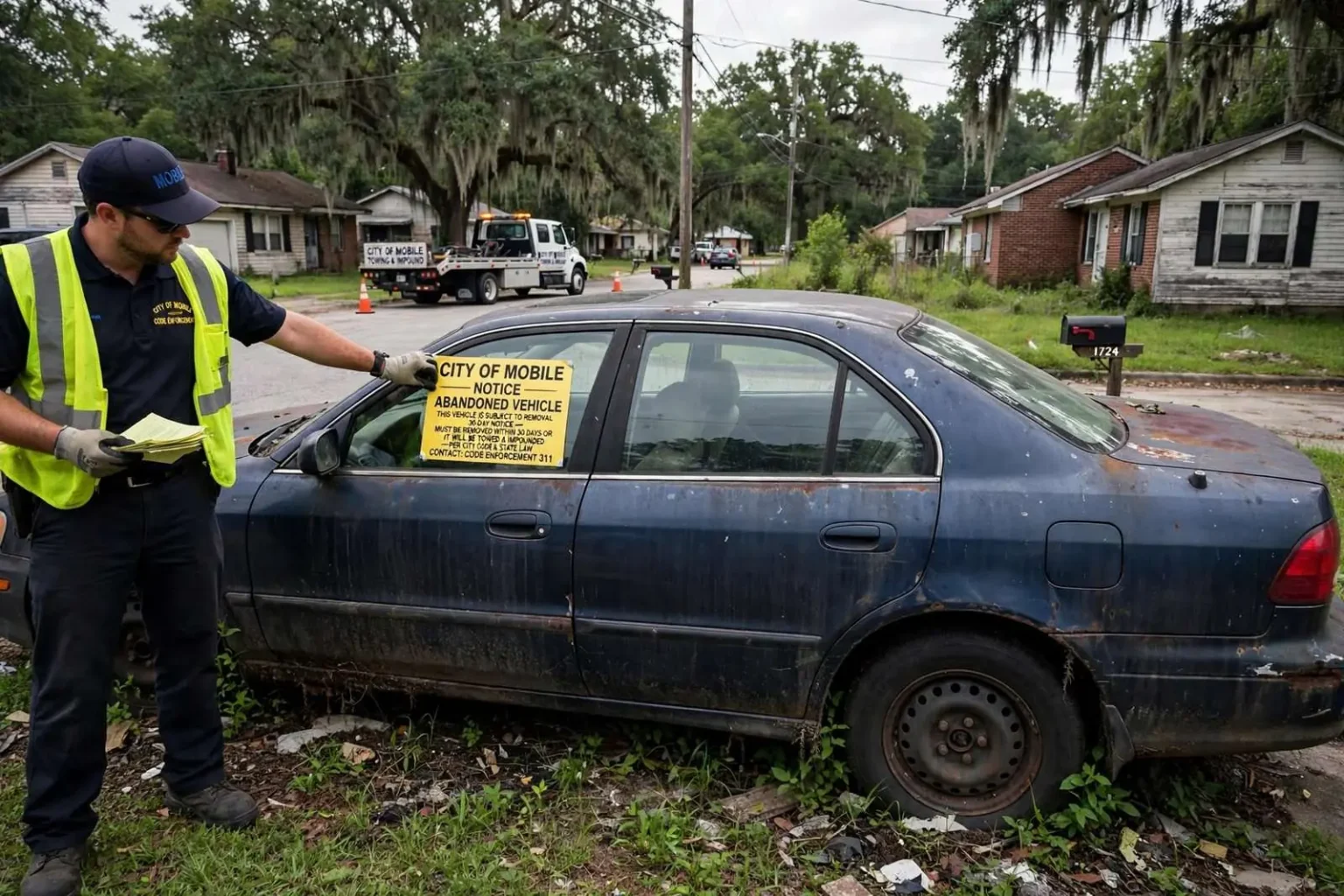
MOBILE, Ala. — The City of Mobile has begun placing notices on abandoned vehicles, giving owners 30 days to remove them from a property or have them towed. The enforcement push pairs recently passed state legislation with a city ordinance, giving the city and the Mobile Police Department a clearer path to target junk cars left sitting in the front yards of homes across the city.
Under the process, crews place a yellow sticker on the vehicle, meaning the owner has 30 days to remove it or it will be impounded. Once at the impound yard, the owner still has 60 days to pay the impound and storage fees to recover the vehicle. If they don’t, the city can sell the car.
“Really, this is huge from the standpoint of us trying to arrest and reverse blight,” Mobile Mayor Sandy Stimpson said.
A long-running problem in Mobile neighborhoods
Abandoned and inoperable vehicles have been among the most persistent complaints in Mobile’s neighborhoods for years. Residents report junk cars sitting on lawns, on streets, and in vacant lots, where they collect weeds, leak fluids, attract dumping, and signal to the surrounding block that no one is minding the property. City leaders have repeatedly described the cars as one of the most visible symptoms of the broader blight problem that has weighed on property values and neighborhood confidence in parts of the city.
Before the new tools were in place, enforcement was slow. Vehicles on private property raised legal questions about property rights and due process, and city crews could not simply hook up and tow a car sitting in someone’s yard. The result was a backlog of complaints that could linger for months while the vehicle in question kept decaying in plain view.
The recently passed legislation changed that equation by establishing a defined process: notice posted on the vehicle, a waiting period for the owner to act, towing if the deadline passes, and a structured path to recovery or sale afterward. That structure matters legally as well as practically. Giving owners 30 days of documented notice protects the city against claims that it seized property without warning, while the 60-day recovery window at the impound lot gives owners additional opportunity to reclaim a vehicle before it is disposed of permanently.
How the enforcement process works
The yellow sticker is the starting point of the clock. When crews identify a vehicle that meets the abandoned or inoperable standard, the sticker serves as formal notice, and the 30-day period gives the owner time to move the car, repair it, or arrange for its removal on their own.
If the vehicle is still there when the deadline passes, it is towed to the city impound yard. There, the impound and storage fees begin to accumulate, and the owner has 60 days to pay those fees and recover the vehicle. Vehicles that go unclaimed through that window become city property to sell, closing out a process that otherwise might have left the same car abandoned again somewhere else.
City officials have framed the fee structure as both a cost-recovery mechanism and an incentive. Towing, storing, and eventually disposing of abandoned vehicles costs money the city previously absorbed without repayment, and storage fees that accrue daily give owners a reason to act quickly rather than let a vehicle sit at the impound lot.
Blight as a citywide strategy
The abandoned vehicle campaign fits within a broader blight-fighting agenda that city hall has pursued across Mobile’s neighborhoods. Blight, in the way Mobile officials use the term, covers more than ugly scenery: it includes derelict structures, overgrown lots, illegal dumping, and abandoned cars, all of which compound one another when left unaddressed. A neglected property drags down the parcels around it, and a street with several neglected properties becomes a harder neighborhood to sell into, live in, or invest in.
Mayor Sandy Stimpson has made blight reduction a signature theme of his administration, pairing code enforcement with demolition programs, neighborhood cleanups, and partnerships with community groups. The logic officials cite is straightforward: visible disorder invites more disorder, while visible enforcement signals that standards are being maintained and that the city is paying attention.
Abandoned vehicles are a particularly visible entry point for that work. Unlike a deteriorating house, which takes months and significant money to address, a junk car can be resolved with a sticker, a waiting period, and a tow truck. The rapid turnaround makes vehicle enforcement one of the quickest ways for residents to see the city’s blight campaign produce visible results on their own block.
The enforcement also has a public safety dimension. Vehicles sitting untended in yards and along streets can conceal hazards, obstruct sight lines at intersections, and, in some cases, be stripped for parts or used for illegal dumping. Police departments in cities across the country treat abandoned vehicle reports as quality-of-life signals, and Mobile is no exception in connecting the condition of its streets to the broader sense of security residents feel.
What residents should know
For property owners, the practical message is to take the yellow sticker seriously. The 30-day notice period is the cheapest opportunity to resolve the situation: a vehicle moved or removed by the owner during that window avoids impound fees entirely, and owners who act quickly at the impound stage face lower storage charges than those who wait.
For neighbors, the new process gives complaints a predictable outcome. A report of an abandoned vehicle now leads, in most cases, to a sticker on the windshield and a defined timeline, rather than an open-ended wait. City officials have encouraged residents to keep reporting problem vehicles, noting that enforcement crews cannot address what has not been flagged.
The ordinance and the underlying state legislation also clarify what the city can and cannot do. Vehicles that are operable and legally parked are a different matter from the derelict cars this process targets, and owners who maintain their vehicles in compliance with city codes have nothing to fear from the campaign.
The partnership between the city and the Mobile Police Department in the campaign also reflects how the work is staffed. Identifying abandoned vehicles across a city of Mobile’s size requires crews moving through neighborhoods regularly, and the police department’s familiarity with problem properties and chronic complaint locations helps direct that effort where it does the most good. The coordination is a change from earlier years, when vehicle complaints, code enforcement, and police priorities could operate on separate tracks.
State legislation played a key role because cities in Alabama operate under constrained authority. Municipal governments can act only where state law gives them room, and older statutes did not clearly contemplate the volume of junk vehicles that accumulate in modern cities. The updated law gave Mobile and other municipalities a firmer foundation for the notice, tow, impound, and sale sequence now in use.
Reversing decades of decline
The blight that Mobile officials describe as the target of the vehicle campaign did not appear overnight. Like many Deep South port cities, Mobile saw population shift away from older neighborhoods over successive decades, leaving behind aging housing stock and vacant parcels that changed hands slowly or fell into neglect. Each abandoned car, overgrown lot, and boarded window added to an accumulation that city government alone could not reverse with any single program.
What city leaders have argued instead is that consistent, visible enforcement changes expectations. When a junk car is towed within weeks of being reported, neighbors see that standards are enforced, and property owners who might have let a similar vehicle decay on their own lots think twice. That multiplier effect — small visible actions that reset expectations across a block — is the practical theory behind campaigns like this one.
The vehicle towing program also complements the city’s larger property tools, including demolition of derelict structures and land bank efforts to return vacant parcels to productive use. Clearing a yard of a rusting sedan does not rebuild a neighborhood by itself, but as part of a portfolio of enforcement and reinvestment measures, officials describe it as one of the most cost-effective moves available.
A measurable difference for neighborhoods
City officials have pointed to the recovery of impounded vehicles and the sale of unclaimed ones as signs the process is functioning as designed. The program’s success, in the administration’s framing, will ultimately be measured in fewer complaints year over year and in the condition of the neighborhoods where enforcement has been most active.
For the neighborhoods where junk cars have been a standing frustration, the change is tangible. What was once a complaint that might go unresolved for months is now a process with a sticker, a deadline, a tow, and a defined end — an outcome residents can watch unfold on their own street.
City crews are expected to continue the notice-and-tow campaign as vehicles are identified across the city, with the mayor and neighborhood leaders framing the effort as one more step in the longer project of arresting and reversing blight in Mobile, one property and one abandoned car at a time.