City of Mobile Rolls Out Curbside Recycling for Downtown Dauphin Street Businesses
The City of Mobile has launched a new curbside single-stream recycling program for Dauphin Street businesses downtown, offering free recycling carts as part of a broader push to cut litter and boost recycling citywide.
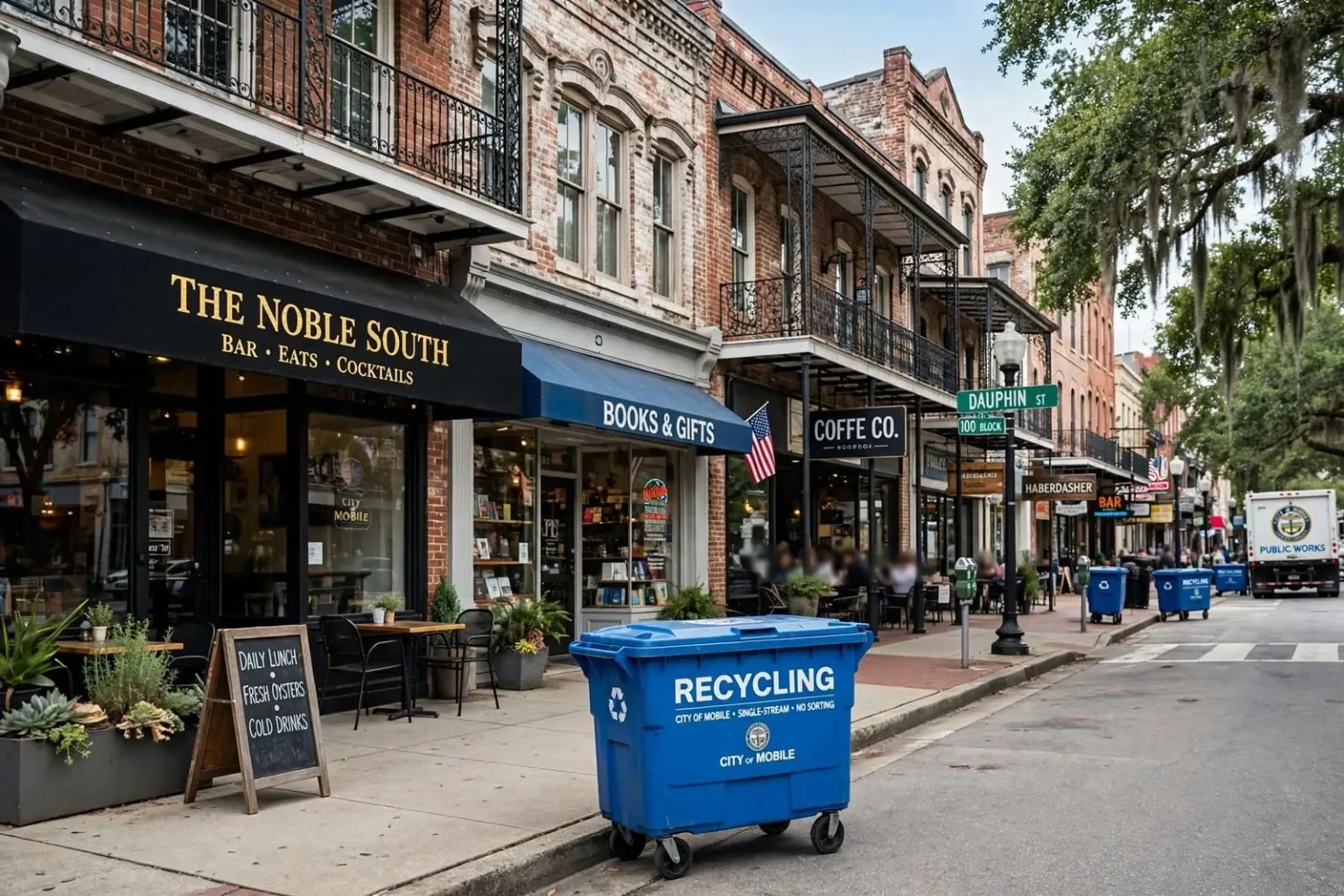
MOBILE, Alabama – Downtown Mobile businesses are getting a new tool to cut down on waste. The City of Mobile has launched a curbside single-stream recycling pilot program for businesses along Dauphin Street, giving downtown shop and restaurant owners an easier way to recycle without leaving the block. The program extends the city’s recycling push into one of its busiest commercial corridors, where the volume of bottles, boxes and paper generated daily by shops, bars and restaurants has long exceeded what the city’s residential-focused system was built to capture.
Under the new program, any interested Dauphin Street-area business can receive a blue recycling cart at no cost. City crews will collect the material directly from downtown curbs and haul it to a transfer station, where it is combined with recycling from elsewhere in the city and moved on to a dedicated recycling facility for processing. The route keeps the logistics simple for participating businesses: fill the cart, roll it to the curb, and the city handles the rest, from collection to sorting to eventual sale of the processed material.
Mayor Sandy Stimpson framed the pilot program as part of a broader push to reshape how the city handles recycling and litter. “I’m thankful to these businesses for helping us lead the effort to become a cleaner, greener community,” Stimpson said. “In the past, the city has simply not devoted enough resources or attention to recycling, but that is no longer the case. Our ultimate goal is to create a more robust recycling program while eliminating litter throughout our city. When recycling is more convenient and less confusing, more people recycle and people who recycle are less tolerant of litter.”
The mayor’s formulation draws a direct line between convenience, participation and public attitude toward litter. Recycling advocates have long argued that the biggest barrier to participation is friction – the sorting, hauling and guessing that turn well-intentioned residents away – and the city’s approach of putting carts at business doorsteps is designed to remove exactly that friction along Dauphin Street.
Built on the single-stream shift
The downtown pilot builds on changes the city made months earlier, when it moved to single-stream recycling and opened two additional public drop-off sites – one near the Mobile Museum of Art in the parking lot of the city’s Western Administrative Complex, and another behind police headquarters off Pinehill Drive. Both locations are open from 7 a.m. to 6 p.m. Monday through Friday and 7 a.m. to 4 p.m. on weekends, and residents can drop off all accepted recyclables in a single container without pre-sorting. Those hours, extending into evenings and covering weekends, were set deliberately to let working residents drop off materials on their own schedules.
Single-stream recycling – the practice of collecting all recyclable materials together in one container rather than requiring residents to separate paper, plastics and metals – has become the dominant model in American cities because it consistently raises participation rates. The tradeoff is more sophisticated sorting at the processing facility, but cities that make the switch typically see collection volumes climb as residents who once found sorting burdensome begin to participate.
The single-stream approach, now extended to the new downtown business cart program, accepts a wide range of materials: glass, newspapers and inserts, cardboard, magazines and catalogs, junk mail and envelopes, paper bags and phone books, colored paper, aluminum cans and lids, tin and steel cans and lids, metal pots and pans, pet food cans, plastic produce clamshells, plastic milk jugs, cereal boxes, foil baking pans, cardboard egg cartons, dry pet food bags, pizza boxes, tin foil, plastic bottles and plastics numbered 1 through 7. The breadth of the list is itself part of the convenience pitch – residents and businesses no longer need to memorize which narrow categories qualify, because nearly everything that can be recycled falls under the accepted list.
For the restaurants and bars that anchor Dauphin Street’s nightlife, the accepted materials cover the bulk of their waste stream: glass bottles, aluminum cans, cardboard deliveries and plastic containers. Cardboard in particular accumulates quickly for downtown retailers, which have historically had to contract privately for its removal or send it to the trash. A free city cart and a curbside pickup route convert that expense into a simple routine.
Why downtown first
Dauphin Street functions as downtown Mobile’s main commercial artery, running through the heart of the historic business district where restaurants, shops, offices and entertainment venues cluster block after block. Concentrating the pilot there puts the program where waste volumes are highest and where the visibility of blue curbside carts can model the behavior for the thousands of visitors and workers who pass through daily. City officials have treated the corridor as a test case: if curbside business recycling proves workable downtown, the model can be evaluated for other commercial districts across the city.
The pilot also aligns with the city’s litter-reduction campaign, which officials have elevated to a signature priority. Litter along commercial corridors tends to multiply where waste handling is improvised – boxes stacked behind stores, bottles overflowed from trash cans – and giving businesses a dedicated, regularly serviced recycling stream is intended to shrink that improvised waste at the source. The mayor’s comment that people who recycle are less tolerant of litter captures the strategy’s second benefit: each new participant expands the constituency that expects a cleaner city.
The transfer station plays a quiet but essential role in the system. Material collected from downtown curbs is combined with recycling gathered from the city’s residential routes and drop-off sites, then consolidated for the trip to the dedicated recycling facility where commodities are sorted, baled and sold. That consolidation is what makes small-scale collection routes economical, since the transfer step lets the city run lightweight, frequent pickups downtown without dedicating long-haul trips to each cart.
For business owners weighing whether to request a cart, the economics are straightforward. The cart is provided at no cost, and participating removes recyclable weight from trash containers that are emptied at the city’s expense. Materials that once went to the landfill as mixed trash – the glass bottles, cardboard, aluminum cans and plastics on the accepted list – instead enter a stream that the city can process and sell as commodities, recovering at least part of the value that disposal forfeits entirely.
The program’s design also reflects lessons other cities have learned about commercial recycling. Voluntary, free-cart models tend to see steady enrollment growth as businesses observe their neighbors participating, whereas mandates imposed without collection infrastructure often produce compliance on paper only. By starting with an interested-business model on a single corridor, Mobile can measure actual participation, tune collection frequency to real volumes and build the operational experience before deciding whether to expand citywide.
The bigger recycling picture
The mayor’s admission that the city “has simply not devoted enough resources or attention to recycling” in the past marked a notable shift in tone from City Hall. For years, Mobile’s recycling options were limited compared with peer cities, and the recent months’ changes – the single-stream conversion, the new drop-off sites, and now curbside business service downtown – represent the most concerted expansion of the program in recent memory. Each step has been framed as part of a single arc toward what Stimpson called a “more robust recycling program.”
The materials list offers a practical guide for anyone in the program. Glass containers of any color can go in the cart, along with newspapers with their inserts, cardboard boxes flattened or whole, magazines, catalogs, junk mail and envelopes, paper bags and even outdated phone books. On the metal side, aluminum cans and lids, tin and steel cans and lids, metal pots and pans and pet food cans are all accepted. Plastics run from bottles and milk jugs to produce clamshells, and even plastics numbered 1 through 7 – the full range of common consumer plastic codes – are eligible. Paper products extend to cereal boxes, foil baking pans, cardboard egg cartons, pizza boxes, dry pet food bags and tin foil.
That breadth matters because contamination and confusion are the classic failure modes of recycling programs. When residents are unsure whether an item qualifies, the safest assumption tends to be no, and participation quietly erodes. Publishing a single, generous list of accepted materials and backing it with no-sort collection is the city’s answer to both problems at once.
By removing the need to sort materials and placing carts directly at business doorsteps, city officials hope the program will make recycling routine for the shops, restaurants and offices that line one of downtown Mobile’s busiest commercial corridors – and, in turn, help cut down on litter throughout the area. If the Dauphin Street pilot performs as intended, the blue carts rolling to downtown curbs each week could become the template for how Mobile handles business waste across the city, one corridor and one business at a time.