Clotilda: The Exhibition to Open at New Africatown Heritage House in July
Clotilda: The Exhibition opens July 8 at the Africatown Heritage House, telling the story of the 110 people brought to Mobile in 1860.
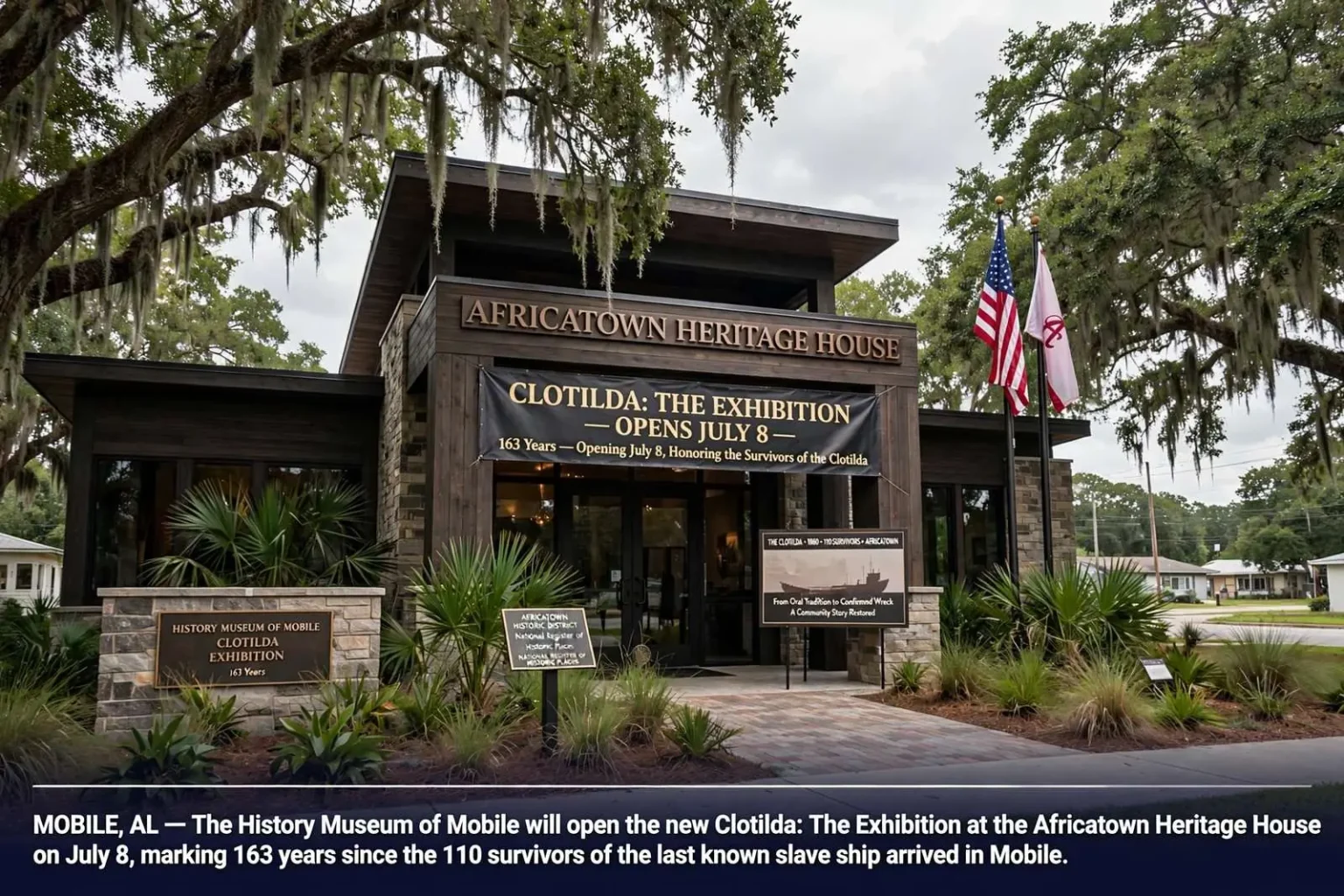
The History Museum of Mobile has announced that Clotilda: The Exhibition will open to the public on July 8 at the newly constructed Africatown Heritage House — a date chosen deliberately, marking 163 years since the 110 men and women aboard the Clotilda were brought to Mobile against their will. The opening gives the Africatown community a permanent place to tell one of the most consequential stories in Alabama history, and gives visitors from across the Gulf Coast and beyond a reason to walk the streets where that history continued for generations.
Museum staff have been developing the exhibit since 2020 inside the new Heritage House, which was built to tell the story of the survivors of the last known slave ship to reach American shores and the community they built in Africatown. The galleries trace the voyage, the years of bondage that followed, and the remarkable aftermath: survivors who gained their freedom established their own community north of Mobile, where families, churches, and schools grew around the people who had endured the voyage together.
The Story the Exhibition Tells
The Clotilda arrived in Mobile in 1860, more than five decades after the international slave trade had been outlawed in the United States. The vessel’s voyage was an illegal gamble undertaken on behalf of interests in Mobile, and after the 110 African men, women, and children were smuggled up the Mobile River, the ship was burned and sunk to hide the evidence. For more than 150 years the wreck’s location was a local mystery, passed down in oral tradition by the descendants of those who came aboard it.
That mystery was solved when the ship’s remains were identified in the Mobile River and confirmed through archaeological work, a discovery announced to international attention and verified with the involvement of the Alabama Historical Commission. The finding transformed the story from family memory and folklore into a documented archaeological site, and it added urgency to the long-running effort to build a museum space where the full account could be told in the community the survivors created.
Why the Date Matters
The July 8 opening was chosen to mark 163 years since the survivors were brought to Mobile, tying the exhibit’s debut directly to the moment the community’s story in America began. For descendants of the Clotilda survivors, many of whom still live in and around Africatown, the anniversary date makes the opening a homecoming as much as a museum launch — an acknowledgment that the building stands in the neighborhood their ancestors built with their own hands after emancipation.
Africatown itself remains a living community just north of downtown Mobile, bounded by waterways and industry along the Mobile River. It was placed on the National Register of Historic Places in recognition of its singular history as a community founded by African survivors of the illegal transatlantic trade, and the Heritage House now serves as its front door for the growing number of visitors who come to learn what happened there.
A Community-Backed Project
The museum credits a long list of partners for making the project possible, including Mobile County Commissioner Merceria Ludgood and the county commission, the City of Mobile, the Alabama Historical Commission, the Alabama Power Foundation, the Daniel Foundation of Alabama and the Crampton Trust. The breadth of that list reflects how the Heritage House came together — a blend of county government, city government, state preservation leadership, and private philanthropy, each contributing to a project that no single entity could have carried alone.
Ludgood’s district includes Africatown, and the county’s support tied the Heritage House into broader public investments in the community. The Alabama Historical Commission’s role carried added weight because of its stewardship of the Clotilda wreck itself, which gives the agency standing as the state’s authority on the archaeological record the exhibition draws upon. Foundation support from the Alabama Power Foundation, the Daniel Foundation, and the Crampton Trust filled gaps that public funding alone could not, a common pattern for civic projects across the Gulf Coast in recent years.
Since 2020, museum staff have shaped the exhibit’s content alongside that partner network, working to present the voyage, the survivors’ lives, and the founding of Africatown with the seriousness the subject demands. The development timeline spanned the period after the wreck’s identification, meaning the exhibition was built in direct conversation with the newest chapter of the Clotilda story rather than assembled from materials gathered decades ago.
The History Museum of Mobile’s Role
The History Museum of Mobile, the institution overseeing the exhibition, has operated for decades as the region’s primary repository of Gulf Coast history, and its staff bring the curatorial standards of an accredited museum to the Heritage House. The Clotilda project is among the most significant undertakings in the museum’s recent history — a permanent installation at a separate site rather than a gallery within its downtown walls, requiring ongoing coordination with descendants, partners, and the community itself.
For the museum, the Heritage House extends its mission into a neighborhood whose story is inseparable from the city’s. Mobile’s growth as a port city, its economy, and its culture were all shaped by the events the exhibition documents, and presenting that history at the site of the community the survivors founded gives the institution a presence where the record is felt most directly.
Plan Your Visit
Once open, the Africatown Heritage House will welcome visitors Tuesdays through Saturdays from 10 a.m. to 5 p.m., giving the community and travelers alike five days a week to experience the exhibition. The schedule supports school groups arriving in the morning, touring visitors midday, and local residents stopping in on Saturday afternoons.
The Heritage House sits within the Africatown community itself, a short drive north of downtown Mobile, and a visit pairs naturally with the neighborhood’s other landmarks — its historic church sites, the community cemetery where survivors rest, and the waterfront along the Mobile River where the Clotilda’s journey ended. Visitors are encouraged to treat the exhibition as the starting point for the larger landscape, since the streets around the building are as much a part of the story as anything inside it.
What the Opening Means for Africatown
For decades, descendants of the Clotilda survivors carried the story largely through family tradition while the wider world paid little attention. The wreck’s identification, the founding of the Heritage House, and now the opening of Clotilda: The Exhibition represent a reversal of that neglect — institutional recognition that the community’s account is central to the history of Mobile, Alabama, and the nation.
The exhibition also arrives at a moment of heightened interest in Africatown’s future. Renewed attention has brought researchers, journalists, and travelers to the neighborhood, and community organizations have worked to ensure that the interest benefits residents through preservation, planning, and investment. The Heritage House is the most visible piece of that effort: a building created not to memorialize the community from a distance, but to let Africatown tell its own story in its own place.
On July 8, when the doors open on the 163rd anniversary of the voyage’s end, the exhibition will formally take up that task. For the 110 men and women whose forced journey gave Africatown its beginning, and for the descendants who have kept their memory for more than a century and a half, the opening marks the moment their story gained a permanent home on the ground where it happened.
From Oral Tradition to Confirmed Wreck
The path from the Clotilda’s sinking to its identification ran through generations of Africatown families who never let the account fade. Descendants preserved the names of the voyage’s survivors, the details of the ship’s burning, and the general location of its remains in the waters near the community, even as skeptics dismissed the story as legend. That persistence is what made the eventual search possible: archaeologists knew where to look because the community had always said where it was.
The confirmed identification answered a question that had stood since 1860, and it did so with physical evidence — the ship’s distinctive construction, its dimensions, and the remains of the fire set to conceal the crime. For the exhibition’s curators, working after that confirmation meant the galleries could be anchored to verified archaeology rather than contested memory, a distinction that shapes how the story is presented to visitors who may know the Clotilda only from national headlines.
The Heritage House gives that full arc a home: the crime, the cover-up, the survival, the community, and the modern search that vindicated the families who kept the story alive. On July 8, the public will finally be able to walk through it in the neighborhood the survivors built, five days a week, in the place where the story is still lived.