Clyde Jones Campaign Opens Mobile Headquarters on Spring Hill Avenue With Labor Day Fish Fry
The Democratic candidate for Alabama's 1st Congressional District opened a campaign office at 1106 Spring Hill Avenue with a Labor Day fish fry. Campaign figures made a series of political claims, reported here as attributed statements from a single campaign's event.
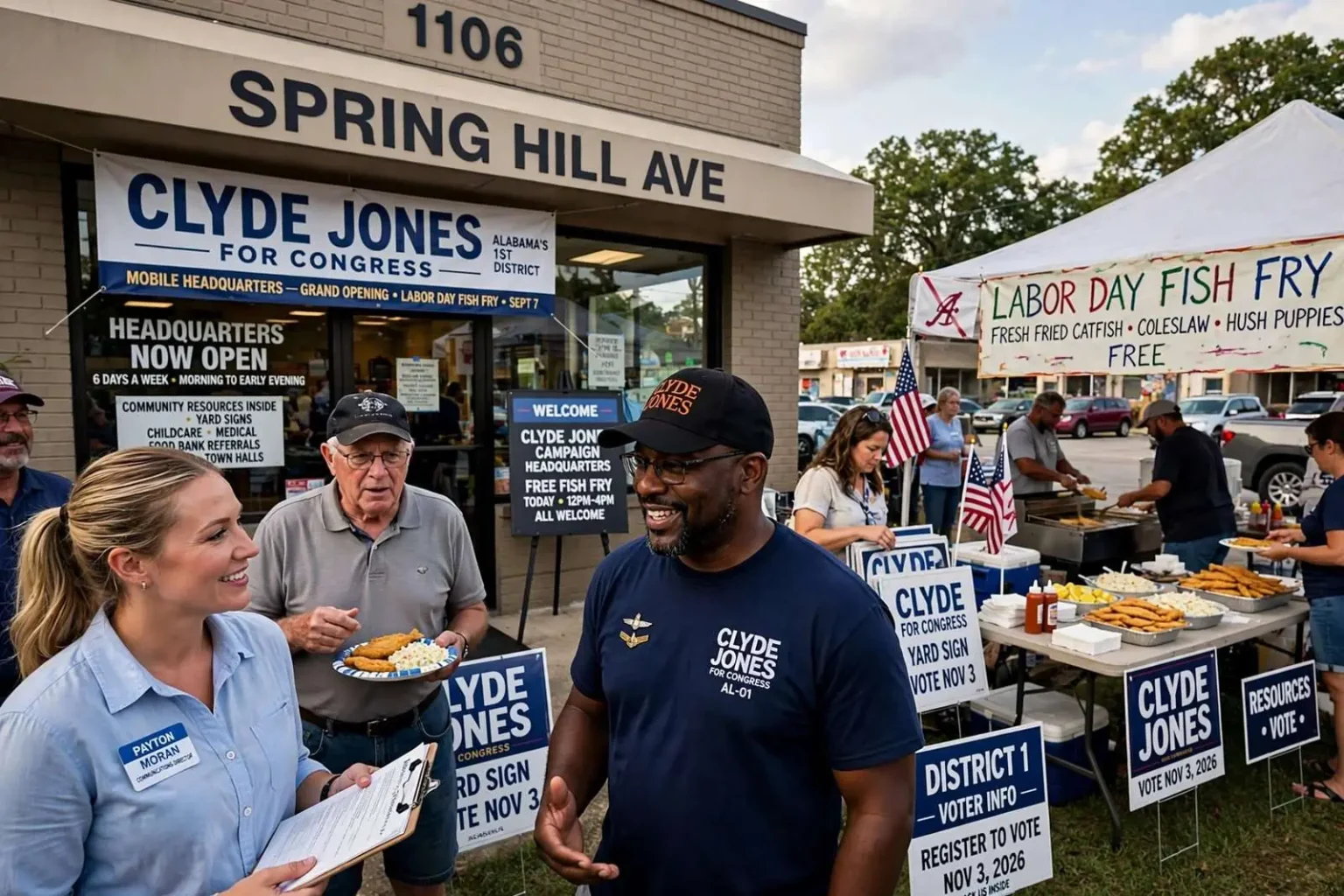
MOBILE, Ala. — The campaign of Clyde Jones, the Democratic candidate for Alabama’s 1st Congressional District, opened a new headquarters on Spring Hill Avenue over the Labor Day holiday, marking the occasion with a community fish fry that ran from noon into the late afternoon on Monday, Sept. 7.
The office sits at 1106 Spring Hill Avenue in Mobile. According to the campaign’s communications director, Payton Moran, it will be open to the public and staffed six days a week, from morning until early evening.
This article describes an event organized and hosted by a single campaign. Other candidates on the ballot in the 1st Congressional District were not participants in the opening and were not asked to respond to statements made there. The characterizations quoted below are those of the campaign’s own representatives, and they are presented here as statements, not as findings by this newspaper.
A storefront office, staffed six days a week
Moran said the office is intended to function as more than a place to store campaign literature. She described a mix of political material and referrals to outside services for anyone who walks through the door.
“We’ll always have somebody here if you wanted to stop and grab a yard sign, we also are going to have resources from around the community so if you feel like you need support — whether that looks like childcare, whether that looks like medical help, whether that looks like food banks and things like that — we have all those kinds of resources here at the office and contacts to help you,” Moran said.
The campaign said it plans to keep using the space for community events and for regular town hall meetings, where attendees would be able to hear Jones speak, ask about his platform and raise concerns of their own. No schedule of those town halls was provided at the opening, and the campaign did not announce dates for future events.
Jones framed the office as a tool for the closing stretch of the race. “We’re under sixty days leading to the election so we’re going to definitely be utilizing this space to its fullest potential and making sure we get people out to vote,” he said.
The candidate on the location
Asked about the choice of address, Jones said he wanted to be, in his words, “very visible to the people,” and to give the surrounding neighborhood a common space to gather. “It’s important for us to be in the community that we serve,” he said.
Moran drew a contrast between an office-based campaign and one built on social media. “He [Jones] is out here talking to people today. We’re not going to sit behind a computer, just post a couple graphics on social media and call it a day. We’re going to engage with people and hear not only their issues but what they want him to work on,” she said.
Whether a physical headquarters translates into votes is a question this article cannot answer, and the campaign offered no measurements — no counts of attendees at the fish fry, no volunteer sign-up totals and no fundraising figures. What can be reported is what the campaign said it intends the space to do.
A district that has been redrawn
Moran said one recurring source of confusion among voters this cycle has been recent redistricting, which changed which congressional district some residents live in.
“When it comes to voting for the U.S. House of Representatives, you are now going to be in District 1 completely if you’re in Mobile,” she said.
By the campaign’s account, District 1 now takes in Mobile County, Baldwin County, Escambia County and most of Covington County. Readers who want to confirm which congressional district covers their own address should check with election officials rather than rely on a campaign’s summary; the Alabama Secretary of State’s office is the state agency that maintains voter registration records and polling place information.
The source material for this article does not describe how the district lines were drawn, who drew them, or what legal proceedings, if any, surrounded them. This newspaper has not independently verified the boundary description above, and it is reported here as the campaign stated it.
How the campaign describes the stakes
Moran argued that voters in the district should be paying closer attention to the race than they typically do to a House contest.
“People do need to stay a little more aware because this race right now is probably one of the highest stakes races that we’ve ever had in this location,” she said.
In making that case, Moran pointed to what she called the effects of “Trump’s economy,” to what she described as an uptick in activity by U.S. Immigration and Customs Enforcement, and to what she characterized as Black voters’ feelings of disenfranchisement following the redistricting. Each of those is her assessment, offered on behalf of the campaign. The event produced no data, documents or independent analysis supporting them, and this newspaper is not adopting them as its own description of conditions in the district.
“I think people need to remember there is a direct correlation between who you put in these seats, who you vote for and how your daily life is impacted,” Moran added.
The candidate’s stated priorities
Community focus has been a theme of the Jones campaign since it began. In an earlier candidate questionnaire, Jones wrote: “Congress needs to remember who they work for — not their party, not the White House, but the people in their district. I’ll make certain their voices are heard and their needs are addressed, starting on day one.”
At Monday’s event, he returned to the same idea. “Being in federal government will help make sure we put attention and give attention to these communities that have been neglected or have been overlooked on purpose,” Jones said. He did not name specific communities, programs or federal spending decisions in the remarks reported here.
According to his campaign, Jones is a decorated Army veteran and a faith leader. The campaign lists his main areas of focus as affordability, restoration of checks and balances, health care and immigration reform. Those descriptions come from the campaign itself; no service records, endorsements or policy documents were released at the opening, and no detailed proposals under those headings were presented.
A contested claim, kept inside quotation marks
Closing out the event, Jones urged supporters to prepare in advance for Election Day and made a broader claim about the state’s politics.
“Make sure you have a plan to vote — Alabama is not a red state, we are a voter-suppressed state,” he said.
That statement is a contested political characterization, not an established fact, and it is reproduced here as the candidate’s own words. Whether Alabama’s election laws and administration suppress turnout is a subject of long-running disagreement among officeholders, advocacy organizations, researchers and courts. Nothing presented at the campaign’s opening was offered as evidence for the claim, and readers should understand it as an argument made by a candidate seeking office rather than as a conclusion reached by this newspaper.
The same standard applies to the other assertions in this article. Where a campaign figure has described economic conditions, immigration enforcement or the effects of redistricting, those descriptions appear in quotation marks and are attributed by name. They are reported because they are part of the record of a public campaign event, not because South Alabama News has verified them.
What this article covers, and what it does not
Readers should treat this as coverage of one campaign’s event on one afternoon. It is not a survey of the 1st Congressional District race, not a comparison of the candidates, and not an assessment of anyone’s fitness for office.
No other candidate’s campaign took part in the Labor Day opening, and no representative of any opposing campaign was present to answer the statements quoted here. This newspaper is not naming other candidates in this article because the source material for it does not, and reporting a partial or unverified field would be worse than reporting none. Voters who want the full, official list of qualified candidates for the district should obtain it from state election officials.
South Alabama News covers campaign events across Mobile and Baldwin counties and applies the same approach regardless of party: quotes are attributed, contested claims stay inside quotation marks, and the newspaper’s own voice is reserved for what can be independently established. Campaigns of any affiliation that hold public events in the coverage area are welcome to make them known.
Election Day and how to check your registration
Per the campaign, voting in the race will take place on Tuesday, Nov. 3, 2026. Jones’s own remark that the campaign is “under sixty days leading to the election” reflected the calendar as of the Labor Day opening.
Voters who are unsure whether they are registered, which precinct they belong to, or where their polling place is located can check with the Alabama Secretary of State’s office, which administers statewide voter registration information, and with their county board of registrars in Mobile, Baldwin, Escambia or Covington counties. This article does not list a web address, phone number or deadline for those offices, because the source material provides none and publishing an unverified contact or date would risk sending readers to the wrong place at the wrong time. The correct details are available directly from the Secretary of State’s office and from county election officials.
That caution matters more than usual in a cycle involving new district lines. A voter whose congressional district changed may still vote at the same polling place, or may not; only election officials can answer that question for a specific address. Anyone who moved, changed names or has not voted in several cycles has particular reason to confirm their status well before Election Day rather than on it.
The bigger picture for the coastal counties
Alabama’s 1st Congressional District, as the campaign described its current shape, covers the state’s two coastal counties along with Escambia County and most of Covington County — a mix of urban Mobile, the fast-growing Baldwin County suburbs and beach communities, and rural stretches to the north and east. A single member of the U.S. House represents all of it.
Campaign offices, fish fries and town halls are the ordinary machinery of a congressional race, and this fall other campaigns will hold their own. South Alabama News intends to cover those events as they are announced, and to report what candidates say in the same way it has here: in their own words, with their names attached, and with the paper’s own conclusions kept separate from theirs.
For now, the recorded facts of this event are these. A campaign opened an office at 1106 Spring Hill Avenue in Mobile on Sept. 7. It served food, said the office will be staffed six days a week, and said town halls and community events will follow. Its candidate and its communications director made a series of political arguments, quoted above and attributed to them. Election Day, per the campaign, is Nov. 3, 2026.