Coast Guard Medevacs Fisherman 180 Miles Off Pensacola in Joint Gulf Rescue
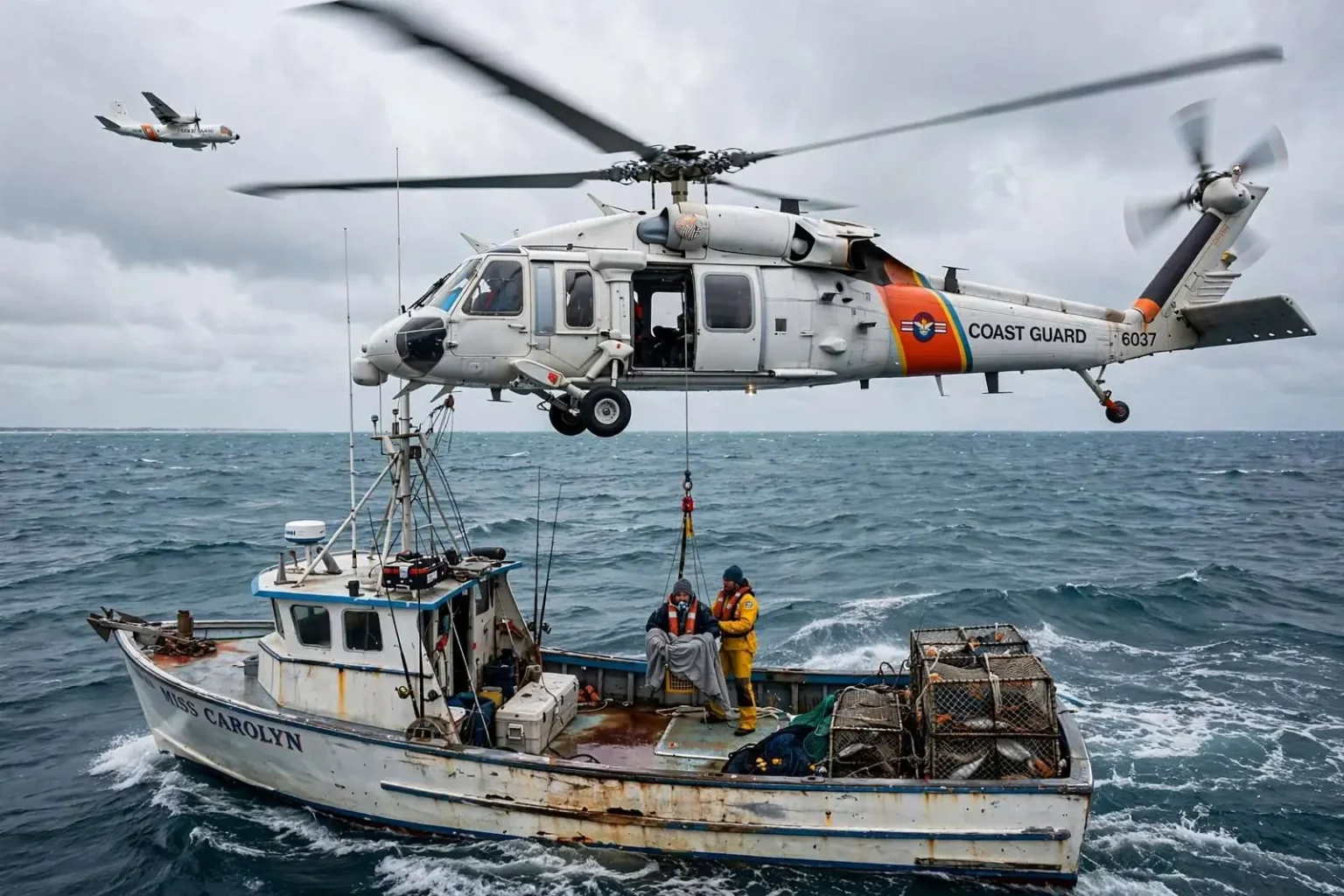
A Coast Guard MH-60 Jayhawk crew hoisted an ailing fisherman from a vessel 180 miles off Pensacola and flew him to New Orleans.
A fisherman suffering a medical emergency nearly 200 miles offshore is recovering after a coordinated Coast Guard rescue in the Gulf of Mexico, one of the long-distance medevacs that the service’s Gulf Coast units execute regularly but rarely in public view.
Coast Guard Sector Mobile got the call around 10:30 a.m. Monday from a good Samaritan vessel relaying a medevac request from a fishing vessel operating 180 miles south of Pensacola. The distance placed the boat far beyond helicopter range from Mobile’s own air facilities, setting up a joint operation between two Coast Guard sectors.
How the rescue unfolded
Sector Mobile scrambled an HC-144 Ocean Sentry aircrew, the medium-range surveillance aircraft that can fly far offshore, locate a vessel and coordinate communications while maintaining contact with the crew in distress. At the same time, an MH-60 Jayhawk helicopter crew out of Sector New Orleans flew out to meet the fishing boat — a range that pushed the Jayhawk to the practical limits of its endurance and required careful fuel planning and, typically, support from the fixed-wing aircraft overhead.
The Jayhawk crew hoisted the man aboard from the fishing vessel and carried him to University Medical Center in New Orleans for treatment. The hoist — lowered by cable from the hovering helicopter to the boat’s deck — is the standard method for transferring a patient who cannot safely travel aboard his own vessel, and crews train on it constantly for exactly this kind of case.
The aircraft involved
The HC-144 Ocean Sentry, based at Coast Guard Aviation Logistics Center operations and flown from sectors across the Gulf, serves as the service’s eyes at long range. On a medevac case like this one, its role includes finding the vessel, relaying weather and position updates, and acting as an on-scene communications relay between the fishing boat, the helicopter and the command centers ashore. Its endurance lets it remain on scene far longer than a helicopter could.
The MH-60 Jayhawk is the Coast Guard’s principal rescue helicopter, capable of flying more than 200 miles offshore when conditions and fuel planning allow. Sector New Orleans operates Jayhawks out of the New Orleans area, and its crews routinely cover the central Gulf — including the deep-water fishing grounds hundreds of miles from any port. The joint Mobile–New Orleans response is a standard arrangement for cases in the eastern-central Gulf, where the nearest helicopter may belong to a different sector than the one that took the call.
The good Samaritan role
The initial call reached Sector Mobile through a good Samaritan vessel — another boat in the area that relayed the medevac request when the fishing vessel needed help. In the offshore fleet, where single-sideband radio, satellite phones and satellite messaging connect vessels across hundreds of miles of open water, mariners routinely serve as communication bridges for each other. Coast Guard command centers encourage exactly this: any vessel hearing a distress or medevac relay should contact the nearest sector, which can then coordinate the response.
The relay also highlights how fishing operates 180 miles offshore. Boats working the Gulf’s deep water stay out for days or weeks, and a medical emergency aboard — chest pain, an injury, an illness — cannot wait for the trip home. The medevac system exists for precisely that gap, and the Coast Guard treats any medical call from a vessel at sea as an emergency response regardless of the vessel’s size or distance.
Sector Mobile’s watch
Coast Guard Sector Mobile, headquartered on Mobile Bay, watches over a large stretch of the central Gulf Coast, including the ports of Mobile and Pensacola, the Intracoastal Waterway and the offshore waters south of the Alabama and western Florida coasts. Its command center staffs communications around the clock, taking distress calls, coordinating surface and air assets, and launching responses that range from disabled vessels a few miles offshore to medevacs hundreds of miles out.
A case like Monday’s exercises the whole system: the watch stander who took the relay, the controllers who determined which aircraft could reach the vessel, the Ocean Sentry crew that launched from Mobile, the Jayhawk crew that launched from New Orleans, the hospital in New Orleans that prepared to receive the patient, and the good Samaritan mariner whose radio relay started it all.
The outcome
The fisherman was delivered to University Medical Center in New Orleans, where he could receive treatment impossible aboard a fishing boat 180 miles from land. His condition was reported as recovering — the outcome every element of the rescue was built to produce.
The case stands as a representative example of how the Coast Guard covers the Gulf’s far waters. No single unit had everything the case required: Mobile had the call and the long-range aircraft, New Orleans had the helicopter and the hoist crew, and a civilian vessel nearby had the first word. Combined, they brought a sick fisherman from a boat 180 miles south of Pensacola to a hospital bed in New Orleans within hours of the first radio call.
The coordination between sectors is governed by the Coast Guard’s area command structure, which assigns offshore waters so that every stretch of the Gulf has a responsible sector, while allowing the response to draw on whatever air station can reach the vessel most effectively. A sector that takes the call does not need to own the aircraft; it needs to manage the case. Controllers weigh each asset’s range, fuel, crew duty limits and the weather between, then task the combination that gets a rescue swimmer and hoist capability to the scene fastest.
Weather planning is central to a 180-mile flight. The Jayhawk crew that launched from the New Orleans area had to account for winds, visibility and the possibility of having to divert, and the Ocean Sentry overhead gave the operation an extra margin — an aircraft that can remain with the boat, feed weather updates and even guide the helicopter directly to a vessel that would otherwise be difficult to spot among the Gulf’s open water. Long-range medevacs in the Gulf routinely succeed on the strength of that layered arrangement.
The hoist itself
The transfer of the fisherman from his vessel to the Jayhawk followed the Coast Guard’s standard hoist procedure. The helicopter approaches the boat from upwind, the rescue swimmer or crew member is lowered to the deck to assess and package the patient, and the litter or stokes basket is then hoisted with the patient secured. Deck motion, rigging, antennas and the boat’s own superstructure all complicate the evolution, which is why crews drill it repeatedly against vessels of every size.
Once hoisted, the patient receives care from the flight crew during the return leg — oxygen, monitoring and stabilization — while the aircraft turns toward shore. The flight from 180 miles offshore to a New Orleans hospital runs well over an hour, and the helicopter delivers directly to a trauma center or medical facility when the case warrants, as it did here with University Medical Center, keeping the patient out of the ambulance-transfer step that smaller cases sometimes require.
Why fishermen work that far out
The fishing grounds 180 miles south of Pensacola sit along the edge of the continental shelf and into the deep water beyond, where Gulf fleets target species unavailable closer to shore — deep-drop fish, pelagic species and the bottom fisheries that require the longer runs. Boats making those trips carry ice, fuel and provisions for days away from port, and crews accept the distance as part of the trade. The economics of the fishery push vessels to stay out as long as the catch holds, which is precisely why medical emergencies so far offshore end up as Coast Guard cases.
Federal fisheries management shapes the pattern as well. Season openings, quota limits and closed areas concentrate effort into defined windows, sending fleets far offshore all at once during peak periods. When multiple boats work the same distant grounds, the good Samaritan network thickens — more vessels in radio range, more potential first responders, and faster relays when someone needs help.
The system’s record
Long-range medevacs like Monday’s happen throughout the year across the Gulf, though most never make the news. The Coast Guard’s Gulf air stations — New Orleans, Houston, Corpus Christi, Clearwater and the aviation units supporting Sector Mobile’s area — together execute hundreds of medevacs annually, from commercial fishermen to recreational boaters to offshore energy workers. The uniform outcome sought in every case is the one this rescue achieved: the patient delivered to definitive medical care alive.
For the crew of the fishing vessel, the response meant their shipmate left the boat by helicopter before mid-afternoon of the day the emergency began. For the Sector Mobile watch standers, the case closed the way controllers want every case to close. And for the good Samaritan vessel whose radio relay started the chain, the rescue stands as proof of how much the first call matters — a distress relayed 180 miles from shore, answered by aircraft from two sectors, ending at a hospital bed in New Orleans.