
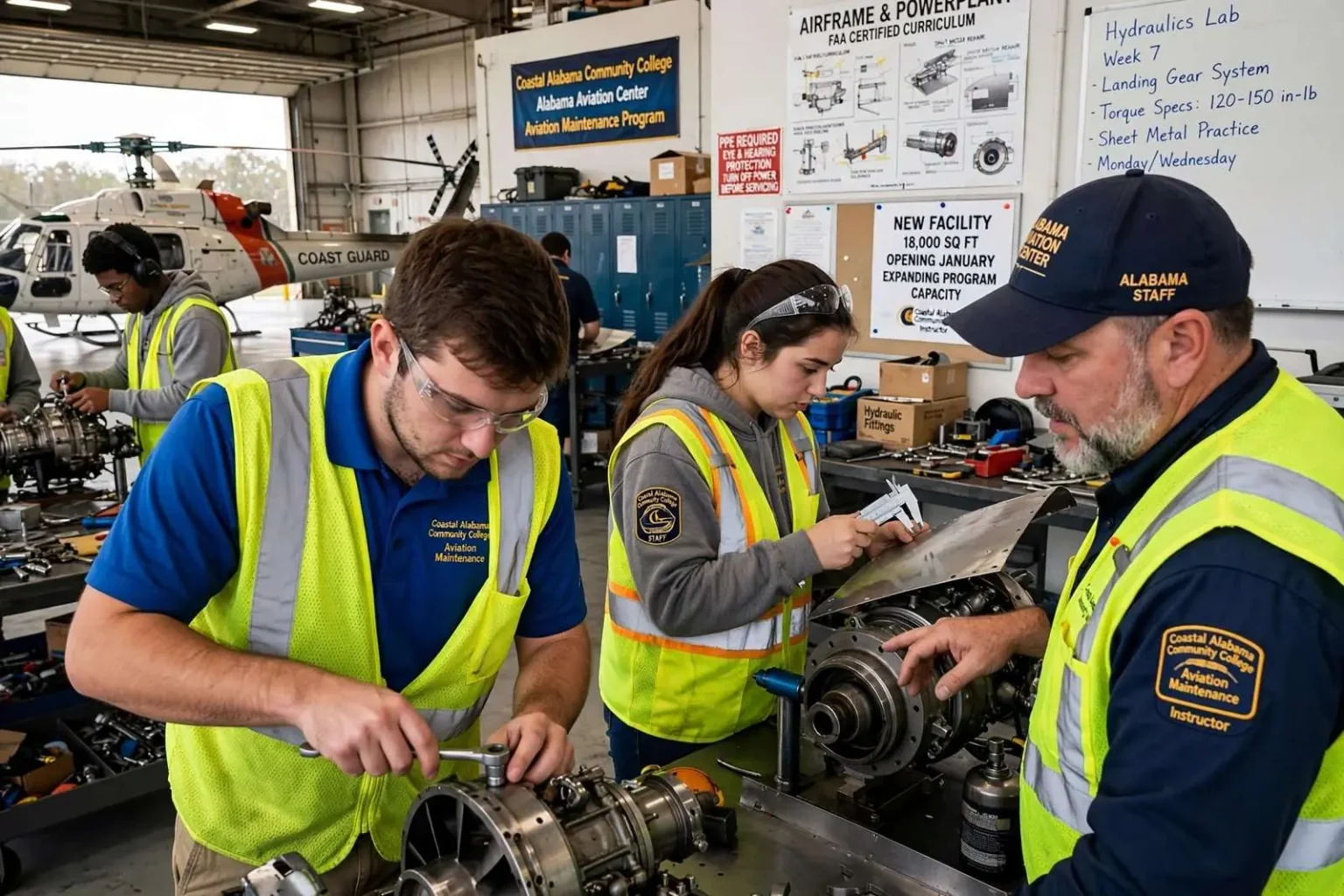
MOBILE, Ala. — Coastal Alabama Community College is expanding its aviation maintenance training to help meet rising demand for skilled aircraft mechanics in southwest Alabama. The Alabama Aviation Center at the college currently has about 450 students enrolled, bringing the program to 99% capacity, according to Director of Aviation Dave Mosow.
Students learn a broad range of skills — sheet metal work, hydraulics and engine teardown and rebuild — that qualify them to service aircraft ranging from commercial jets to Coast Guard helicopters. “They get a broad spectrum of what happens in aviation maintenance,” Mosow said.
The capacity problem the college describes is the arithmetic of a program that has outgrown its building. Aviation maintenance training is credential-driven work: students in an FAA-certified airframe and powerplant curriculum must log hands-on time on actual aircraft and components, and that time can only be generated where there are bays, benches, and instructors to supervise it. At 99% of capacity, the Alabama Aviation Center has reached the ceiling of what its existing footprint can teach — and every qualified applicant it turns away is a mechanic the region’s employers will have to recruit from somewhere else.
That employers care is easy to see in the regional landscape. Mobile’s waterfront is now one of the most aviation-intensive corners of the Gulf Coast, with the commercial aircraft assembly operations at the aeroplex near Brookley Field drawing suppliers, component plants, and maintenance contractors into the metro economy. The U.S. Coast Guard’s aviation presence in Mobile — the service’s training center for rotary-wing operations sits on the same waterfront — adds military and federal maintenance work to the demand base, and the region’s corporate aviation, cargo, and regional airline operations round it out. Every one of those employers hires for the same credential the Alabama Aviation Center trains.
Building Room to Grow
To make room for more students, the college is building an 18,000-square-foot climate-controlled facility that will let future mechanics work on planes and helicopters indoors.
“It’s going to rival many institutions around the country in aviation training,” said Dr. Aaron Milner, president of Coastal Alabama Community College. “We really think it’s going to change training and aviation for southwest Alabama and be a benefit to our state.” Milner said he hopes the new facility will be in use by January.
Climate control is more than comfort in aircraft maintenance education. Sheet-metal work, composite repair, hydraulic system assembly, and precision engine teardown all depend on tolerances that Gulf Coast humidity and heat make harder to hold — corrosion accelerates in unconditioned hangars, adhesives and sealants have temperature windows, and instruments calibrated indoors drift when the shop floor runs thirty degrees hotter. A fully conditioned 18,000 square feet of hangar-style space also allows the program to stage aircraft indoors year-round, so that a tear-down begun on Monday does not sit weathering while a student cohort rotates through other coursework.
The January target gives the college a compressed construction-to-instruction timeline, and it reflects how community college capital projects in Alabama tend to move: the state’s two-year system builds fast when a workforce program has documented employer demand behind it. A facility of this size can also change what the program can accept for training — larger airframes, rotorcraft that would not fit the current footprint, and component labs arranged the way working hangars are arranged rather than the way classrooms are.
A Workforce at a Turning Point
Program officials say the expansion comes as the aviation maintenance workforce nationally nears a wave of retirements.
“Most of the aircraft maintainers now are getting towards retirement age. They’re going to retire in the next 10 to 15 years,” said student Brady Smart. “It’s very important that we’re able to get newer, younger people in, get them working on those aircraft, get them learning now.”
The retirement curve Smart describes is the structural reason training programs across the country are expanding at once. The certified mechanic workforce that carried the airline industry through the last half-century was hired heavily in the 1970s and 1980s, and that cohort is now exiting faster than the industry’s traditional pipelines replace it. Aircraft fleets, meanwhile, keep growing, and the newest generation of commercial aircraft brings composite structures and increasingly digital systems that require training the older workforce never received. The result is a shortage that employers describe in the same terms across the country — not enough certified hands, and a waiting period measured in years to produce them.
That pipeline arithmetic is also why employers behave the way Mosow describes.
Mosow said area employers are already recruiting students before graduation, hoping to retain them afterward.
Pre-graduation recruiting has become the norm in technical education fields with credential bottlenecks, and aviation maintenance is the textbook case. The FAA certification a student earns is portable and scarce, and employers who wait for the graduation ceremony lose the cohort to whoever interviewed first. For students, the dynamic converts a two-year program into something close to a guaranteed job market — and it gives the college a lever for its expansion case, because every additional seat in the new facility becomes a hire some regional employer is already asking for.
The economics matter to southwest Alabama beyond the airport fence. Aircraft mechanics are paid at rates that anchor middle-class households, and the work is geographically sticky — the shops, assembly lines, and maintenance bases in the region need people who live within commuting distance, which makes the program one of the more reliable producers of retained local talent. For students from Baldwin County and the rural counties in the college’s service area, the credential is a route into skilled industrial work without leaving the Gulf Coast.
What the Training Covers
The breadth Mosow emphasizes — sheet metal, hydraulics, engine teardown and rebuild — is the core of what an airframe and powerplant credential requires. Sheet metal is the structural language of both legacy aluminum airframes and the repair side of modern composite aircraft; hydraulics runs everything from landing gear to flight controls; and engine work is the discipline that most directly determines whether an aircraft is safe to release back to service. Training across that range on everything from commercial jets to Coast Guard helicopters means graduates arrive with experience on both fixed-wing and rotary-wing equipment — a spread that matches exactly the mix of employers on the Gulf Coast, where airline, cargo, corporate, and federal aviation operations sit within a few miles of one another.
It is also training that is difficult to fake or shortcut. FAA-certified mechanic programs are governed by fixed hour requirements and inspected curricula, and the practical tests that finish them are administered against national standards. A certificate from the Alabama Aviation Center means the same thing to an employer in Mobile as it does to one in Atlanta or Dallas, which is what makes the credential a durable asset in a labor market where the shortage is national and the competition for mechanics is consequently nationwide.
The Regional Stakes
For the communities the college serves, the expansion is as much an economic development story as an academic one. Southwest Alabama’s aviation cluster — the assembly operations on Mobile’s waterfront, the suppliers strung out along the I-10 and Highway 45 corridors, the Coast Guard’s aviation base, and the region’s general aviation and cargo facilities — depends on a local supply of certified maintainers to grow. When a program hits 99% capacity, the constraint binds quietly: employers recruit elsewhere, new suppliers weigh the local workforce pipeline in their site decisions, and talented students who cannot get a seat train for other industries.
Coastal Alabama Community College operates across a broad swath of the state, and the aviation program’s expansion ripples through campuses and communities well beyond the Mobile area — into the rural counties where the college is often the principal source of postsecondary technical training. The January target for the new facility means the constraint on enrollment could loosen within a single academic year, and program officials’ expectation is straightforward: fill the new bays with students, and let the employers already circling the program hire them as they finish.
For a region whose industrial identity has shifted decisively toward aviation and advanced manufacturing over the past decade, the college’s bet is that the mechanic shortage is not a passing labor-market squeeze but a long structural condition — one that a Gulf Coast institution can turn into a decades-long advantage for its students and its employers alike.
A Credential With National Reach
The portability of the mechanic credential also cuts in the region’s favor on the recruiting side. Students who train in Mobile can take the same certification to positions in Memphis, Dallas, or Atlanta if a first job does not materialize locally — but the reverse flow is equally real, and it is what regional workforce planners are counting on: mechanics certified elsewhere who settle on the Gulf Coast for the lifestyle and the cluster of aviation employers now operating here. Programs like the Alabama Aviation Center are, in effect, the shared labor pool for that whole exchange, and every seat the new facility adds enlarges it from both directions.
For the students themselves, the calculus Brady Smart described is the practical one: the older generation of maintainers is leaving, the aircraft are not getting simpler, and the programs that train replacements are limited in how fast they can scale. Getting into a seat now, learning the sheet metal and the hydraulics and the engine work while the cohort ahead retires, is a hedge against the same shortage everyone else in the industry is complaining about — and, in southwest Alabama, a route into it while the local supply of certified hands remains thin enough that employers recruit before the cap and gown.