Cock of the Walk Coleslaw Coming to Mobile and Baldwin County Grocery Shelves
The signature coleslaw from the long-closed Cock of the Walk catfish restaurant is heading to Cain's Piggly Wiggly and Greer's Market shelves this week.
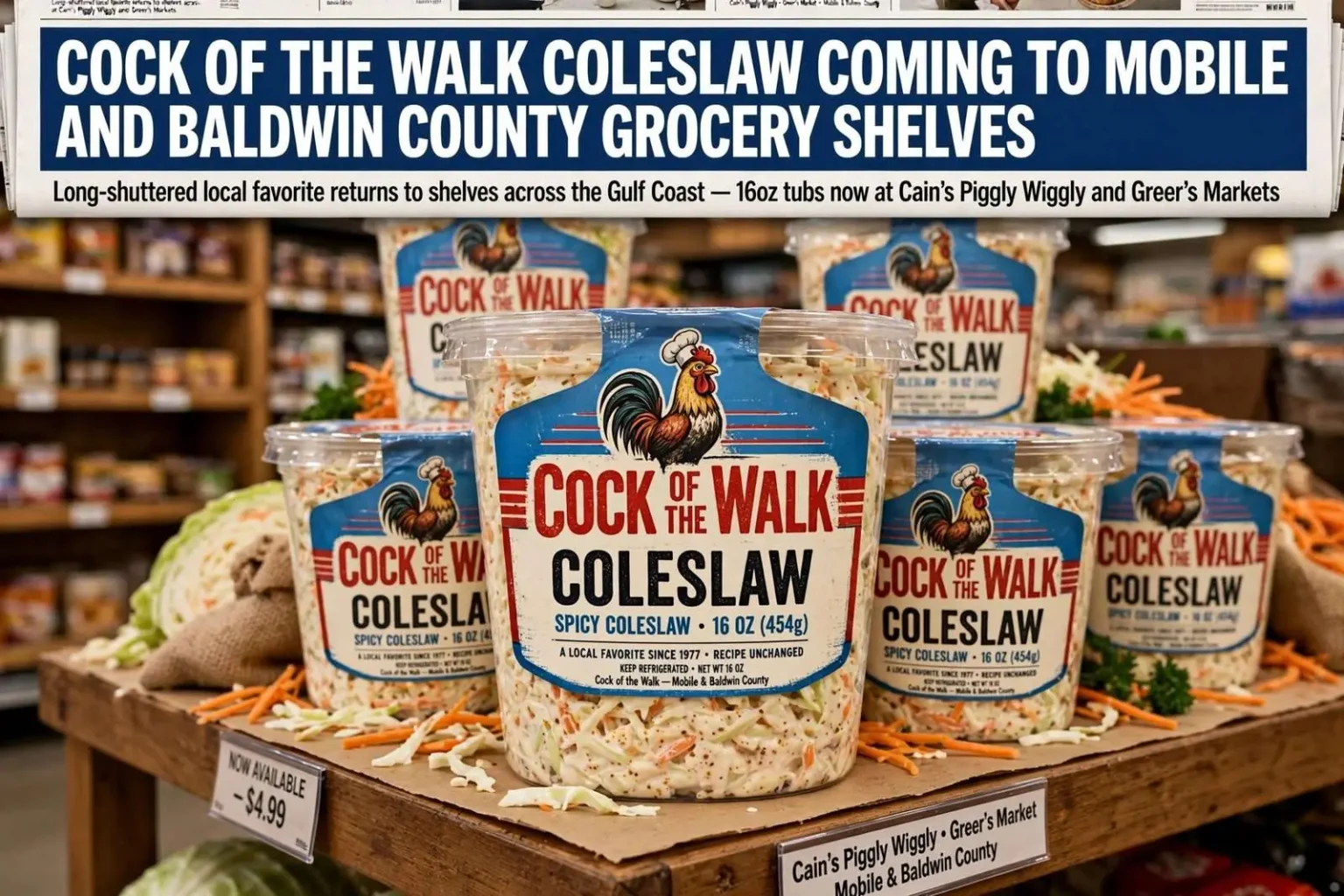
A taste of a long-shuttered local favorite is about to make a comeback on grocery shelves across Mobile and Baldwin counties. The signature coleslaw once served at Cock of the Walk, the catfish restaurant that closed its Mobile-area locations more than a decade ago, will soon be sold in stores throughout the region. For longtime fans of the restaurant, the move puts within arm’s reach a side dish that has taken on an outsized place in local food memory since the dining rooms closed.
Packaged in 16-ounce tubs and priced between $4 and $5, the coleslaw will be available at Cain’s Piggly Wiggly stores in Fairhope, Loxley and Foley, along with five Greer’s Market locations in Mobile, Fairhope, Robertsdale, Perdido, Florida, and Pensacola. The rollout spreads the product across both sides of Mobile Bay and into the western Panhandle, a footprint that mirrors where the restaurant’s former customers actually live. Store placement matters for a nostalgic food product, and the chains involved are ones shoppers already associate with local brands.
Mike Rickels, president and CEO of Keelboat Concepts Inc., which owns the franchise rights to Cock of the Walk, said orders for the retail product began this week, with the coleslaw hitting Greer’s shelves first and Cain’s Piggly Wiggly stores shortly after. The staggered launch lets the company gauge demand and production before the full network of stores is stocked. Keelboat Concepts has shepherded the brand through years without a Mobile presence, keeping the name alive through the Pensacola restaurant and licensing arrangements.
A Restaurant Remembered
Cock of the Walk’s Mobile location on Halls Mill Road operated from 1984 to 2005, and the chain also ran three different locations on the Eastern Shore at various points between roughly 1990 and 2003. For more than two decades, the restaurants were fixtures of the local dining scene, drawing families, church groups and workday lunch crowds with a straightforward menu built around fried catfish. The Halls Mill Road building, with its riverside-style hospitality, became the location most Mobilians remember when the name comes up.
Since the Mobile-area restaurants closed, fans craving the chain’s fried catfish, cornbread and coleslaw combo had to make the drive to Pensacola, where the chain is headquartered. The drive became a rite of passage for devoted customers, some of whom planned occasional trips across the state line around a meal. Closing the distance between that memory and the average grocery cart is the entire premise of the retail launch.
At the restaurant, the spicy, fresh coleslaw is served at the table with every meal and refilled as often as diners like. The bottomless presentation made the slaw more than a side dish; it was part of the restaurant’s signature experience, as closely associated with the brand as the catfish itself. Translating a table-service item into a packaged product required keeping both the flavor and the texture of the restaurant version intact.
Rickels said the recipe hasn’t changed since Cock of the Walk was founded in Natchez, Mississippi, in 1977, calling it a formula that “has stood the test of time for almost 40 years.” He said the recipe is closely guarded, comparing it to how tightly Coca-Cola protects its own formula. The comparison is a familiar one in the food business, but in this case the point is practical: the chain’s brand identity rests on a single unchanged recipe that few employees have ever seen in full.
The company has fielded retail requests for years, and the decision to move forward reflects both sustained customer demand and the maturity of the production arrangements behind the scenes. Getting a restaurant recipe onto grocery shelves involves packaging, shelf-life testing, distribution agreements and quality control that a restaurant kitchen never has to consider. Rickels said customers have been asking for the coleslaw to be sold in stores for almost as long as the chain has existed, and the company has been considering the move for years.
Anticipation on Social Media
When Cain’s Piggly Wiggly teased the news on Facebook, the post drew hundreds of likes and was shared widely, with commenters expressing excitement about no longer having to make their own batch at home. The response illustrated how food nostalgia operates in small markets: a single post about a discontinued restaurant item can generate the kind of engagement that paid advertising rarely matches. Comment threads filled with memories of specific visits, family traditions and attempts to recreate the recipe at home.
Home cooks have long tried to approximate the spicy slaw from memory, swapping recipe attempts at church suppers and family gatherings, with varying success. Those imitation efforts are themselves part of the brand’s local history, and each failed approximation has only deepened the loyalty to the original. The retail tubs end the guessing game for shoppers willing to spend the price of a couple of heads of cabbage.
Shoppers eager for an early taste can sample the coleslaw at the Greer’s Market in Fairhope on Friday afternoon, where tubs will be available for purchase before the official rollout the following week. Early access events like this one serve a dual purpose for the company, generating word-of-mouth buzz while letting staff see how the packaged product performs outside the restaurant environment. The Fairhope store’s proximity to the Eastern Shore communities where the chain once operated makes it a fitting site for the preview.
Customers who bring an empty coleslaw container to the Pensacola restaurant will also receive a free order of fried dill pickles. The promotion ties the retail launch back to the restaurant itself, encouraging grocery shoppers to make the trip to the last full-service location and reinforcing the connection between the packaged product and the dining experience it came from. Fried dill pickles, a staple of the restaurant’s appetizer menu, give longtime customers one more familiar taste on the plate.
The promotion also gives the company a measurable way to track how many retail customers cross over to the restaurant, data that will inform how aggressively the retail line expands. Promotions that bridge restaurant and retail are increasingly common among regional brands, but they work best when the product itself carries the kind of emotional weight this slaw clearly does on the Gulf Coast.
What Comes Next for the Brand
Rickels said the company is now working on packaging its fish breading and cornbread mix for retail sale as the next products to hit local store shelves, with an eye toward eventually distributing Cock of the Walk products more broadly. A home cook armed with the breading, the cornbread mix and the tubbed slaw can assemble most of the restaurant’s signature plate without leaving the kitchen. That completeness is the strategic logic behind the product sequence.
Extending the line beyond the coleslaw also diversifies the brand’s revenue at a time when the company operates a single restaurant location. Packaged goods carry different margins and different growth prospects than dining rooms, and for a brand with a footprint as recognizable as Cock of the Walk’s across two states, the retail shelf is the most practical path to scale. Broader distribution would take the product into markets the restaurant never served.
The Gulf Coast has a long history of restaurant brands making the jump to retail, and the successes share a common trait: a single signature item that customers identify completely with the name. Cock of the Walk’s slaw fits that profile almost perfectly, having been served without variation for nearly four decades. The challenge now is production volume, keeping the packaged version consistent as more stores carry it.
Why the Slaw Matters Locally
Part of the coleslaw’s standing in local memory comes from what surrounded it. The restaurant’s Mobile locations fed generations of families celebrating birthdays, team victories and Friday nights, and food tied to those occasions acquires a significance that goes beyond flavor. When the locations closed, the slaw became one of the few parts of the experience that could plausibly be preserved, which is why its retail debut has drawn the reaction it has.
The launch also lands at a moment when regional grocery chains across the Gulf South have leaned into local products as a point of differentiation against national competitors. Greer’s and Piggly Wiggly stores in the area have long stocked regional favorites, and a Mobile Bay Area brand returning to shelves fits the model. For the chains, carrying the slaw is a way of signaling local roots to shoppers who have more options than ever.
For older customers, the $4-to-$5 price point makes the purchase an easy impulse, the kind of item dropped into a cart on a whim and on the table that night. Affordability was part of the restaurant’s identity too, with catfish plates served at family-friendly prices. Keeping the retail product in the same accessible range preserves that character.
The company’s plans for fish breading and cornbread mix suggest the retail line will eventually tell the whole story of the restaurant’s plate, but the coleslaw remains the anchor. It was the item customers asked about first when the restaurants closed, the item they tried to recreate at home and the item the Facebook announcement singled out. Launching with the hardest-to-replicate product was the right order of operations.
Whether the broader distribution Rickels envisions materializes will depend on how the initial rollout performs across the seven initial stores and how production scales. For now, the immediate fact on the ground is simpler: a side dish that disappeared from Mobile and Baldwin counties more than a decade ago is back, in tubs, at a price most anyone can manage. For the customers who spent years driving to Pensacola for their fix, that is the headline.