
Conde Cavaliers Open Mobile’s Mardi Gras Parade Season With Route A Run
The Conde Cavaliers open Mobile's Mardi Gras parade season at 6:30 p.m. Friday on Route A, with a secret code word earning extra throws.
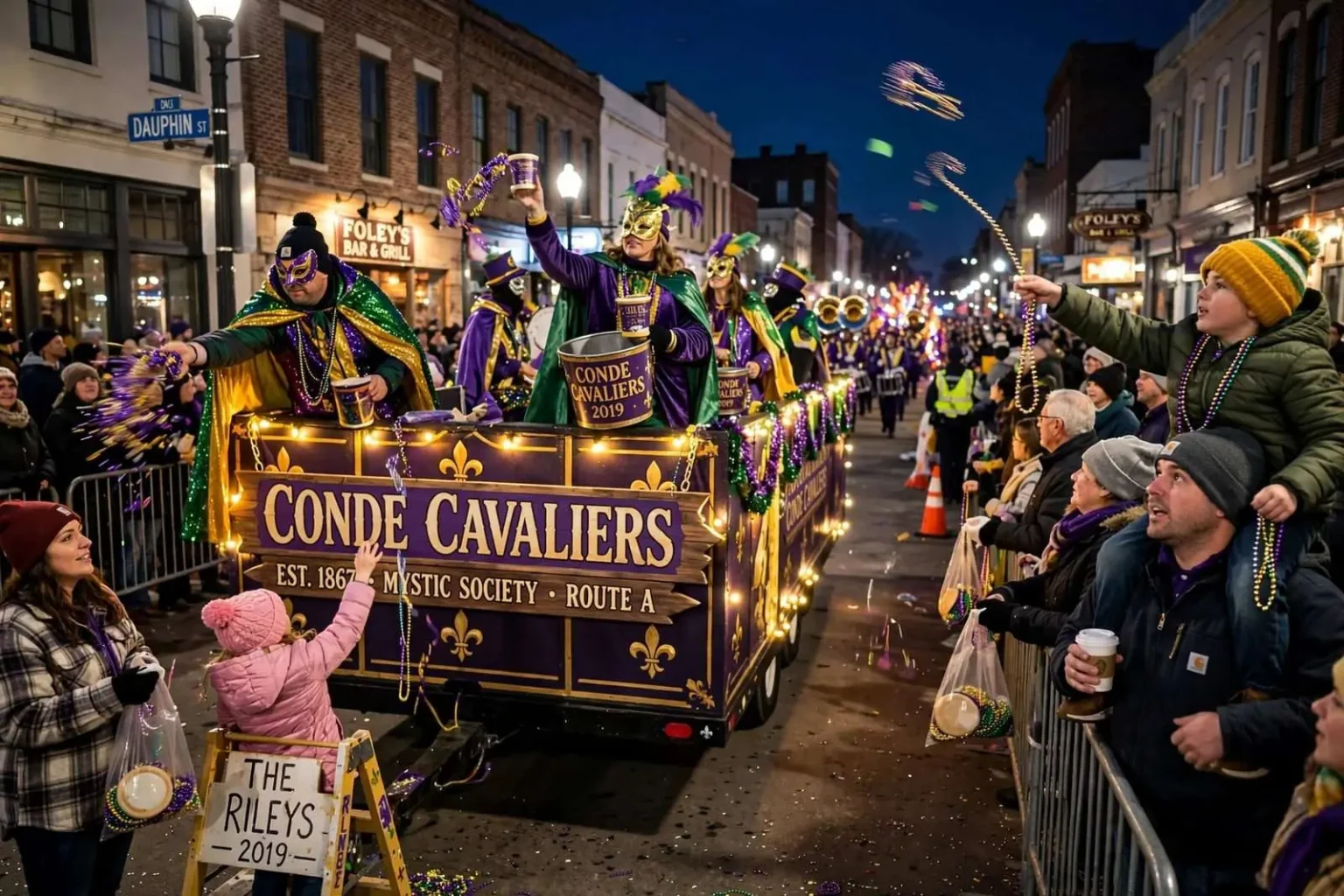
Mardi Gras 2019 officially got rolling in Mobile on Friday night, as the Conde Cavaliers paraded through downtown as the first mystic society of the season to take the streets, kicking off weeks of nights when the city’s oldest celebration takes over its most historic blocks.
The parade rolled at 6:30 p.m. along the traditional Route A corridor, drawing crowds of families and revelers ready to catch beads, cups and moon pies after a carnival season of pre-dawn ball seasons and float-building. The first parade of the year carries a particular energy in Mobile: the weeks of anticipation, the unveiling parties and the float-building marathons at the dens all finally turn into the real thing, with masked riders and marching bands filling the street.
Float riders added a game within the parade this year: members aboard one float listened for a secret code word shouted from the crowd, and anyone who hit it could count on an extra shower of good throws coming their way. The twist turned thousands of strangers into participants, with families along the route trying guesses between volleys of beads and wondering which call would hit the mark.
Mobile’s Claim to America’s Original Mardi Gras
Mobile celebrated its first Carnival in 1703, when French Catholic colonists gathered in the young settlement on the Mobile River, and the city has marked the season in one form or another ever since. That history makes Mobile’s Mardi Gras the oldest in the United States, more than a decade before New Orleans existed, a fact Mobilians hold onto with civic pride and repeat to visitors throughout the season. The celebration has survived wars, depressions and hurricanes, and the modern season stretches from the social events of November through Twelfth Night in early January to the crescendo of the final two weeks before Ash Wednesday.
The city’s mystic societies, the private organizations that stage the parades and balls, are the backbone of that tradition. Each society operates from its own den, where members spend the weeks before the season building and repairing floats, buying throws and planning themes. Membership is passed down through generations of families, and the societies’ parades follow established routes through downtown that locals know by shorthand, Route A chief among them.
The Conde Cavaliers hold a familiar place in that schedule. One of Mobile’s longtime parading societies, they have traditionally held the honor of opening the downtown parade schedule, meaning their Friday night run sets the tone for everything that follows. Being first carries its own pressures: the floats must be ready early, the organization’s ball comes early in the ball calendar, and the crowds along the route are fresh, packed and eager for a season to begin.
Route A and the Geography of a Mobile Parade
Route A carries parades through the heart of downtown Mobile, along streets lined with historic buildings, churches and the gathering spots where families stake out territory with ladders and coolers hours before a parade rolls. The corridor passes some of the most photographed blocks in the city, and on parade nights they fill with children perched on shoulder-high ladders painted with family names, a Mobile custom as distinctive as any throw.
For businesses downtown, the first parade night marks the start of the most lucrative stretch of the carnival calendar. Restaurants and bars fill with parade crowds, and the streets take on a festival rhythm that repeats, night after night, as the schedule builds toward Fat Tuesday. Residents plan their parking, their babysitting and their parade attendance around the published route maps, and the opening parade is when everyone discovers whether their usual spot is still their usual spot.
The throws themselves follow their own traditions. Beads remain the currency of the season, but moon pies, a nod to the throw’s Gulf Coast roots, and decorated cups branded with each society’s emblem draw their own devoted chasers. Veteran parade-goers teach newcomers the etiquette of the route: make eye contact with a rider, call out, and catch what comes, but never fight a child for a throw.
The Season Ahead in 2019
The Conde Cavaliers’ Friday night run set the stage for weeks of parades leading up to Fat Tuesday, when Mobile, the home of America’s original Mardi Gras, celebrates the season’s grand finale. Night by night through the final two weeks, the parades grow larger and more frequent, the crowds thicken, and downtown becomes a nightly festival ground. The season’s climax arrives with the final parades on Mardi Gras day itself, capped by the traditional evening procession that closes the celebration until the following year.
Behind the Scenes: Balls, Dens and the Carnival Calendar
What the crowd sees on a parade night is the public face of a season that begins months earlier. Mystic societies hold their balls through the winter, formal events where members present royal courts of maids and knights and where the year’s theme is unveiled to members and guests. The balls and parades are two halves of the same celebration, and many Mobilians grow up attending one or the other or both, learning the society names and their signature throws the way children in other cities learn sports teams.
The dens are where the work happens. Float-building season runs through the fall and early winter, as crews weld frames, apply the sculpted and painted panels that give each float its theme, and test the lights and sound systems that turn a trailer into a moving stage. By the time the first parade rolls, each society has invested months of evenings and weekends, which is why the opening night carries the feel of a debut performance.
The secret code word game that riders played on the Conde Cavaliers’ first night reflects how societies tinker with the formula from year to year. The parade format, floats, bands, dance groups and throws, is constant, but each organization looks for small ways to make its night memorable, and games that pull the crowd into the show have become a favorite device. For families standing along Route A, the extra burst of throws for a correct guess was an early-season bonus in an already generous night.
Weather, Logistics and the Opening Night Crowd
Early-season parades in Mobile roll in whatever February weather arrives, and the opening Friday night drew the usual mix of cold-weather layering and carnival spirit. City crews spend the days before each parade posting barricades, marking the route and coordinating with police and fire officials, and the first parade of the year doubles as the operational shakedown for the hundreds of personnel who will manage the season’s peak nights.
For visitors, the opening parade is the easiest night of the season to learn the city’s rhythms. Crowds are large but not yet at their Fat Tuesday density, parking is manageable, and the traditions, the ladders, the moon pies, the call-and-response with masked riders, are all on display in their plainest form. Many families treat the Conde Cavaliers’ run as their annual calibration: one night to remember how cold it gets standing still, how loud the floats are, and how many beads a five-year-old can realistically carry home.
A Tradition Handed Down
The strength of Mobile’s Mardi Gras lies less in any single parade than in its continuity. The societies that opened the 2019 season follow organizations that have paraded in Mobile for three centuries of carnival seasons, and the families filling Route A on opening night include members and fans of those same societies across generations. Children who caught their first throws from the Conde Cavaliers this year will, in the ordinary course of things, be bringing children of their own to the same blocks in another twenty.
The first parade ended the way opening nights do, with streets full of beads and the season officially alive. Ahead lay weeks of floats and bands, the society balls on their long calendar, and the steady build toward Fat Tuesday, when the final parades roll and Mobile closes out another year of the celebration it has been hosting longer than any other city in the country. The Conde Cavaliers had done what they always do: opened the door, thrown the first beads, and given the city its annual proof that carnival season, whatever else changes, begins exactly where it always has.
Mardi Gras as Mobile’s Economic Engine
Beyond the pageantry, carnival season is a serious economic engine for Mobile. Hotels fill during the peak two weeks, restaurants and bars hire seasonal staff, and the float-building, costume-making and throw-purchasing that feed the season flow through local businesses. City officials estimate that the celebration draws hundreds of thousands of people to downtown parade nights across a season, and the opening parade is when the register starts ringing in earnest. For a downtown that has worked for decades to keep itself active after business hours, the nightly crowds of February are the calendar’s anchor.
The season also functions as a homecoming. Former residents plan trips back for parade nights, colleges schedule winter breaks around Fat Tuesday, and families time visits so grandchildren can experience the ladders and the throws. That gravitational pull is part of what keeps the mystic societies strong: the celebration is a reason to come home, and coming home is a reason to join.
The Throw Economy and Its Rules
Veteran parade watchers know that the throws follow unwritten rules. Riders on the Conde Cavaliers’ floats carried the usual load of beads in every color of the society’s palette, along with cups and the moon pies that have become a Gulf Coast signature. The exchange between float and crowd, a call from a masked rider, a wave from a child on a ladder, an arc of beads in return, is the transaction at the heart of the celebration, and societies guard its goodwill carefully.
City ordinances and society rules govern what can be thrown and how, a body of regulation built up over decades in response to injuries and near misses. Throws must be light and soft, floats must maintain speed along the route, and the gap between floats is patrolled by mounted and foot police who keep the crowd back from the wheels. The system has made parade nights among the most policed and most family-friendly mass events in the region, and the opening parade is when those arrangements are proven out before the season’s heaviest crowds arrive.
Looking Down the 2019 Schedule
With the Conde Cavaliers’ opening night complete, the 2019 schedule built steadily toward its climax. The societies that followed through the season each brought their own themes, courts and signature throws, and the parade nights multiplied as Fat Tuesday approached, until downtown was rolling multiple parades on a single night. The final stretch, the last weekend and Mardi Gras day itself, belongs to the oldest and largest organizations, closing with the traditional farewell procession that formally ends the season on Ash Wednesday’s eve.
For the crowds on Route A, the math is simple: the opening parade is the first of many, and the ones who come out on the cold first Friday are the ones who will be back for the finale. The Conde Cavaliers’ night of beads, moon pies and shouted code words set the season’s tone exactly as the society intended, generous, playful and unmistakably Mobile’s own.


