
Controversial ‘Zeitgeist: Moving Forward’ Gets a One-Night Free Screening in Downtown Mobile
Peter Joseph's controversial documentary Zeitgeist: Moving Forward screened once for free at downtown Mobile's Crescent Theater on Presidents Day 2011.
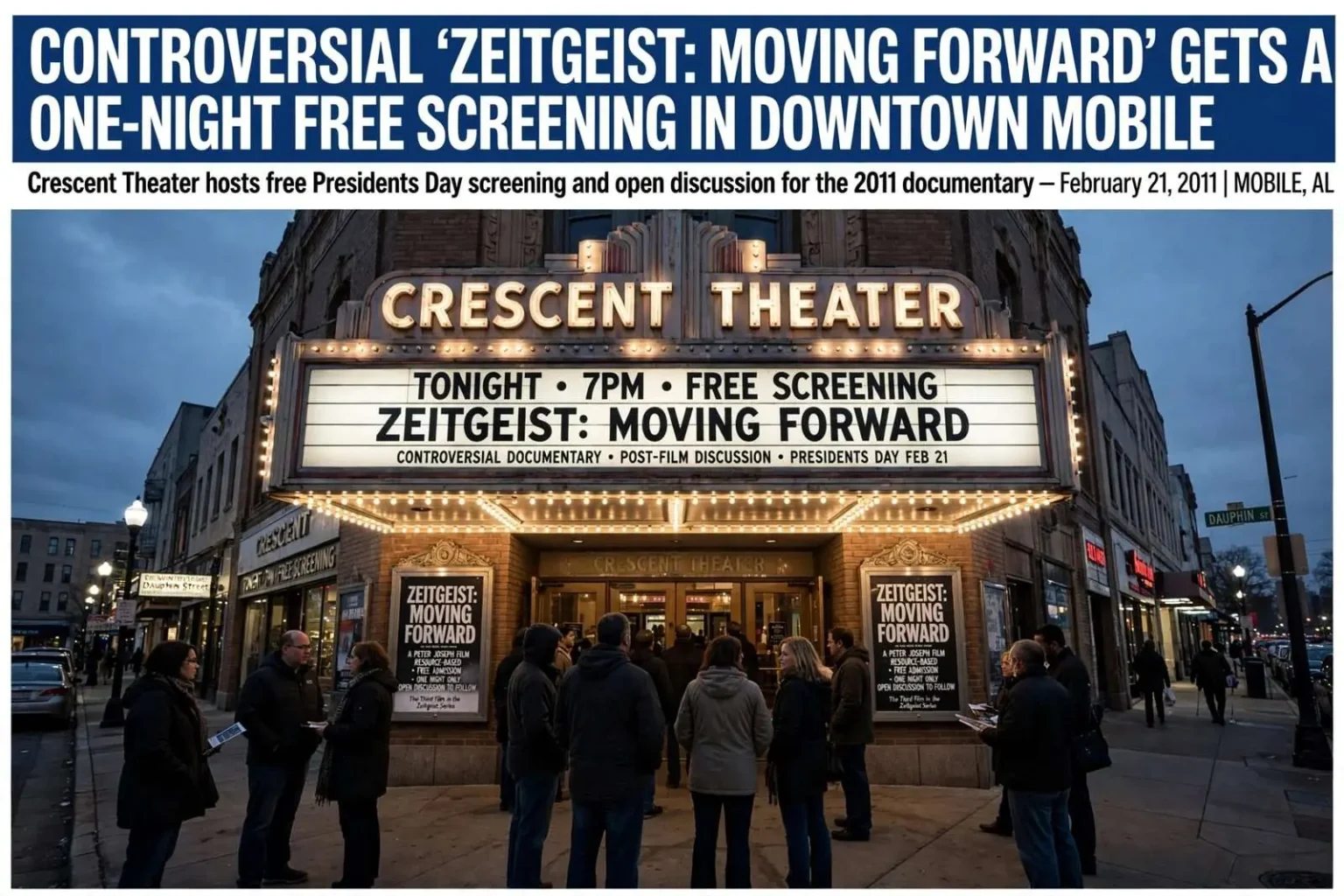
The Crescent Theater threw open its doors on Presidents Day, Feb. 21, 2011, for a one-time, free-admission screening of “Zeitgeist: Moving Forward” — followed by an open group discussion for anyone willing to wade into the debate the film was built to start. The event gave Mobilians a chance to see on a big screen one of the most talked-about and most contested independent documentaries of its era, and to argue about it immediately afterward in the company of strangers.
Directed by Peter Joseph, the feature-length documentary argues for a transition out of the world’s current monetary-based socioeconomic system toward what it calls a “Resource-Based Economy,” framing its case around what it presents as empirical attributes of human and social survival. The film, released in January 2011, was the third in the Zeitgeist series, following the original “Zeitgeist” and its sequel “Zeitgeist: Addendum,” and it drew heavy online viewership in its first weeks, premiering to large audiences through free internet distribution rather than a conventional theatrical rollout.
The Resource-Based Economy concept at the film’s center holds that society should manage resources scientifically and distribute goods based on availability rather than through money, markets, or wage labor. The idea is associated with Jacque Fresco’s Venus Project, which features prominently in the film, and with the Zeitgeist Movement that grew up around the series as an activist organization promoting the transition Joseph’s films describe.
A Film Designed to Spark Argument
The film is deliberately provocative. It asserts a number of contested ideas — including the Christ myth theory, alternative theories about who was responsible for the September 11 attacks, and claims that bankers manipulate the international monetary system and the media to consolidate power. Those assertions made it one of the most talked-about independent documentaries of its era, and the reason organizers planned a post-screening discussion rather than a simple lights-up exit.
The earlier Zeitgeist films in particular drew sharp criticism for their treatment of religion and the September 11 attacks, with fact-checkers and reviewers disputing large portions of their claims, while defenders argued the films were valuable for the questions they raised rather than the specific conclusions they drew. “Moving Forward” shifted the series’ emphasis toward economics and human behavior, but it carried the franchise’s reputation with it, and audiences knew going in that they were watching something built to challenge them rather than to soothe them.
Free-admission screenings of this kind typically draw a mixed crowd: the curious who had heard of the film online but never seen it, devotees of the series already familiar with its arguments, skeptics ready to push back, and ordinary moviegoers with a free evening on a holiday. The post-film discussion format acknowledges what a provocative documentary does to a room, people walk out wanting to talk, and giving them a forum immediately afterward turns a private reaction into a public conversation.
Presidents Day made practical sense as a date as well. With schools and many offices closed, the Monday evening was free for working adults and students who might not attend a weeknight event, and the holiday’s loose association with national history gave the screening a topical hook, a film about how societies ought to organize themselves, shown on a day set aside for the country’s founding leadership.
The Crescent Theater and Downtown Mobile
For downtown Mobile, the event turned the small Crescent screen into a town square of sorts for one night: a controversial film, free admission, and an open invitation for the audience to argue about it afterward. The Crescent, located on Dauphin Street in the heart of downtown, was by that point an established part of the city’s cultural fabric, known for championing independent and art-house cinema that the multiplexes wouldn’t book, and for hosting local film events, festivals, and screenings tied to the city’s growing creative community.
Independent theaters like the Crescent occupy a particular role in cities of Mobile’s size. They provide the only local venue for foreign films, documentaries, and festival picks, and they double as gathering spaces for film societies, meetups, and special events. A free screening of a fringe documentary is exactly the sort of booking that distinguishes such a theater from the suburban multiplex, and the discussion component fit the Crescent’s identity as a place where cinema serves as a starting point rather than an endpoint.
The screening also plugged into the Zeitgeist Movement’s grassroots distribution strategy. The film’s makers encouraged public screenings worldwide, particularly around its release window, and community-organized showings in small venues, coffee shops, and single-screen theaters formed a nationwide network of premieres that the conventional studio system would never have mounted. Mobile’s showing was part of that wave, bringing the film to the Gulf Coast through local initiative rather than national promotion.
Documentary screenings followed by discussion were a recurring format at small theaters and community spaces in the early 2010s, particularly for films dealing with economics in the years after the financial crisis. The recession had made monetary-system critiques newly credible to wide audiences, and films questioning the structure of banking and currency found reception in cities far from the academic and media centers that usually shape such debates. Mobile was no exception, and the Crescent’s willingness to screen the film at no charge lowered the barrier to exactly the curious-but-uncommitted viewer such films most need to reach.
For attendees, the format promised an evening of two halves. The first belonged to Peter Joseph’s film, with its sweep through human behavior, social systems, and its argument that scarcity and money are artificial constraints on what a technologically capable society could provide. The second half belonged to the audience: an open discussion in which agreement was never the point. Films like this one function socially as much as cinematically, and the organizers’ decision to build the discussion into the event recognized that the argument after the movie was as much a part of the experience as the movie itself.
Whether visitors came to nod along or to object, the evening’s structure gave both a stake: watch, then speak. That design separates a community screening from a commercial engagement, where the credits roll and the audience disperses to separate cars. In the Crescent’s small house, the reaction to the film played out in the room, face to face, the way arguments about society unfolded before the internet made them anonymous.
The one-night, free-admission format also reflected the realities of specialty film exhibition: no studio backing, no marketing budget, and an audience that had to be reached through word of mouth, local listings, and the theater’s own channels. Films that arrive that way tend to draw self-selected crowds, and in the case of “Zeitgeist: Moving Forward,” a self-selected crowd is precisely the point — everyone in the room chose to spend a holiday evening confronting ideas that a decade later remain as contested as they were that February night in downtown Mobile.
Understanding what the film argues requires a bit of background on the series itself. The original “Zeitgeist,” released online in 2007, became one of the first viral documentaries of the streaming era, viewed by millions through free distribution. Its sequel, “Zeitgeist: Addendum” in 2008, pivoted the series toward economic critique and introduced the Venus Project connection. “Moving Forward,” completed after several years of production, was positioned as the series’ most substantive entry, replacing the earlier films’ montage style with a more conventional documentary structure built around interviews with authors, researchers, and activists in fields ranging from anthropology to behavioral economics.
The Resource-Based Economy idea, as the film presents it, contends that the Earth holds sufficient resources to meet human needs if those resources were managed rationally rather than through ownership and price. The film argues that money itself is an obsolete intermediary, that technological automation could eliminate much drudgery, and that human behavior is shaped far more by environment and culture than by fixed nature, and therefore that a differently organized society would produce differently behaving people. Critics have attacked the proposal as unworkable and utopian, asking who plans and who decides in a world without markets; supporters counter that the current system’s failures, from boom-bust cycles to engineered scarcity, make the experiment worth considering.
The discussion sessions that followed screenings around the country tended to follow a familiar arc: initial reactions, challenges to specific factual claims from the film, then a broader argument about whether the film’s diagnosis of economic problems is separable from its proposed cure. Audiences frequently split between those who found the critique of the monetary system compelling while doubting the alternative, and those who accepted the full framework. Facilitators of such discussions generally considered that split a success, since the film’s stated goal was to provoke examination rather than conversion.
For Mobile viewers in February 2011, the screening arrived at a moment when economic anxiety was still close to the surface locally. The Gulf Coast had absorbed the recession and, just months before, the Deepwater Horizon spill and its fallout for the fishing and tourism industries, giving the film’s arguments about resource management and economic vulnerability an unusual local resonance. A conversation about how a society organizes and distributes its resources was not an abstraction in a region still counting the costs of the previous year.


