
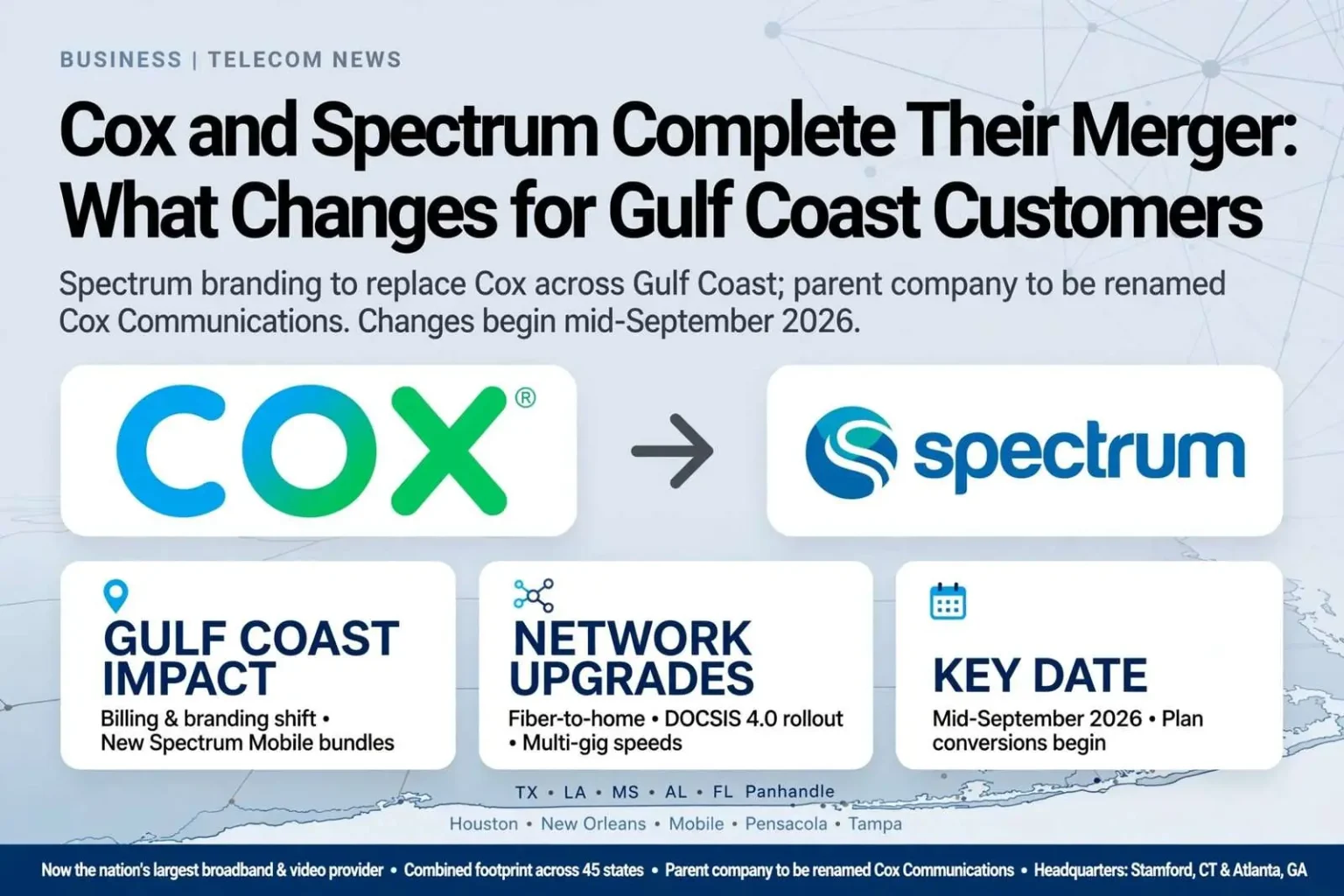
Charter Communications has closed its landmark transaction with Cox Communications and simultaneously completed its acquisition of Liberty Broadband Corporation, creating the nation’s largest broadband and video provider with a combined footprint across 45 states. For subscribers along the Gulf Coast, the corporate mechanics matter less than two practical questions: what name will appear on the bill, and what happens to the service itself.
The Spectrum Name Takes Over
Consumers will not see the Cox name on their services for much longer. Going forward, all customer-facing internet, television, home phone and mobile products across every market will operate under the Spectrum brand. At the corporate level, the direction reverses. The parent company will officially change its name from Charter Communications to Cox Communications within the next year. The combined business will remain headquartered in Stamford, Connecticut, while maintaining a substantial corporate presence in Atlanta, Georgia, a reflection of Cox Enterprises’ longtime home base.
What Cox Customers Should Expect
The transition begins immediately, with the most visible changes — pricing structures and product rollouts — scheduled for the middle of September 2026. Customers in former Cox territories will be moved onto Spectrum-branded plans over that period. For households already on Spectrum, day-to-day service and existing plans are expected to remain consistent. The principal difference is scale: an expanded national footprint extends key network perks across a larger service area, which typically affects things such as mobile coverage arrangements and out-of-home Wi-Fi access.
The Terms of the Deal
Under the closing terms, Cox Enterprises received approximately $4 billion in cash along with common and convertible preferred units, giving it an approximate 26% fully diluted ownership stake in the combined entity. Alex Taylor, chairman and chief executive of Cox Enterprises, has taken on the role of chairman of the combined company’s board of directors. The deal brings together two of the oldest names in American cable, both with roots that stretch back decades into the early days of the cable television industry.
The Liberty Broadband acquisition gives the combined company full control of the roughly 26% stake that Liberty Broadband had previously held in Charter. Simplifying that ownership structure removes a layer of corporate complexity that had existed for years and gives the new parent company more flexibility to invest in network upgrades, mobile integration and customer-facing technology.
What Gulf Coast Subscribers Are Watching
For Gulf Coast customers, the parts of the deal most likely to be felt at home are billing, branding and any changes to bundled services. The shift from Cox branding to Spectrum branding will be the most visible sign that the merger is complete, but the bigger questions concern pricing, plan options and the future of bundled mobile and internet packages.
Spectrum has long offered a paired mobile service through its Spectrum Mobile brand, leveraging Verizon’s network to deliver nationwide coverage at prices that undercut the major wireless carriers. Former Cox markets have generally had access to similar mobile products under their own branding, and the combined company has signaled that bringing all customers under the Spectrum Mobile umbrella is a near-term priority. For households that already use Spectrum Mobile, the changes should be limited to the consolidation of accounts and any updated billing arrangements.
Network Investments and the Cable Industry Landscape
The cable industry has been consolidating for two decades, and the Charter-Cox deal is the largest transaction in that trend since Charter’s own acquisition of Time Warner Cable in 2016. The combined company now serves millions of customers across the country, with a particularly heavy presence in the South, the Midwest and the Mountain West. For Gulf Coast markets, that means local crews, regional call centers and field operations will continue to operate under the Spectrum banner, while back-office and corporate functions will increasingly be coordinated from the company’s Stamford and Atlanta hubs.
The combined company has indicated that the merger will unlock new opportunities for network investment, including the deployment of more fiber-to-the-home upgrades and continued expansion of the DOCSIS 4.0 standard that promises multi-gigabit download speeds over existing coaxial cable. For Gulf Coast subscribers, those investments typically translate into faster available speeds and more reliable service over time, though the rollout is uneven and varies by neighborhood.
Competitive Context for the Gulf Coast
Gulf Coast households have a growing number of options for home internet, with fiber providers, fixed wireless carriers and traditional cable all competing in many neighborhoods. The combined Spectrum brand will face stiffer competition from AT&T Fiber, Brightspeed, Verizon Home Internet and a handful of regional fiber builders that have been extending their footprints into suburban and rural parts of Alabama and the Florida Panhandle. That competition typically benefits consumers in the form of promotional pricing and faster speeds, and the Charter-Cox combination is unlikely to change that dynamic in the near term.
What to Watch in the Coming Months
The most important date for subscribers is mid-September 2026, when the first wave of Cox-to-Spectrum plan conversions is expected to roll out. Customers will receive notifications by mail, email and through their online account portals explaining any changes to their plan, billing cycle or equipment. Most subscribers should expect to see the Spectrum name on their bill shortly thereafter, along with updated customer service contact information.
For Gulf Coast households weighing whether to stay with their current provider or shop around, the merger creates an ideal moment to compare plans. Speeds, bundle pricing, equipment rental fees and contract terms can all vary significantly from one provider to the next, and a quick comparison can sometimes surface savings that exceed any promotional offers available through the new combined company.
A Shift in Corporate Identity
The decision to rename the parent company Cox Communications rather than Charter marks a notable reversal. Charter has been the publicly traded face of the cable business for decades, while Cox had operated as a private company for most of its existence. Bringing the Cox name back to the top of the corporate structure reflects the influence that Cox Enterprises wields through its 26% ownership stake and the chairman role held by Alex Taylor. For the company’s rank-and-file employees and for subscribers, the corporate parent name rarely has any practical effect, but it is a signal of how the post-merger balance of power has been arranged.
Looking Ahead
With the merger closed and the Liberty Broadband acquisition completed, the combined company’s near-term focus is expected to be on operational integration, billing system consolidation and the rollout of new Spectrum-branded plans across former Cox markets. Over time, those changes should translate into a more uniform customer experience across the country, even if local crews and field operations continue to reflect the regional roots of the businesses that joined together. For Gulf Coast subscribers, the most practical takeaway from the deal is straightforward: pay attention to the next bill, expect the Spectrum name to replace Cox on most customer-facing materials, and keep an eye out for any new bundled offerings that may arrive once the integration is complete.
The Bigger Picture for Cable Subscribers Nationwide
The Charter-Cox-Liberty Broadband transaction is the largest in a series of cable industry moves that have reshaped how Americans receive high-speed internet and television. Across the country, the combined company now serves millions of households, employs tens of thousands of workers and operates one of the most extensive hybrid fiber-coaxial networks in the world. For cable customers, that scale can bring benefits in the form of larger national Wi-Fi footprints, more uniform mobile service plans and more consistent pricing across markets.
It also brings scrutiny. Federal and state regulators have kept a close watch on cable consolidation for years, and any future transactions that combine regional providers with the combined company are likely to draw significant review. For now, the closed deal allows the company to focus on integration and customer experience rather than on regulatory proceedings.
Where Gulf Coast Customers Can Turn for Help
Customers with questions about the transition can reach the company through the same channels used before the merger closed: the Spectrum customer service number, online account portal, retail stores and social media support accounts. For now, the underlying systems continue to operate much as they did before, with billing platforms and field operations running in parallel until the integration is complete. Most issues can be resolved through standard support channels, and the company has indicated that no immediate service interruptions are expected as a result of the merger.
For subscribers who have used the Cox name on their bills and correspondence for years, the rebranding will require a brief adjustment, but the underlying service is expected to remain consistent. As the integration moves forward, the combined company will continue to invest in the network upgrades and product rollouts that have been a hallmark of both brands.