
CreekFest Returns to Mobile’s Tricentennial Park With Free Music, Food and Watershed Fun
CreekFest 2022 runs 10 a.m. to 2 p.m. Saturday at Mobile's Tricentennial Park — free live music, food trucks, artists and Three Mile Creek watershed.
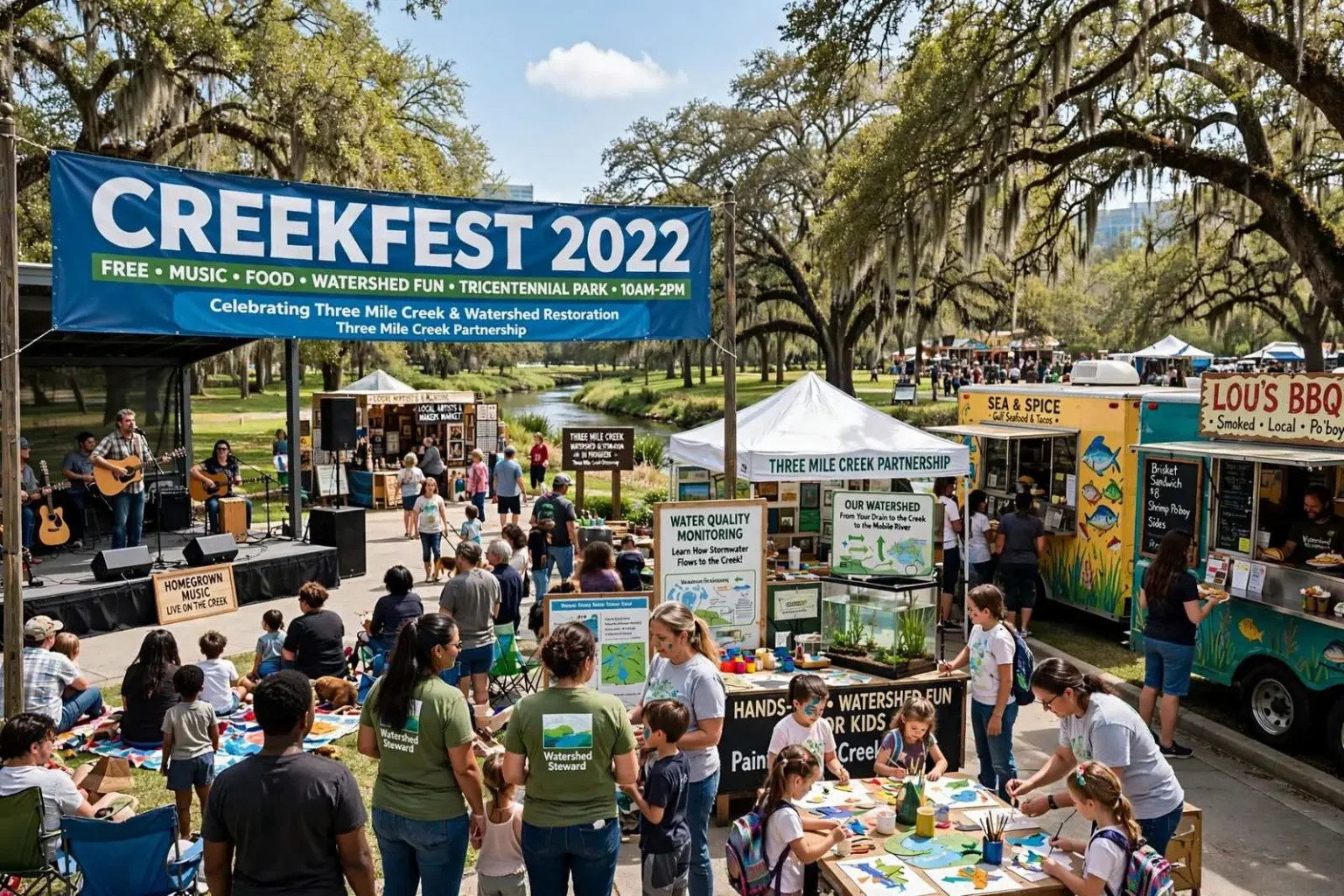
Mobile’s Tricentennial Park came alive Saturday as CreekFest returned for 2022, offering a free day of live music, local food trucks, art and hands-on activities from 10 a.m. to 2 p.m. The festival celebrates Three Mile Creek and the watershed restoration work transforming the corridor that winds through central Mobile.
Organizers describe it as a gathering that “allows the diverse communities within the watershed to come together as one in celebration of the Creek and its unique natural environment.” That framing is the point of the event: CreekFest is less a single-purpose festival than an annual checkpoint for a long-running effort to reclaim a urban waterway that generations of Mobilians knew mainly as a drainage channel.
Visitors found space for local artists and small business owners, activities for all ages, and exhibits from area organizations working throughout the watershed — giving residents a direct look at the progress being made on one of the city’s most ambitious environmental projects. The free admission and daytime hours were deliberate choices, aimed at drawing families from the neighborhoods that line the creek rather than an events crowd from across the city.
The Creek at the Center of It All
Three Mile Creek runs through the heart of Mobile, gathering stormwater from a broad swath of the city before emptying toward the Mobile River. Its name is its geography — the waterway sits roughly three miles from downtown — and its history mirrors the city’s: an urban creek that absorbed decades of development, paving and runoff until portions of it became better known for flooding and pollution than for recreation.
The restoration effort has worked to change that. The corridor project ties together creek cleanup, greenway development, stormwater management and neighborhood revitalization along the waterway’s path through central Mobile. City planners have pitched the creek’s revival as both an environmental project and an economic one: a restored greenway with walkable paths and usable parkland raises the quality of life in the surrounding neighborhoods and connects communities that the creek’s decline had cut off from their own backyard.
Tricentennial Park, the festival’s home, sits along that corridor and was developed as part of the city’s 300th-anniversary legacy projects — a greenspace meant to anchor the creek’s recovery the way similar urban waterway parks have revived creek corridors in cities across the country. On festival day, the park serves as a working demonstration of the idea: families using green space that a generation ago was a neglected drainage edge.
A Festival Built by a Partnership
CreekFest is presented through the Three Mile Creek Partnership, the coalition of city, nonprofit and community groups behind the creek’s revival. That structure — rather than a single department or promoter — reflects the scope of the work: watershed restoration crosses property lines, government departments and neighborhood associations, and no single entity owns the whole effort.
The coalition model also shapes what the festival looks like. Exhibits from the organizations working throughout the watershed give each partner a face-to-face audience with residents, from conservation groups monitoring water quality to city departments planning greenway segments to neighborhood associations whose members live along the banks. The festival doubles as the partnership’s largest public engagement event of the year.
More details about the partnership’s ongoing work are available on its Facebook page, where organizers post updates on restoration milestones, volunteer opportunities and meeting announcements — the standing invitation for residents who want to move from festival-goer to participant.
What Visitors Found on Saturday
The 10 a.m. to 2 p.m. format packed the festival into a family-friendly window: music starting late morning, food trucks serving lunch, and activities designed for children who might spend an hour at the park and leave with paint on their hands and a new sense of where their neighborhood’s water goes. Live music from local acts filled the park’s open space, keeping with the event’s emphasis on showcasing homegrown talent alongside homegrown food vendors.
Local artists and small business owners got booth space that turns the festival into a small market — an economic benefit the organizers weigh alongside the environmental message. For neighborhood entrepreneurs, a free community festival that draws hundreds of families is a rare direct-sales opportunity, and the vendor lineup gives the event its block-party feel.
The hands-on activities carry the educational load. Watershed organizations use games, demonstrations and creek exhibits to teach the basics that the restoration depends on: where stormwater travels, why litter in a neighborhood drain ends up in the creek, and how the corridor’s new green spaces are designed to soak up and slow the runoff that once poured straight into the waterway. Children who learn the creek’s path through their own neighborhood are the residents most likely to defend it later.
Why Watershed Restoration Matters in Mobile
Mobile’s relationship with water makes the Three Mile Creek project more than cosmetic. The city is one of the rainiest in the United States, and its flat, low-lying terrain means stormwater management is a permanent public works challenge. Urban creeks like Three Mile Creek are the drainage system’s backbone, and their health — the width of their floodplains, the condition of their banks, the amount of pavement draining into them — determines how the city weathers heavy rain.
Restored greenways along urban creeks serve as that system’s relief valves. Parkland that absorbs rainwater, trees that stabilize banks, and daylighted, cleaned channels that move water efficiently all reduce flooding pressure on surrounding streets and homes. The environmental benefits stack on top: improved water quality flowing toward the Mobile River and the Bay, habitat for the birds and aquatic life that urban creeks can support when their water is clean.
The neighborhood dimension is the third leg. The creek corridor runs through central Mobile communities that have historically seen less public investment than other parts of the city, and the restoration plan treats the greenway as neighborhood infrastructure — safe walking paths, usable parks and a cleaner environment where residents live, not a project they drive across town to visit. CreekFest, held in the park at the corridor’s heart, is that idea made visible for a day.
The City’s Broader Greenway Vision
The Three Mile Creek corridor project fits into Mobile’s broader effort to reconnect residents with the water that defines the city. Civic leaders have spent years promoting the idea that a city built on rivers and the Bay should have usable public spaces along its waterways, and the creek greenway is the flagship of that thinking — a project that pairs recreation with drainage, conservation with neighborhood development, and environmental cleanup with public health.
Urban greenways of this kind have a track record in comparable cities. Corridor parks along restored urban streams have been shown to raise adjacent property values, attract foot traffic that supports local businesses, and give cities a marketable identity feature — all while performing the stormwater work that grey infrastructure alone struggles to handle. Mobile’s planners have looked to those models as the creek work advances segment by segment.
Each phase of the corridor adds pieces to that vision: extended trails, improved crossings, new plantings and bank stabilization, and park upgrades like the green space at Tricentennial Park where CreekFest sets up. The festival’s timing in the spring keeps the project in front of the public during the stretch of the year when the park and the creek are at their most usable.
Community Ownership of the Creek
The partnership’s emphasis on the “diverse communities within the watershed” speaks to the geography of the project. The creek’s drainage area takes in neighborhoods of widely different incomes and histories, and the restoration’s premise is that the creek belongs to all of them — that a shared waterway can be the common ground its communities build around, rather than the neglected boundary line they face away from.
That is why the festival measures success in attendance from the neighborhoods themselves rather than from across the metro area. A watershed effort lives or dies on local ownership: residents who use the greenway, report dumping and litter, join cleanup days, and show up at planning meetings are the constituency that keeps a decade-long project funded and maintained through changes in city leadership.
The free, daytime, family-first format is engineered for that goal. Admission prices and evening schedules skew events toward audiences with disposable income and flexible hours; CreekFest’s design does the opposite, betting that the people who live nearest the creek are the ones the project most needs to reach — and that a Saturday morning of music, food and creek-side activities is the most effective invitation available.
How to Follow and Support the Work
Residents who want to stay involved have straightforward options. The Three Mile Creek Partnership’s Facebook page carries the running updates — festival announcements, volunteer days, planning milestones — and the organizations exhibiting at CreekFest each maintain their own volunteer pipelines, from water-quality monitoring to cleanup crews to trail maintenance.
Volunteer work is the most direct way to contribute, and creek cleanups are the signature activity: removing the litter and debris that accumulates in urban waterways is visible, family-friendly work that produces an immediate result along the banks. Community meetings are the other avenue, where corridor plans are presented and public input shapes which segments move forward and how the greenway connects to the neighborhoods around it.
The 2022 festival ended at 2 p.m. with the park returned to its everyday role — but the work it celebrated continued the following Monday, in planning sessions and along the creek banks, moving Mobile’s most ambitious environmental project another segment closer to the greenway the city has been promised. CreekFest’s real product is the audience that stays engaged after the music stops.


