
Crescent Theater Pairs a Local Cult Comedy With Hobo With A Shotgun and a Harper Lee Documentary
Mobile's Crescent Theater lines up locally made The Night Shift, Rutger Hauer's Hobo With A Shotgun and a Harper Lee documentary in late June 2011.
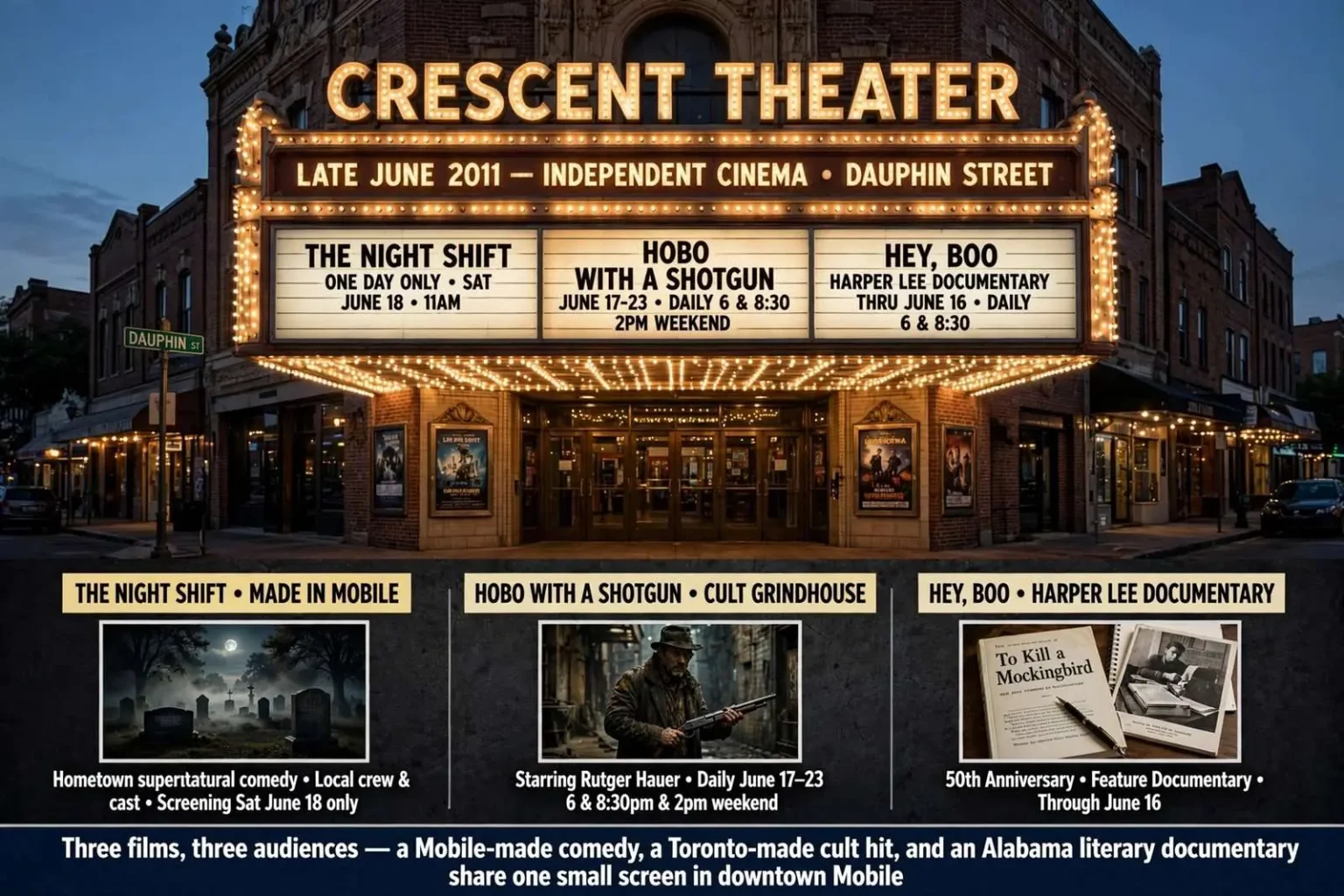
Downtown Mobile’s Crescent Theater stacked its late-June 2011 calendar with an unusually local-minded mix: a one-day-only screening of a homegrown supernatural comedy, a full week of the grindhouse revenge film Hobo With A Shotgun, and the closing days of a documentary about To Kill a Mockingbird author Harper Lee. Three films, three audiences and three very different meanings for the Gulf Coast — one made here, one imported from the outer edges of cult cinema, and one drawn from Alabama’s most famous novel — all sharing a single small screen in the heart of the Dauphin Street entertainment district.
The lineup is a fair portrait of what the Crescent does. As downtown Mobile’s indie-minded cinema, the theater has built its identity on programming the films the multiplexes pass over — documentaries, regional productions, festival pickups and cult titles — and on giving local audiences a place to see work connected to their own community. A week that includes a Mobile-made comedy, a Toronto-made cult hit and a film about Alabama’s most celebrated novelist is precisely the range that keeps the theater’s regulars checking the schedule.
The Night Shift, Made in Mobile
The homegrown draw is The Night Shift, a locally produced supernatural adventure-comedy screening Saturday, June 18 at 11 a.m. for one day only. The film follows cemetery night watchman Rue Morgan, who spends his afterlife fending off creatures of the night while pining for day-shifter Claire — until a scourge of paranormal occurrences leaves him watching his back as well as the graveyard. The premise gives the production its appeal: a ghost-story romance with comedy in its veins, the kind of genre blend that independent filmmaking does at its most inventive and that studio systems rarely attempt on a small scale.
Produced using area talent, the film earned early notices calling it a “funny, action packed little film” with cult-classic potential and “charming and fun.” For Mobile’s small but persistent community of filmmakers and actors, The Night Shift represented the thing every regional production hopes for — a finished picture, real reviews and a theatrical screening in its own hometown. Local productions live or die on word of mouth, and a one-day screening at a beloved downtown theater is both a milestone and a test: the audience that turns out on June 18 tells everyone involved whether the film’s cult-classic potential has a future.
One-day screenings carry their own logic. The Crescent uses them for films without a distribution deal that can only reach local audiences if the theater books the print itself, and the limited window creates the urgency that gets casual moviegoers off the couch. For a hometown film, a single Saturday morning show becomes an event — part screening, part hometown premiere, part reunion for everyone who worked on it — and missing it means waiting for a home video release that may be a long time coming.
Hobo With A Shotgun Comes to Town
Also new that week is Hobo With A Shotgun, running daily at 6 and 8:30 p.m. from June 17 through 23, with a 2 p.m. weekend matinee. Rutger Hauer stars as a vigilante drifter who dispenses justice with a 20-gauge in a city ruled by a crime boss. The film is pure grindhouse — an intentionally over-the-top revenge picture in the tradition of the exploitation cinema of the 1970s and 1980s, made with full awareness of its own absurdity and played with complete commitment.
Hauer’s casting is the film’s masterstroke. The Dutch actor, who built his reputation on intense, philosophical roles in films like Blade Runner, brings unexpected gravity to a character that exists on paper as a joke, and the performance is precisely why the film crossed over from joke to cult favorite. The title itself comes from one of the most famous marketing stunts of recent cinema history — a fake trailer created for a competition tied to the exploitation homage Grindhouse — and the feature expansion of that trailer became a calling card for a particular strain of gleeful, bloody, self-aware genre filmmaking that found an audience exactly in theaters like the Crescent.
Cult cinema needs theatrical settings to work. These films are made for a crowd — for cheering, groaning and laughing in the dark with strangers — and their afterlife depends on independent theaters willing to book them. A full week of daily evening screenings with weekend matinees gives the film’s fans room to plan, and for the Crescent it fills the post-mid-June calendar with a title that reliably draws the late-night movie crowd that follows the Dauphin Street bar scene.
Hey, Boo and Harper Lee
Through June 16, the theater hosts Hey, Boo: Harper Lee and To Kill a Mockingbird, marking fifty years since the novel won the Pulitzer Prize. The documentary explores why Lee never published again and traces the book’s Deep South context, with reflections from Anna Quindlen, Tom Brokaw, Wally Lamb, Richard Russo, Oprah Winfrey and Andrew Young. It screens daily at 6 and 8:30 p.m., with weekend matinees at 2 p.m.
The documentary arrives at a bookend moment in American literary history. To Kill a Mockingbird was published in 1960, won the Pulitzer Prize the following year, and became one of the most widely read novels in American schools — while its author, the Monroeville, Alabama native who modeled Maycomb on her hometown, declined fame, gave no meaningful interviews and never published another book in her lifetime. Hey, Boo takes that silence as its subject, assembling some of the most recognizable names in American letters and media to consider both the novel’s endurance and the mystery of its author’s retreat from public life.
For Alabama audiences, the film has a local weight it does not carry anywhere else. Lee’s Deep South context is the Gulf Coast’s own — the small towns, the courthouse squares, the racial history the novel confronted in 1960 and that the region has spent the decades since reckoning with. Documentaries about the region’s literary giants rarely get theatrical runs in the region itself, which makes the Crescent’s booking the rare chance to see the film the way it deserves: in a theater, in Lee’s home state, in the company of an audience that lives inside the world the book described.
One Theater, Three Kinds of Cinema
Put side by side, the three bookings say something about the state of moviegoing in 2011. The multiplex model has consolidated screens around four-quadrant studio releases, leaving documentaries, regional films and genre curiosities to fight for space on home video and streaming. Independent theaters like the Crescent are where that fight is won or lost, and a calendar that can hold a hometown ghost comedy, a Rutger Hauer grindhouse picture and a Harper Lee documentary in the same two weeks is a calendar built on taste rather than on marketing budgets.
The scheduling itself shows the craft behind that kind of programming. Hey, Boo ran through June 16 with daily shows, closing just as Hobo With A Shotgun opened its June 17-23 run, and The Night Shift’s single Saturday morning screening slotted into the gap without displacing either. Daily 6 and 8:30 p.m. evening shows with 2 p.m. weekend matinees give audiences the predictable rhythm that builds regular attendance — dinner downtown, a movie after — while the one-day homegrown screening works as an event that the regular schedule cannot contain.
What the Crescent Means to Downtown Mobile
The Crescent’s fortune is tied to downtown Mobile’s revival, and it returns the favor nightly. The Dauphin Street entertainment district has spent years rebuilding itself as the center of the city’s nightlife, and small venues — theaters, galleries, music rooms — are the anchors that give the street its identity beyond bars and restaurants. A movie theater that programs documentaries about Alabama authors and local films made around town gives downtown a cultural depth that no national chain would provide, and it puts butts in seats that then walk to dinner, to bars and back again.
For local filmmakers, the theater’s willingness to book homegrown work matters more than any single screening. A region’s film community needs a theatrical venue that will say yes — to a finished feature, to a festival showcase, to a hometown premiere — and without one, productions shoot here and premiere somewhere else. The Night Shift’s June 18 screening is the kind of date that keeps Mobile’s production community pointed toward the next project, with the proof on the screen that a Mobile-made film can get a Mobile audience.
The late-June calendar delivers the Crescent’s whole identity in one week: a documentary about the state’s most famous novelist closing out its run, a cult film with a legendary actor settling in for seven days, and a comedy made by the theater’s own neighbors playing one Saturday morning. For Mobile moviegoers, the message of the schedule is the message the theater has been sending for years — the movies worth seeing are not always the ones playing everywhere, and downtown is where the rest of them live.


