
Crescent Theater’s Spring Slate: ‘Paul’ Extended, Watt Key Q&A for ‘Alabama Moon,’ First Film Scramble Results
The Crescent Theater's spring 2011 lineup extended Paul, welcomed Alabama Moon author Watt Key and screened the first Mobile Bay Film Scramble.
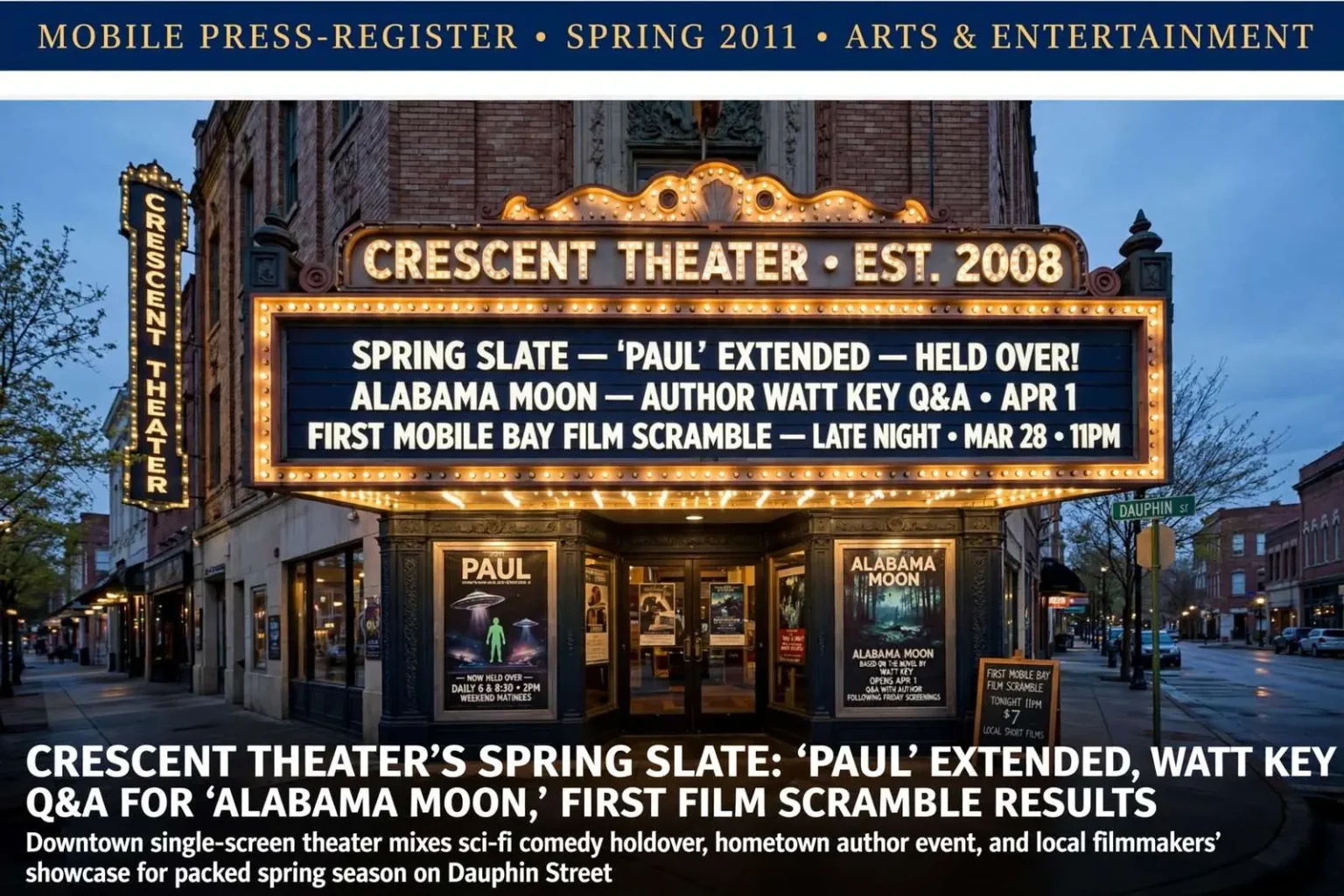
Downtown Mobile’s Crescent Theater rolled out a packed spring 2011 calendar, and for the city’s small but devoted single-screen movie house, the season delivered a mix that ranged from a big-studio sci-fi comedy to a hometown literary homecoming and a late-night showcase of locally made short films. The slate gave downtown moviegoers a reason to stay on Dauphin Street after dinner and, in one memorable week, a chance to hear a best-selling Alabama author talk about the book that put him on the map.
At the center of the early spring schedule was “Paul,” the 2011 sci-fi comedy starring Simon Pegg and Nick Frost, the British actors best known for “Shaun of the Dead” and “Hot Fuzz.” In the film, the pair play two science-fiction obsessives on a road trip across America’s UFO heartland — the deserts and roadside stops of the Southwest — whose pilgrimage to Comic-Con goes sideways when they encounter a wisecracking alien, voiced by Seth Rogen, who escapes a government facility and tags along for the ride.
The theater opened “Paul” on March 18 and quickly decided the comedy deserved more time. The house held the film over for an additional week, screening it daily at 6 and 8:30 p.m., with 2 p.m. matinees on weekends. For a one-screen venue competing against the multiplexes out west in Mobile County, a holdover of a wide-release comedy was a sign that downtown audiences were showing up in numbers the theater could not ignore.
‘Paul’ sticks around
The extended run also fit the Crescent’s long-standing identity as a house that favors films with personality over pure blockbuster muscle. Since opening in 2008 in the heart of downtown Mobile, the theater has built its reputation on a careful mix of independent films, documentaries, and select studio comedies that appeal to an adult audience, often giving smaller titles the long runs they would never get at a larger complex.
The holdover week meant fans of Pegg and Frost — who co-wrote “Paul” alongside director Greg Mottola’s affectionate nod to decades of alien-invasion cinema — had extra chances to catch it in a proper theater setting. The 6 p.m. and 8:30 p.m. daily showings put the film conveniently after the workday, and the weekend matinees gave families and early risers a cheaper window to catch the comedy on the big screen.
But the biggest local draw of the spring had Alabama written all over it. On April 1, “Alabama Moon” opened at the Crescent, bringing to the screen the novel that put south Alabama writer Watt Key on the national literary map. The coming-of-age story follows a boy raised off the grid in the deep Alabama woods by a survivalist father, and who must find his way in the modern world after his father’s death — a story rooted in the pine forests and small towns of the state.
Watt Key comes home for ‘Alabama Moon’
Key, whose novel was first published in 2006 and went on to earn a string of state and national honors for children’s literature, attended opening night at the Crescent in person. He led question-and-answer sessions after both Friday screenings, giving Mobile audiences a rare chance to hear directly from the writer behind the story — how the book came together, how it made the long journey from manuscript to published novel to film, and what it was like to watch Alabama settings play out on screen.
For a city that reads its local authors closely, the appearance carried real weight. Key has become one of Alabama’s most prominent writers for young readers, and “Alabama Moon” is frequently taught in schools across the state. Seeing the film at an independent downtown theater, with the author on hand afterward, was the kind of event the multiplexes cannot replicate — and it gave teachers, parents, and young readers in the audience a direct connection to the story they had already met on the page.
The opening night celebration did not end with the credits. Late that same evening, the Crescent turned its screen over to the results of the First Mobile Bay Film Scramble, the theater’s homegrown short-film competition designed to get Gulf Coast filmmakers in front of a hometown audience.
The rules of a film scramble are simple and demanding: competing teams get a short window to write, shoot, and edit a complete short film, and the finished entries were due back at the theater by 6 p.m. on March 28. Whatever made it in by the deadline went up on the Crescent’s screen in a single late-night program, starting at 11 p.m., with admission set at $7. For the price of a movie ticket, audiences got a sampler of what Mobile’s grassroots film community could produce — comedies, dramas, experiments, and everything in between — much of it shot on location around the city in the days before the deadline.
The scramble screening fit the Crescent’s late-night tradition, a slot the downtown house has long used for programming that would not survive in a conventional theater schedule. It also underscored the theater’s role as a de facto arts venue for downtown Mobile, hosting not just commercial releases but the work of the people who live and shoot here.
What followed
The spring slate kept rolling from there, with a lineup that leaned into comedy and genre fare in roughly two-week blocks. The political satire “Cedar Rapids,” starring Ed Helms as an insurance agent whose first convention goes off the rails, ran April 8 through April 21 — another extended engagement for a comedy that found an audience with Gulf Coast moviegoers.
Next came “Dylan Dog: Dead of Night,” the adaptation of the long-running Italian comic book about a private investigator who specializes in the undead, running April 29 through May 5. It was followed immediately by “Super,” director James Gunn’s darkly funny take on an ordinary man who decides to become a superhero, which ran May 6 through May 12. Both films played the house’s standard schedule of daily 6 and 8:30 p.m. showings with 2 p.m. weekend matinees, a rhythm that has become the Crescent’s signature — steady, predictable showtimes that regulars can plan an evening around.
The season stretched into early summer as well, with the grindhouse homage “Hobo With a Shotgun” arriving June 17, giving the theater’s cult-film audience something to look forward to as summer blockbusters crowded the multiplexes.
For downtown Mobile, the calendar represented exactly what the Crescent has tried to be since it opened: a small theater with an outsized personality, willing to hold a comedy over an extra week, roll out the red carpet for an Alabama author, and hand its screen to local filmmakers at 11 p.m. — all in the same spring. Residents who want to keep up with the theater’s rotating schedule can find current showtimes on its website or at the box office on Dauphin Street, where the single screen continues to prove that in Mobile’s entertainment scene, smaller has often meant more interesting.
The spring run also says something about how downtown Mobile’s entertainment district has grown up around the theater. Since the Crescent opened its doors on Dauphin Street in 2008, the surrounding blocks have filled in with restaurants, bars, and galleries that feed off the same evening foot traffic. A 6 p.m. screening slots neatly before a downtown dinner, and an 8:30 p.m. show pairs naturally with drinks afterward — a scheduling pattern the theater has quietly mastered.
The single-screen format is part of that appeal. With only one film playing at a time, the Crescent turns each title into a shared civic event: when the whole city is watching the same movie in the same week, the lobby conversations before and after become part of the experience. That dynamic is nearly impossible to find in a 14-plex, and it is why the holdover of “Paul” and the author appearance for “Alabama Moon” mattered more here than a similar booking would elsewhere.
A home for local film
The First Mobile Bay Film Scramble deserves particular note for what it signals about the region’s creative community. Short-film competitions of this kind have long served as proving grounds for independent filmmakers — a place where a crew can test an idea, learn to work under a deadline, and screen the result for a real audience rather than leaving a finished file on a hard drive. The March 28 entry deadline gave crews just enough time to script, shoot around town, and cut their pieces together, and the 11 p.m. screening turned the results into a genuine social event rather than a critique session.
The $7 admission also kept the event accessible, in keeping with the theater’s general pricing philosophy. Downtown revival efforts live or die on whether residents feel an evening out is within reach, and a late-night local-film showcase at seven dollars is about as low a barrier to entry as the movies offer anywhere on the Gulf Coast.
Between the author Q&A, the scramble results, and a comedy holdover, the theater’s spring 2011 season managed something rare for a venue with one screen: it served film fans, readers, and local creators all at once. The weeks that followed — “Cedar Rapids,” “Dylan Dog: Dead of Night,” “Super,” and eventually “Hobo With a Shotgun” in June — kept the momentum going with the theater’s familiar daily 6 and 8:30 p.m. showtimes and 2 p.m. weekend matinees.
For residents who had drifted out of the habit of going downtown for a movie, the calendar made the case for coming back. And for the Gulf Coast film community, the scramble screening on that opening Friday night made an even simpler point: Mobile has people making movies, and downtown has a screen for them.


