
Crestview Man Dies After Truck Crashes Into Parked Tractor on State Road 85
FHP says 28-year-old Jacob Wetherbee died after his truck drifted off State Road 85 near Plympton Road and hit a parked tractor in Okaloosa County.
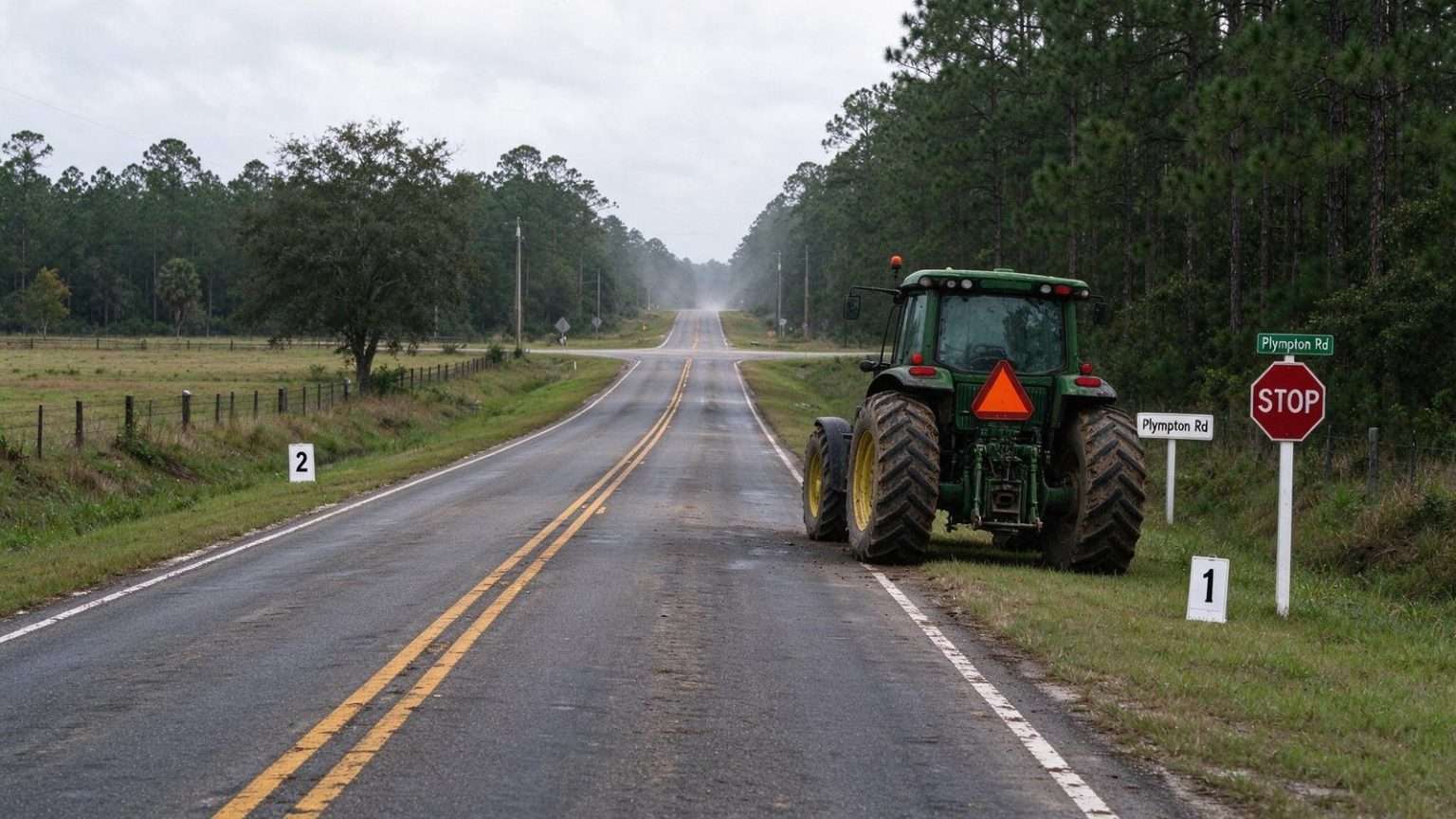
A 28-year-old Crestview man died after his truck crashed into a tractor parked along State Road 85 in Okaloosa County, according to Florida Highway Patrol records of the January crash. Troopers said Jacob Wetherbee was traveling southbound on State Road 85 and approaching the intersection with Plympton Road when his truck drifted into the northbound lane.
According to the patrol’s account of the collision, the vehicle clipped a stop sign before slamming into the rear of the parked tractor. The impact proved fatal, and the crash was recorded in the patrol’s files as one of the deadly collisions investigated along that corridor in January. When a crash involves a fatality, Florida Highway Patrol troopers document the scene in detail, photographing the vehicles, measuring skid and gouge marks, and interviewing witnesses before the roadway is reopened to traffic.
Investigators in crashes of this kind typically work to establish a timeline of the final seconds: the path of the striking vehicle, the point of impact with the fixed object, and the position of the parked equipment at the time of the collision. That information becomes part of the official crash record, which can later be reviewed for traffic-homicide purposes or cited in civil proceedings arising from the wreck.
The collision occurred on a rural stretch of State Road 85 that connects Crestview with communities to the south. The roadway narrows through farmland in northern Okaloosa County, where slow-moving farm equipment is a familiar sight along the shoulders. That mix of everyday passenger traffic and heavy agricultural machinery shapes the character of the road and the kinds of crashes that occur along it.
A corridor that narrows through farmland
State Road 85 serves as one of the principal north-south routes in Okaloosa County, linking Crestview — the county seat, sitting near the midpoint of the Florida Panhandle — with the smaller communities and farm country to its south and, farther down the corridor, the stretches that run toward the Fort Walton Beach area. North of Crestview, the road threads through rolling farmland where fields, pasture, and woodlots come close to the pavement.
That geography matters in crashes like this one. Where the roadway narrows, there is often less of a recoverable shoulder, less margin for a driver who drifts out of the lane, and fewer physical barriers separating moving traffic from objects at the edge of the right of way. A tractor parked along or partly on the shoulder in such a setting occupies space that a drifting vehicle can reach in an instant.
Farm equipment is a routine presence in northern Okaloosa County. Tractors and other machinery move between fields along the same corridors used by commuters, school traffic, and freight, and they frequently park or stage along the roadside during planting and harvest seasons. Drivers accustomed to the route generally know to expect the equipment, but visitors and drivers passing through unfamiliar stretches may not anticipate a large, slow vehicle at the edge of the travel lane.
State troopers who patrol the rural highways of the Panhandle regularly emphasize the basics for corridors like SR 85: maintain lane discipline, watch for equipment entering and leaving fields, and slow down at intersections where sight lines are limited by vegetation or terrain. The intersection with Plympton Road, where Wetherbee’s truck was headed before it drifted, is one of the junctions along that farmland stretch where two rural roadways meet the state corridor.
The patrol’s records of the January crash note the direction of travel, the drift across the centerline into the northbound lane, and the sequence that followed — the clipped stop sign, then the impact with the rear of the parked tractor. Those details, assembled from the on-scene investigation, form the factual record of the wreck.
How investigators document a fatal rural crash
When a crash on a state road results in a death, the Florida Highway Patrol’s response goes beyond a routine accident report. Troopers close the scene while the investigation proceeds, and a crash reconstruction may be assigned to map the physical evidence: measurements of the roadway, the final resting positions of the vehicles, and the damage patterns on each one.
In a crash where a vehicle leaves its lane and strikes a parked object, investigators examine whether a mechanical problem, a swerve, or a lapse contributed to the drift, and whether the parked vehicle was positioned legally and conspicuously. The stop sign that Wetherbee’s truck clipped is itself evidence — a sign strike marks the vehicle’s path near the right of way and helps establish the line of travel before impact.
Florida’s traffic-homicide process gives investigators an extended window. Toxicology testing, vehicle inspections, and reconstruction analysis can take weeks or months, and the patrol’s public crash report is typically finalized only after those steps. In the interim, the initial account — direction of travel, lane departure, sequence of impacts — stands as the working record, and it is the document on which any later legal or insurance review will rely.
Parked equipment and the hazards of the shoulder
Collisions between moving vehicles and parked farm equipment are a recurring hazard on rural roads across the Gulf Coast region. Agricultural machinery is wide, heavy, and often parked close to the travel lane where there is no room to move it farther off the pavement. At night or in poor weather, a tractor at the edge of the road can be hard to distinguish from the darkness behind it until a driver is close upon it.
Farm country requires a balance. Equipment has to move along public roads to reach fields, and during busy seasons it may sit along the roadside for stretches of time. Florida law sets out requirements for slow-moving vehicle identification and, in many circumstances, warning devices when a vehicle is stopped on the roadway — one of the tools used to reduce risk along farming corridors.
For drivers, the safety formula on roads like SR 85 comes down to speed and attention. A vehicle at rural-highway speed covers a long distance in the seconds it takes to recognize a hazard and react. The weight difference is decisive: a tractor with attached equipment can weigh several times what a pickup weighs, with no crush structure to absorb the energy of a rear-end collision. The striking vehicle takes the full force of the impact.
Crestview and the communities along the route
Crestview, where Wetherbee lived, is the seat of Okaloosa County and one of the fastest-growing cities in the Florida Panhandle. Its position at the junction of major routes carrying traffic between Interstate 10 and the Gulf has made the area a crossroads for the region, and growth around the city has pushed more commuter traffic onto rural roads like State Road 85 that were built for far lighter volumes.
The communities south of Crestview along the corridor are small, rural, and closely tied to the land. Farming remains part of the local economy, and the equipment that works that land shares the same two-lane road as everyone else. Okaloosa County’s road network reflects its split character: the southern part is dominated by the Fort Walton Beach–Destin metro area and its military installations, while the northern part — where the January crash occurred — is farmland and pine forest, where state roads are narrower and shoulders are often just a strip of grass and dirt between pavement and ditch.
On those northern stretches, a driver’s mistakes have little room to be absorbed. There are no wide medians or clear zones to give an errant vehicle a place to recover. A drift out of the lane brings a vehicle quickly to a sign, a tree, a ditch — or heavy machinery parked at the roadside. Fatal crashes along the rural portions of SR 85 have been investigated repeatedly over the years, and each fits the same ledger of risk factors: narrowing pavement, mixed traffic, limited shoulders, and growing volume.
What the record shows
Within the limits of what the patrol’s records describe, the essential facts are few and clear. Wetherbee, 28, of Crestview, was driving southbound toward the Plympton Road intersection. His truck drifted into the northbound lane, clipped a stop sign, and struck the rear of the parked tractor. He died as a result of the collision. The records do not state a cause for the lane departure, and none should be assumed from the bare facts.
The crash falls into the category traffic-safety researchers have studied for decades: the lane-departure collision with a roadside object, among the most common fatal crash types on rural two-lane roads. Such wrecks occur for a mix of reasons — fatigue, distraction, impairment, evasive maneuvers — that no single report can fully untangle. Junctions like Plympton Road concentrate turning movements in a short stretch, and drivers approaching them watch for entering traffic rather than the edge of the pavement.
For the Crestview community, the January crash was a personal loss — a 28-year-old resident killed on a road he likely traveled often. It was also a reminder that the margin between an ordinary trip and a fatal one on State Road 85 is measured in feet of pavement and seconds of attention.
Sharing the road with farm equipment
The presence of tractors and other machinery along State Road 85 is not an anomaly but a fixture of the corridor’s role in the local economy. Northern Okaloosa County’s farms use the state road to move equipment between fields and to reach markets and suppliers, and during peak agricultural seasons the sightings become near-daily events for anyone who drives the route.
Safety guidance for rural driving in farm country is consistent across the Southeast, and it applies directly here. Drivers are advised to slow down as soon as they see equipment ahead, to assume the machine may turn into a field or stop without warning, to pass only where the law and sight lines clearly permit, and to watch the shoulders where machinery may be parked or entering the road.
The reverse matters too, and it is where parked equipment becomes the hazard it was in the January crash. A tractor left at the roadside is a fixed object in the recovery zone drivers rely on when something goes wrong. Reflective markings and slow-moving vehicle emblems help, particularly after dark, but they work only when drivers are attentive enough to see and react to them.
Intersections deserve special mention. The approach to Plympton Road, where the fatal drift began, is the kind of junction found throughout the farm districts of the Panhandle — a smaller local road meeting the state corridor, marked with a stop sign on the minor approach while through traffic moves at highway speed. A moment’s drift in exactly that zone can end in catastrophe.
The aftermath and the wider pattern
After a fatal crash, the immediate work belongs to the responders: law enforcement who secure and investigate the scene, emergency crews who attend to the injured, and the personnel who manage the closure and reopening of the roadway. On a rural corridor like SR 85, a serious crash typically closes or restricts the road for a substantial period, rerouting traffic onto the county roads that parallel it.
The longer work belongs to the investigation. The patrol’s finalized crash report becomes the authoritative account, the document on which any subsequent legal, insurance, or governmental review will rely. In the Wetherbee crash, that account begins with the facts already stated: the southbound travel, the approach to Plympton Road, the drift into the northbound lane, the clipped stop sign, and the fatal impact with the tractor’s rear.
The January collision fits squarely into the pattern residents and officials know by heart on this corridor. It stands as the record describes it: a 28-year-old Crestview man, a southbound truck, a farm-road stretch in January, and a parked tractor that became the fixed object at the end of a lane departure — the kind of event rural Northwest Florida knows too well, and the kind its drivers are asked to keep in mind every time they pass a tractor at the edge of the road.