Crews Let Vacant Semmes House Burn After Early-Morning Fire
Firefighters in Semmes, Alabama let a vacant house burn out after an early-morning blaze; the cause remains under investigation.
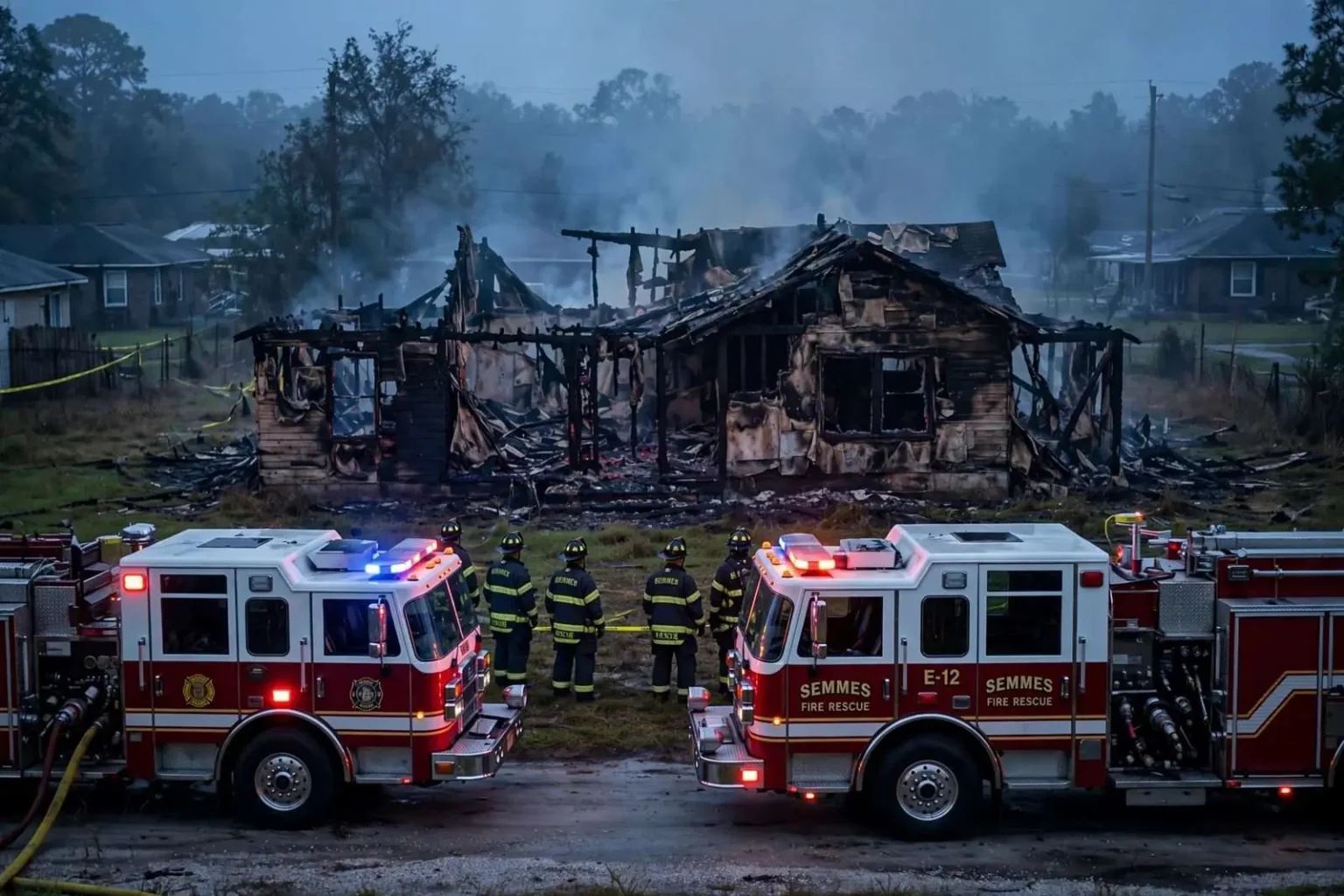
Fire crews in Semmes spent the early hours of a Monday morning watching a house burn rather than fighting it — a deliberate call, made after investigators determined the home was vacant. The fire broke out around 3:30 a.m., and with no one inside and no lives at risk, commanders allowed the structure to burn itself out under the watch of engines positioned to keep the flames from spreading.
The decision, unusual to observers but routine in the fire service, reflects the calculus commanders make on every fireground: the risk to firefighters has to be justified by what can be saved. An unoccupied house with no exposure hazards presents the lowest-stakes version of that equation. Fighting an interior blaze in a vacant structure means sending crews through floors and ceilings that may be compromised, into a building whose layout and hazards may be unknown, to protect property that is already heavily damaged.
Instead, crews took up defensive positions, protecting neighboring properties and monitoring the fire until it exhausted itself. Daylight showed the result: another vacant west Mobile County property in ruins, its remains smoldering as the sun came up over the scene.
No injuries were reported in connection with the fire, which ranks as the most important outcome in any residential blaze. Fire officials emphasize that the defensive posture — often misunderstood by onlookers as inaction — is itself a safety strategy, one that has prevented countless firefighter injuries and deaths in departments across the country.
Why crews sometimes let a fire burn
The tactic that Semmes crews employed overnight has a long history in American firefighting. In the early days of a structure fire, commanders conduct a risk assessment: Is anyone inside? Are neighboring homes or businesses exposed? Is the structure stable enough for crews to work inside? When the answers point to an empty, failing building with little left to save, an interior attack offers all of the danger and almost none of the benefit.
Defensive operations, by contrast, keep crews outside the collapse zone. Water is applied from a distance to cool the fire and shield exposures, and the building is allowed to consume itself. The approach protects lives first — firefighters’ and neighbors’ — and accepts the loss of the structure. In vacant buildings, where there may be no utilities to shut off safely, no owner on scene and no knowledge of what is inside, the case for a defensive stance is especially strong.
Vacant structures carry additional hazards that make them uniquely dangerous to attack. Floors may be rotten, stairways compromised, and debris or openings hidden by darkness and smoke. Squatters sometimes occupy vacant homes without anyone’s knowledge, which is why crews typically search or verify vacancy before committing to a defensive posture — a step that happened in this case, with investigators determining no one was inside.
The investigation begins
What sparked the blaze remained unclear, with investigators unable to say how it started. The origin of the fire — whether accidental, weather-related, or intentionally set — had not been determined as of early morning reports from the scene, and the investigation remains open until evidence points to a cause.
That determination matters for several reasons. Accidental causes, such as electrical faults in abandoned utility connections, have different implications than fires of undetermined origin in empty buildings, which fire investigators treat with particular attention. Vacant structures are statistically more likely to experience intentionally set fires than occupied ones, a pattern fire services track nationally, and an arson finding would add a criminal dimension to an otherwise quiet early-morning incident.
The time of the fire — around 3:30 a.m. on a Monday — is consistent with the hours when residential fires are hardest to detect, since neighbors are asleep and darkness hides smoke until flames grow large. By the time crews arrived, the decision was already shaped by the building’s condition and its vacant status.
Vacant properties and the risks they carry
The ruined house joins a list of vacant west Mobile County structures that fire departments watch with concern. Vacant buildings pose a triple hazard to a community: they endanger trespassers and homeless individuals who may enter them, they threaten neighboring occupied properties when they burn, and they drain public resources each time crews must respond.
Fire officials urge owners of vacant properties to take basic precautions — securing doors and windows, disconnecting utilities where safe and permitted, and maintaining insurance coverage — while neighbors are encouraged to report signs of occupation or fires set inside vacant structures. Early reporting of suspicious smoke in an empty building gives crews the best chance to protect exposures and investigators the best chance to preserve evidence.
Semmes, incorporated as a city in western Mobile County, maintains its own fire protection alongside the mutual aid network that links departments across the county. Early-morning incidents like this one typically draw on that network, with multiple engines and tankers responding to ensure water supply and manpower in areas farther from hydrant grids.
What happens to the property now
After the flames are out and the investigation concludes, a burned vacant house becomes a property matter. Owners are typically responsible for securing or demolishing the remains, and local government code enforcement can step in when a burned structure becomes a hazard — attracting trespass, harboring pests or threatening to collapse. Ruined vacant buildings that sit unaddressed often become the next fire hazard, repeating the cycle the fire service works to break.
For neighbors on the scene early Monday, the immediate concern was simpler: that the fire stayed contained to the vacant house and the morning produced no injuries. On both counts, the outcome was what commanders planned for when they made the call to let the structure burn — a controlled loss of an empty building in exchange for the certainty that no firefighter or resident would be put at unnecessary risk.
The fire remains under investigation, and officials have not released the property’s address or ownership details. Anyone with information about the fire’s origin is generally encouraged to contact local investigators, and updates would come through the responding agencies as the cause determination moves forward.
A quiet reminder about fire safety
Incidents like the Semmes house fire carry lessons even for residents far from the scene. Working smoke alarms remain the single most effective defense in occupied homes, cutting the risk of death in a house fire dramatically. Early-morning fires — the 3:30 a.m. window when this blaze began — are precisely when families are asleep and detection matters most.
Fire officials also use events like this to reinforce evacuation planning: two ways out of every room, a family meeting spot outside, and the understanding that once out, residents stay out. For empty properties, the lesson is stewardship — vacant buildings that are secured and maintained don’t make headlines, while the ones that are neglected eventually do, as the smoking ruins on a west Mobile County morning made clear.
As of the early morning reports, the scene in Semmes was quieting down, crews were clearing, and investigators were turning their attention from suppression to cause. The house that burned was empty; the neighborhood around it was not. By daylight, that was the tally that mattered.
Inside the defensive decision
The overnight operation in Semmes illustrates how modern fire command actually works. When the first units arrived to find a vacant house well involved, the incident commander’s options were narrow: commit crews to an offensive interior attack on a building with unknown structural integrity, or protect the surrounding area and let the fire consume what was already lost. The choice to go defensive is documented, justified on the radio and reviewed afterward, but experienced commanders rarely second-guess it in these circumstances.
National fire service statistics bear out the reasoning. Firefighter deaths and injuries occur disproportionately during interior operations in deteriorating structures, where collapses and rapidly changing conditions can trap crews. Vacant buildings account for a meaningful share of those incidents relative to the small property value they represent. The calculus that Semmes commanders made in the dark Monday morning — no victims, no savable interior, real collapse risk — is the textbook case for staying out.
Defensive operations also allow departments to manage resources across a long incident. A fire that is left to burn itself out under supervision may take hours to fully extinguish, requiring crews to remain on scene through the morning to watch for flare-ups and hot spots. That commitment is smaller and safer than an interior battle, but it is not passive: engines reposition as the fire shifts, exposures are wetted down and the scene is monitored until the threat to the surrounding area ends.
How fire investigators reconstruct a cause
With the fire out, investigators’ work begins in the ashes. Cause determination involves examining burn patterns, identifying the area of origin, and working backward from where the fire burned hottest and longest. Investigators look at utility connections, heating equipment, lighting conditions and any signs of human activity, then rule possible causes in or out based on the physical evidence.
The categories officials use — accidental, weather-related, or intentionally set — each carry different follow-up paths. Accidental fires close with recommendations and, sometimes, property owner liabilities. Weather-related fires, possible after storms or lightning, close with documentation for insurance. Intentionally set fires become criminal cases, which is why investigators treat undetermined fires in vacant buildings with particular care, preserving evidence until the picture is complete.
In this case, that work proceeds while the property sits in ruins — one more entry in the quiet ledger of west Mobile County structure fires, and one whose final explanation may take days or weeks to arrive.