Crews pull driver from floodwaters near Coffeeville Bridge in Choctaw County
Rescue crews pulled a driver from floodwaters near the Coffeeville Bridge in Choctaw County on Thursday evening. The man was not hurt.
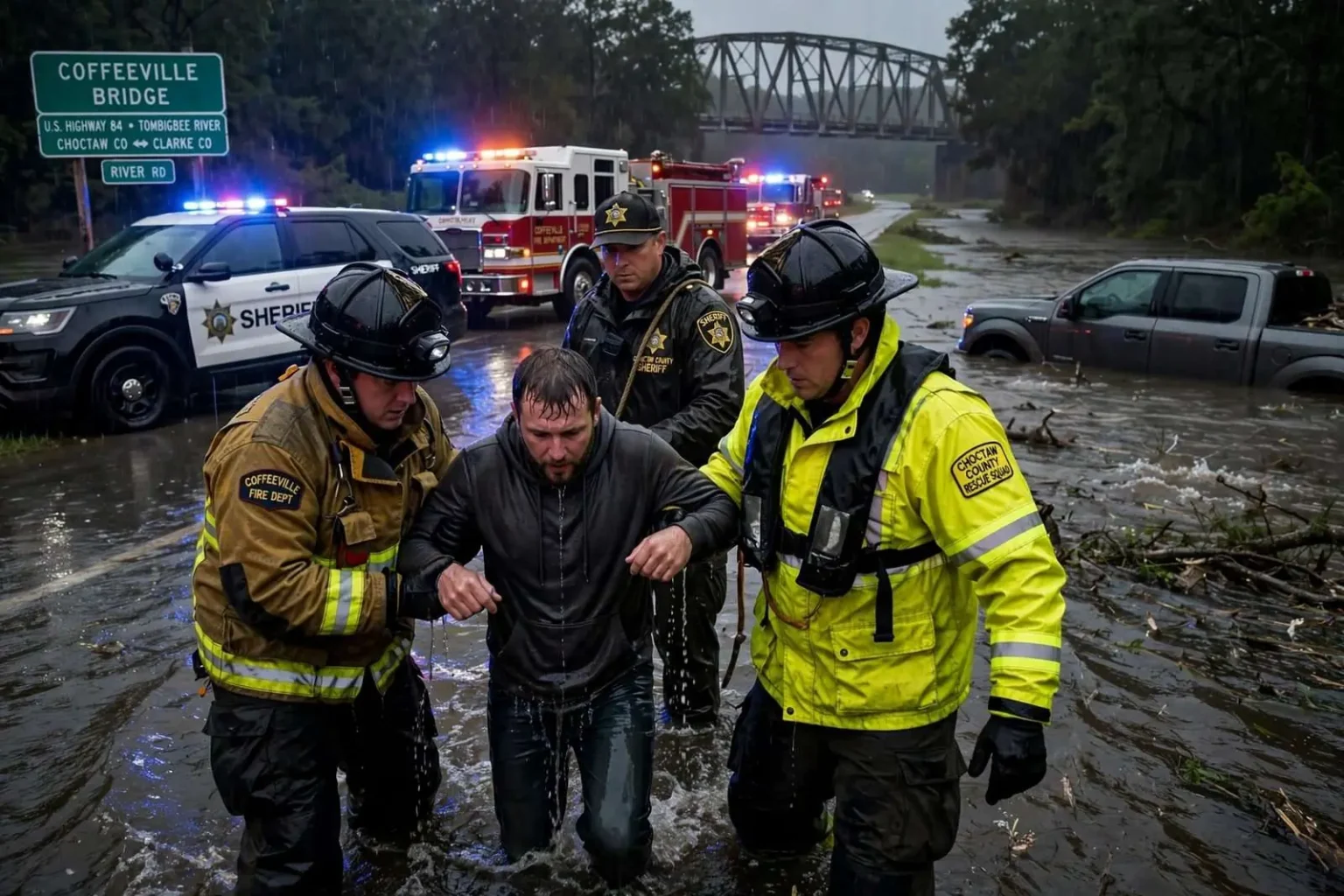
CHOCTAW COUNTY, Ala. — Rescue crews pulled a driver to safety Thursday evening after his truck became stranded in floodwaters near the Coffeeville Bridge, in an incident that highlighted the dangers rising water poses across the region. The rescue happened on River Road around 7:30 p.m., when the driver’s truck was caught in floodwaters close to the bridge that spans the Tombigbee River.
According to responders, the Coffeeville Fire Department, the Choctaw County Rescue Squad, and Choctaw County sheriff’s deputies all responded to the scene. Working together, the crews reached the stranded motorist and pulled him from the water to safety. The man was rescued without injury, a fortunate outcome given how quickly flood conditions can turn deadly for anyone caught in or around moving water.
The Coffeeville Bridge carries U.S. Highway 84 across the Tombigbee River, connecting Choctaw County on the west bank with Clarke County on the east. The river is one of the major waterways of west Alabama, and heavy rain anywhere in its large drainage basin can push water levels up along its banks in a matter of hours. Roads that run close to the river, including the River Road area where the truck became stranded, are among the first places in the county to flood when the Tombigbee and its tributaries rise.
Thursday evening’s rescue underscored the dangers of rising water across the region. Crews at the scene urged drivers to avoid flooded roadways entirely and never attempt to drive through moving water, repeating the safety message that emergency agencies across Alabama emphasize during every period of heavy rain: if a road is covered with water, turn around and find another route.
Why floodwater rescues are so dangerous
Floodwater rescues like Thursday’s are among the most hazardous operations that volunteer fire departments and rescue squads are asked to perform. Water moving across a road can hide a washed-out surface, and even relatively shallow moving water carries surprising force. Safety agencies have long warned that it takes only about a foot of moving water to carry away many passenger vehicles, and drivers frequently underestimate both the depth of water on a roadway and the strength of the current beneath it.
Darkness adds another layer of danger, and the Coffeeville rescue came after nightfall. A flooded stretch of road that is easy to judge in daylight can be nearly impossible to assess at 7:30 in the evening, when the water’s surface, depth, and current are all hidden from view. Responders arriving on the scene must account for their own safety before reaching a stranded driver, using boats or wading teams secured by lines, and coordinating among multiple agencies so that no rescuer is exposed to the current without backup.
The multi-agency response in Choctaw County reflects how these calls work in rural Alabama. A small county like Choctaw does not have a single large emergency service standing by for water rescues; instead, the Coffeeville Fire Department, the county rescue squad, and sheriff’s deputies combine their training and equipment. Volunteer firefighters and rescue squad members train periodically on swiftwater and flood response, and mutual aid among neighboring departments is a standard part of the plan when rising water threatens a community.
Residents of Choctaw County know the pattern well. Low-lying roads near the Tombigbee River and its tributaries flood regularly during periods of heavy rain, and the county has a long history of high-water events along its river roads. The area around Coffeeville, the county’s largest town, sits near the river’s west bank, and the bridge landing area has long been a reference point for water levels in the community.
Emergency officials across south Alabama repeat the same guidance every time heavy rain threatens: never drive around barricades, never drive through standing or moving water, and never assume that a familiar road is safe just because it usually is. The phrase most often used — “turn around, don’t drown” — is a simple directive aimed at preventing exactly the kind of situation that played out near the Coffeeville Bridge. Most flood deaths involving vehicles happen when drivers attempt to cross a flooded roadway rather than take a longer route around it.
The danger is compounded by how quickly conditions change. A road that is merely wet when a driver sets out can be flooded twenty minutes later if a storm cell stalls over the area or if water released upstream arrives downstream. Along the Tombigbee, water levels respond to rainfall across a wide swath of west Alabama and northeast Mississippi, which means a river road can flood even when little rain has fallen locally. Drivers near river crossings are advised to pay attention to forecasts, warnings, and any closure notices posted by county road departments.
For the driver rescued Thursday, the outcome was the best available: a safe extraction and no injuries. Responders did not release the man’s name or details about his condition beyond confirming he was unhurt. It was not clear from initial reports whether any charges or citations would be considered, and officials’ focus remained on the rescue itself and on getting the broader warning out to the public.
What to do when roads flood
Emergency managers recommend a few basic steps that apply to every driver in flood-prone west Alabama. First, check conditions before traveling in heavy rain, especially on roads near rivers, creeks, and low-water crossings. Second, respect every barricade and closure sign — they are placed by people who have seen the road at its worst. Third, if water is across the road at any depth, choose another route; the minutes lost to a detour are never comparable to the risk of a vehicle being swept away. Finally, if a vehicle does stall in floodwater, abandon it if it is safe to do so and move to higher ground rather than waiting inside for rescue.
Passengers and pedestrians face the same risks. Moving water that can push a truck off a road can easily knock an adult off their feet, which is why responders also warn against walking or wading into flooded areas to check on property. Residents who are concerned about a neighbor during a flood should call for trained help rather than attempting a rescue themselves, giving fire departments and rescue squads the chance to respond with the right equipment.
Thursday’s rescue near the Coffeeville Bridge ended without injury, but emergency crews in Choctaw County and across the region emphasize that the outcome depends on early calls, quick response, and no small amount of luck. Drivers who stay out of flooded roads take the luck out of the equation entirely, and that is the message crews said they want every motorist in the region to remember the next time water covers the roadway.
As rain continued to move through the region, responders encouraged residents to monitor local weather information and to report flooded roads to county authorities so that closures can be posted. The coordinated effort by the Coffeeville Fire Department, the Choctaw County Rescue Squad, and Choctaw County deputies brought one driver home safely, and crews hope the story convinces others to keep their vehicles — and themselves — out of the water in the first place.
Choctaw County sits in Alabama’s southwestern corner, a rural county of small communities where the Tombigbee River defines much of the landscape and much of the local geography of risk. Coffeeville, the county seat’s neighbor to the north, lies near the point where U.S. Highway 84 crosses the river, and the bridge landing has been a landmark for generations of travelers moving between the Black Belt and the coastal plain. When heavy rain falls across the region, the roads nearest the river — including the River Road corridor — are the first to go under, and they are the stretches local emergency agencies watch most closely.
Water rescues demand preparation that few other calls require. Crews responding to a vehicle in floodwater must size up the current, establish a downstream safety position in case anyone is swept past the point of the rescue, and deploy boats or wading teams only after securing themselves to shore or to each other. The Coffeeville Fire Department and the Choctaw County Rescue Squad train for these scenarios, and sheriff’s deputies on the scene typically handle traffic control, communications, and coordination with the family of the person being rescued. The fact that the man was pulled out without injury speaks to how that coordination is supposed to work when every minute matters.
The response also illustrates the reality of rural emergency services in Alabama. A single department often cannot field the boats, ropes, trained swimmers, and command structure that a water rescue requires, so calls like Thursday’s draw on several agencies at once. Mutual aid agreements mean that neighboring departments can be activated quickly, and in Choctaw County the volunteer-based structure of fire and rescue services makes that cooperation not just helpful but essential. Residents who serve with these departments train on their own time to be ready for exactly the kind of evening call that came in near the Coffeeville Bridge.
Regional context: rivers, roads, and rising water
The Tombigbee River drains a vast area of northeast Mississippi and west Alabama, and its levels near Coffeeville respond to rain that may have fallen a hundred miles upstream. That dynamic means flood risk along the river does not track local rainfall alone. During widespread rain events, water arriving from upstream can keep roads flooded for days after local skies clear, and county road departments in Choctaw, Clarke, and Washington counties routinely post closures on low-lying routes until levels recede.
Safety officials use a simple rule of thumb when they talk to the public about flooded roads: if you cannot see the pavement, you cannot know what is under the water. The surface may hide a collapsed shoulder, a washed-out culvert, or debris carried downstream, and the current at even modest depth exerts force that most drivers have never experienced. Vehicles weigh less in water, and buoyancy reduces the grip a truck’s tires have on the road surface well before the water reaches the door line. Once a vehicle begins to move, getting out quickly — through a window if necessary — offers the best chance of reaching safety on foot.
For now, crews in Choctaw County are treating Thursday’s rescue as both a success and a warning. The man near the Coffeeville Bridge survived unharmed because responders arrived in force and acted quickly, but the same circumstances on a road farther from town, or a call that comes in during heavier weather, could easily end differently. The guidance from the agencies involved remains what it has always been: stay out of flooded roadways, never test moving water with a vehicle, and let trained crews handle any rescue that becomes necessary.