Clarke County Raises Jail Housing Rates as Choctaw County Nears the End of a $420,000-a-Year Arrangement
The Clarke County Commission approved new inmate housing rates Tuesday, raising in-county municipal rates to $25 a day and out-of-county rates to $28. Choctaw County, which has used the jail since 2019, pays $45 per inmate per day.
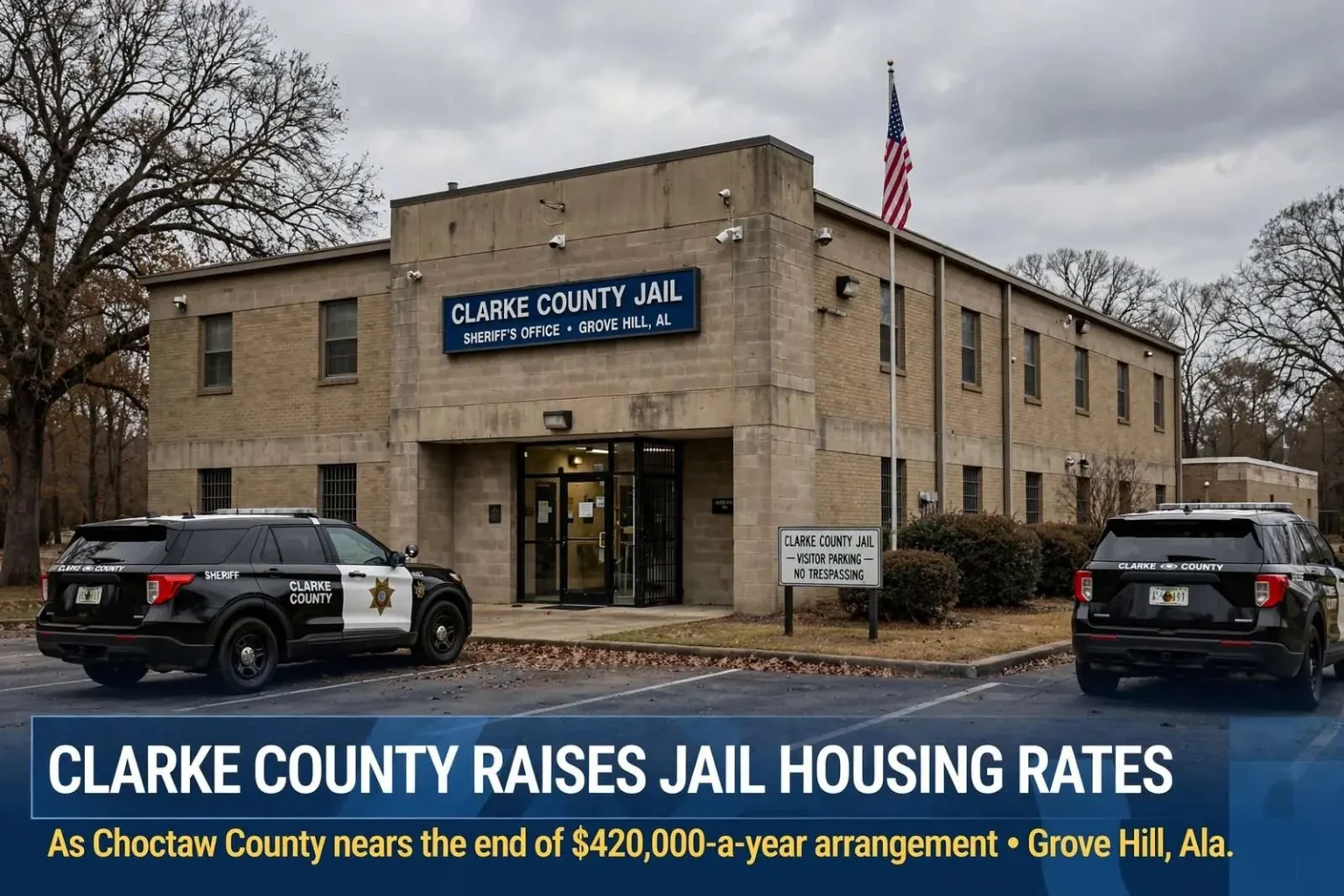
GROVE HILL, Ala. — The Clarke County Commission approved new rate schedules Tuesday for housing inmates from municipalities inside and outside the county, raising daily charges modestly across every category.
Rates increased to $25 per inmate per day, from $24.50, for the municipalities of Grove Hill, Jackson, Thomasville, Fulton and Coffeeville.
For municipalities outside Clarke County — Butler, Gilbertown and Pennington in Choctaw County, and McIntosh in Washington County — the rate rose to $28 per day from $27.
Choctaw County inmates cost $45 per day to house, which Clarke County Sheriff DeWayne Smith said is a standard agreement among surrounding county sheriffs.
Municipal Versus County Inmates
The tiered rate structure reflects a distinction that shapes how jails in Alabama operate. Municipal inmates are charged with misdemeanors; county inmates are charged with felonies.
That difference matters for length of stay. Misdemeanor cases move through municipal court relatively quickly, and municipal inmates typically occupy a bed for days or weeks. Felony cases move through district court, grand jury proceedings and circuit court, a process that routinely takes months and sometimes considerably longer. A county inmate can occupy a bed for a year or more awaiting trial.
At last count, the Clarke County Jail was housing 178 inmates, according to Smith.
Why Choctaw County Pays $45
The largest single line in the rate structure has a specific history behind it.
The Choctaw County Sheriff’s Office has used the Clarke County Jail since its own jail was closed in 2019 because of safety issues. Ground was broken for a new Choctaw County jail and construction started in July 2025.
Smith said the new jail is expected to be completed in six months, though he did not know whether that would mean fully equipped and functioning.
A spokesperson for the Choctaw County Sheriff’s Office said the county has spent $420,000 a year housing inmates in other counties.
That figure is worth sitting with. It represents nearly seven years of payments — well over $2 million — that a county of roughly 12,000 people has spent renting jail beds from neighbors because its own facility could not safely be used.
The Economics of a County Jail
County jails in Alabama occupy an unusual financial position. They are legally required, operationally expensive, and largely invisible in public budgeting until something forces attention onto them.
The cost of operating a jail is dominated by staffing rather than by the number of people held. A jail must be staffed around the clock at levels determined by the facility’s physical configuration and its licensed capacity, not by how many beds are filled on a given night. Correctional officers, medical services, meals, laundry, utilities, maintenance, transport and liability insurance make up a fixed base cost that changes only marginally with population.
That structure is why housing inmates for other jurisdictions is attractive to a county with available capacity. If a jail is already staffed for a given number of beds, an additional inmate adds only marginal cost — food, medical exposure and incremental supplies. The per-diem rate charged to another jurisdiction exceeds that marginal cost, and the difference offsets fixed operating expenses that county taxpayers would otherwise carry alone.
For the paying jurisdiction, the calculation runs the other way. Paying $45 a day per inmate is expensive relative to marginal cost, but it is far cheaper than building and staffing a facility — until the arrangement stretches across years, at which point the arithmetic changes.
The Increases Themselves
The increases approved Tuesday are small in percentage terms: roughly 2 percent for in-county municipalities and just under 4 percent for out-of-county municipalities.
Those adjustments track the reality that jail operating costs do not hold still. Correctional officer wages, inmate medical care, food service and utilities all rise, and inmate medical costs in particular have proven difficult for county jails to control. A county that does not periodically adjust its per-diem rates ends up subsidizing other jurisdictions’ detention costs out of its own general fund.
For the municipalities paying the rates, the increase translates to modest annual amounts. A town holding an average of two municipal inmates would see its annual cost rise by roughly $365 at the new in-county rate.
A 178-Inmate Population in Context
Clarke County’s jail population of 178 is substantial for a county of roughly 22,000 residents, and it reflects the facility’s role as a regional detention resource rather than solely a county lockup.
That population includes county felony inmates, municipal misdemeanor inmates from five Clarke County towns, municipal inmates from four towns in two neighboring counties, and Choctaw County’s county-level inmates. The jail is, in effect, operating as a multi-jurisdictional facility without being formally organized as one.
Regional jail arrangements of this kind are common in rural Alabama, where individual counties lack the population base to justify modern detention facilities of their own. They work well when capacity is available and become difficult when it is not — a jail near capacity has limited ability to accept outside inmates, and the jurisdictions that depend on it can find themselves without options.
What the New Choctaw County Jail Changes
Completion of the new Choctaw County jail will alter the arrangement in both directions.
For Choctaw County, it ends an annual $420,000 outlay and returns control of its detainee population, along with the transport burden that comes with housing inmates in another county — every court appearance requires a round trip.
For Clarke County, it means the loss of the revenue associated with Choctaw County’s inmates and the freeing of the beds they occupy. Whether that is a net positive depends on whether Clarke County needs the capacity for its own population and on how significant the per-diem revenue has been to the sheriff’s budget.
Smith’s caution — that a six-month completion estimate does not necessarily mean a fully equipped and functioning facility — reflects a common gap in detention construction. A jail requires more than a finished building: staffing must be hired and trained, systems certified, policies established and inspections passed before inmates can be housed.
What Comes Next
The new rates take effect under the schedules approved Tuesday. The commission handled the item alongside other business including the fiscal-year 2027 budget and a new solid waste hauling contract.
South Alabama News will report on the opening of the new Choctaw County jail and its effect on regional detention arrangements.