
Crypto Scam Losses Surging Across Alabama, Better Business Bureau Warns
Alabama crypto scam losses jumped from about $12K to over $120K in two years, the Better Business Bureau says. Here are the red flags to watch.
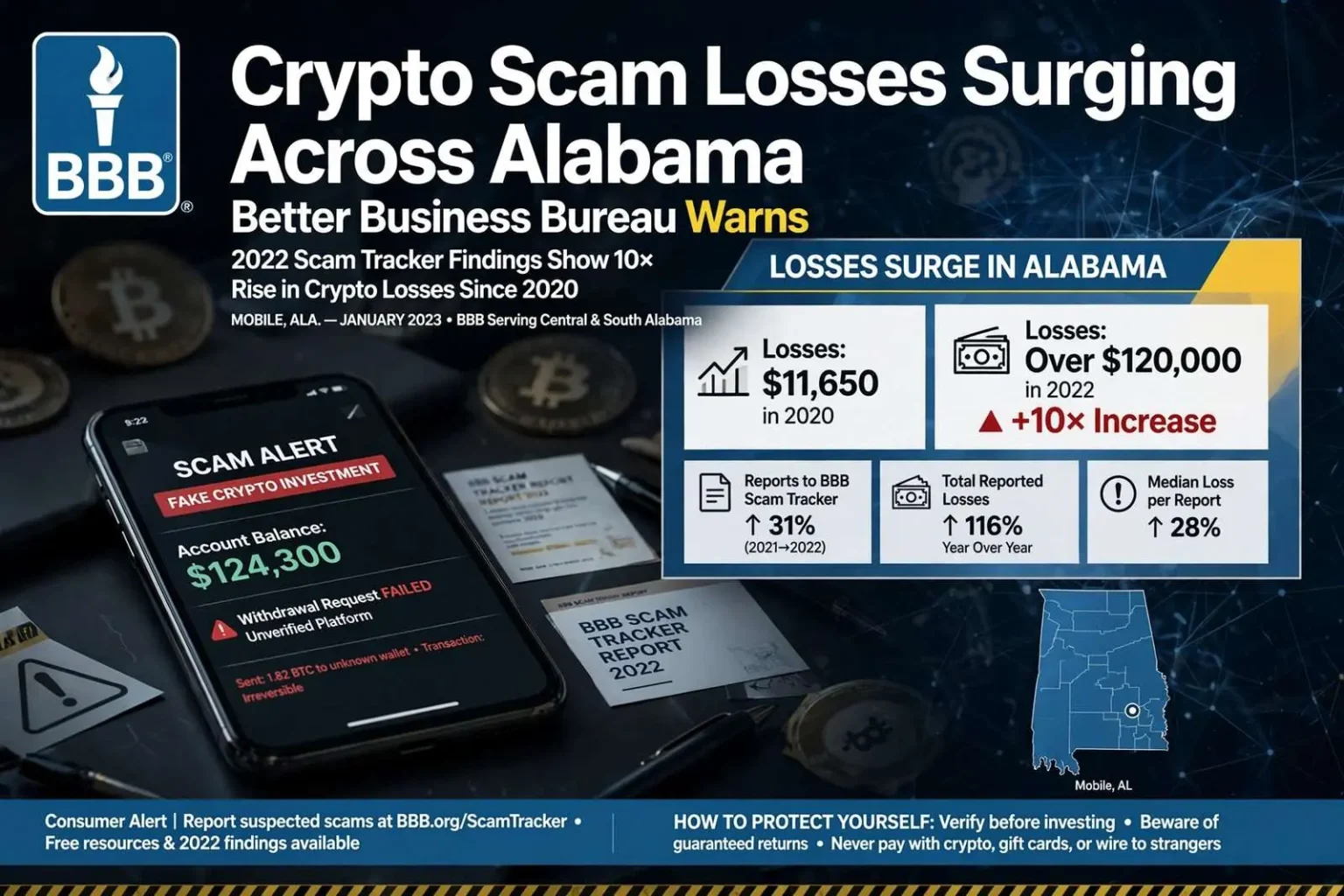
MOBILE, Ala. — Cryptocurrency scams drove the biggest jump in consumer losses of any fraud category in Alabama, according to the Better Business Bureau Serving Central & South Alabama, which shared its 2022 Scam Tracker findings in January 2023.
Monde Donaldson, vice president of the BBB Educational Foundation, said monetary losses reported from crypto scams climbed from $11,650 in 2020 to more than $120,000 in 2022 — a tenfold rise over two years.
The trajectory tracks a national phenomenon. Cryptocurrency moved from a niche investment to a mainstream topic over those same two years, with coin prices soaring in 2021 and ads for crypto trading appearing across television, sports venues and social media. Fraudsters followed the money and the hype, adapting schemes as old as confidence games themselves into the new vocabulary of coins, wallets and exchanges. Alabama’s reported losses reflect what consumer protection agencies nationwide saw: victims drawn by promises of extraordinary returns, often young investors comfortable with digital payments and older adults approached through online channels they trusted.
The numbers behind the surge
Overall, reports to the BBB’s Scam Tracker rose 31% from 2021 to 2022. Donaldson cautioned that a report reflects a complaint, not necessarily a completed rip-off. Even so, the money at stake grew quickly: total reported losses jumped 116% year over year, and the median loss per report rose 28%.
The distinction Donaldson draws matters for anyone reading the data. Scam Tracker collects reports of attempted fraud as well as successful fraud, and a consumer who spots a con before sending money is counted alongside one who lost their savings. That makes the raw report count a measure of exposure rather than harm — but it also makes the dollar figures more alarming, because those grew even faster than the reports did. More Alabamians were being targeted, and those who fell for the schemes were losing larger amounts on average.
The BBB said most scams now reach victims digitally, arriving by text message, email or social media rather than in person.
That shift marks one of the defining changes in the fraud landscape of recent years. Where a scam once required a phone call or a doorstep visit, modern schemes arrive at scale — thousands of texts, spoofed emails and social media messages distributed automatically, each one costing the fraudster almost nothing. The internet also lets con artists impersonate institutions convincingly, copying the logos of real banks, retailers and government agencies into fake websites designed to harvest credentials and payments.
How to spot the red flags
Danger signs range from the payment methods a supposed business demands to sloppy grammar and too-good-to-be-true pitches — particularly any investment promoted as no-risk with guaranteed returns, Donaldson said.
“The best way to protect yourself from falling victim to any scam is to know what scams are out there, how they work, and what the red flags are so you can identify fraudulent offerings prior to completing a transaction,” she said.
The crypto-specific warning signs have become familiar to consumer educators. A stranger online who strikes up a friendship or romance and then mentions a profitable trading platform. An “investment manager” who guarantees returns no legitimate market can promise. Pressure to move money quickly, or to switch conversations to encrypted messaging apps where the pitch cannot be interrupted. Websites that show dazzling account balances growing daily — balances that turn out to be entirely fictional when the victim tries to withdraw. Legitimate investments carry risk, are registered with regulators, and never require payment in gift cards, wire transfers or coins sent to a personal wallet address.
The BBB maintains a digital library breaking down common types of fraud, available around the clock on its website, where consumers can also file a report through its Scam Tracker tool.
Why the Reports Matter
Each report to Scam Tracker does double duty: it documents an individual’s experience and it feeds a public map of active schemes that other consumers can check before they engage. When multiple reports describe the same fake website or the same phone number, patterns emerge quickly, and the BBB can issue alerts while the scheme is still circulating. Officials emphasize that reporting an attempted scam is worthwhile even when no money was lost, because the attempts themselves reveal what is circulating in a community.
For victims who have already lost money, the outlook is sobering. Crypto transactions are irreversible, and recovery of funds sent to a fraudster’s wallet is rare. That reality is why educators stress prevention — the minutes spent verifying a company’s legitimacy through the BBB, state regulators or a simple search for the scam’s signature details are worth more than any after-the-fact remedy.
The Local Role of the BBB
The Better Business Bureau serving central and south Alabama covers a territory that includes Birmingham, Montgomery and the Gulf Coast communities, offering accreditation reviews of businesses, dispute resolution between consumers and companies, and free consumer education. Its Educational Foundation extends that mission into classrooms, senior centers and community groups, where volunteers teach the warning signs of fraud to the audiences most frequently targeted — a job that has grown as scams have shifted from the phone to the pocket.
The tenfold rise in crypto losses the 2022 data documented is, in that sense, both a warning and a call to attention. Fraud follows whatever is new and poorly understood, and as digital assets remain a part of the financial landscape, consumer educators like Donaldson expect the schemes to keep evolving alongside them. Their advice remains the same in every version: slow down, verify, and remember that anyone promising guaranteed riches is not offering an investment but an exit — with the consumer’s money headed through it.
The Most Common Crypto Schemes of the Era
Consumer agencies broke the crypto fraud wave into a handful of recurring patterns, each worth knowing by name. The investment scam was the most costly: a slick website or app shows steady, guaranteed growth, and early small withdrawals are even honored to build trust before the victim deposits their life savings and the platform vanishes. The romance-investment hybrid — sometimes called “pig butchering” by investigators — combines a fabricated personal relationship with the investment pitch, keeping the target engaged for weeks or months before the financial ask arrives.
Impersonation scams adapted the same technology to crypto. Fraudsters posing as government agencies, utility companies or tech support demanded payment in Bitcoin or gift cards convertible to it, exploiting the irreversible nature of crypto payments as a feature. Job scams offered work-from-home positions that began with the “employee” paying for equipment or training in cryptocurrency. And fake giveaways promised to multiply any coins sent to a wallet address, a scheme as old as chain letters wearing digital clothing.
What united them was the payment channel. Crypto’s combination of speed, irreversibility and distance from traditional banking made it the preferred rail for fraudsters, which is precisely why consumer agencies began tracking it as its own category rather than folding it into the older fraud families it borrowed from.
Who Gets Targeted
The stereotype of the scam victim as isolated and elderly has not held up against the data. Younger consumers, raised on digital payments and social media, report losses at high rates, particularly to online investment and job schemes. Older adults remain heavily targeted, especially through impersonation and romance fraud, and they tend to lose more per incident because their savings are larger. Educators now teach the same fundamentals across age groups: no legitimate business demands payment by crypto, gift cards or wire transfer; no investment is guaranteed; and any stranger who steers the conversation toward money is not a friend, however long the correspondence has run.
Families can help by keeping the conversation open — asking parents and grandparents about unusual online contacts, and letting them know that falling for a scam is nothing to be ashamed of, since shame is exactly what keeps victims from reporting while schemes continue to spread. The BBB’s message is that every report, embarrassing or not, helps warn the next person before the transaction is completed rather than after.
Checking Before You Pay
Consumer educators recommend a short checklist before any online payment or investment. Search the company’s name alongside words like “complaint,” “review” and “scam.” Verify that an investment platform is registered with state securities regulators or federal agencies, something a legitimate firm will confirm without offense. Be suspicious of any contact that arrives unsolicited, whatever platform it comes through, and treat urgency as a red flag in itself — real institutions do not demand payment within the hour. Finally, trust the arithmetic: returns that promise to beat the market by orders of magnitude every month are not investments, they are bait.
Alabama consumers can reach the BBB’s resources through its website year-round, where the Scam Tracker tool, the digital fraud library and the complaint process are all free to use. The organization’s message as the 2022 data rolled in was fundamentally optimistic: scams work by isolating their targets and rushing their decisions, and both of those advantages disappear when consumers know what to look for and talk to each other about what they are seeing. The tenfold increase in crypto losses showed how quickly a new technology could be weaponized against the public. The response, educators argue, is the same as it has always been — information, shared early, at scale.


