Customer killed in attempted carjacking at Frisco City convenience store
A customer was killed during an attempted carjacking at the Frisco City Food Mart in Monroe County, Alabama, on Thursday morning, Sheriff Tom Boatwright.
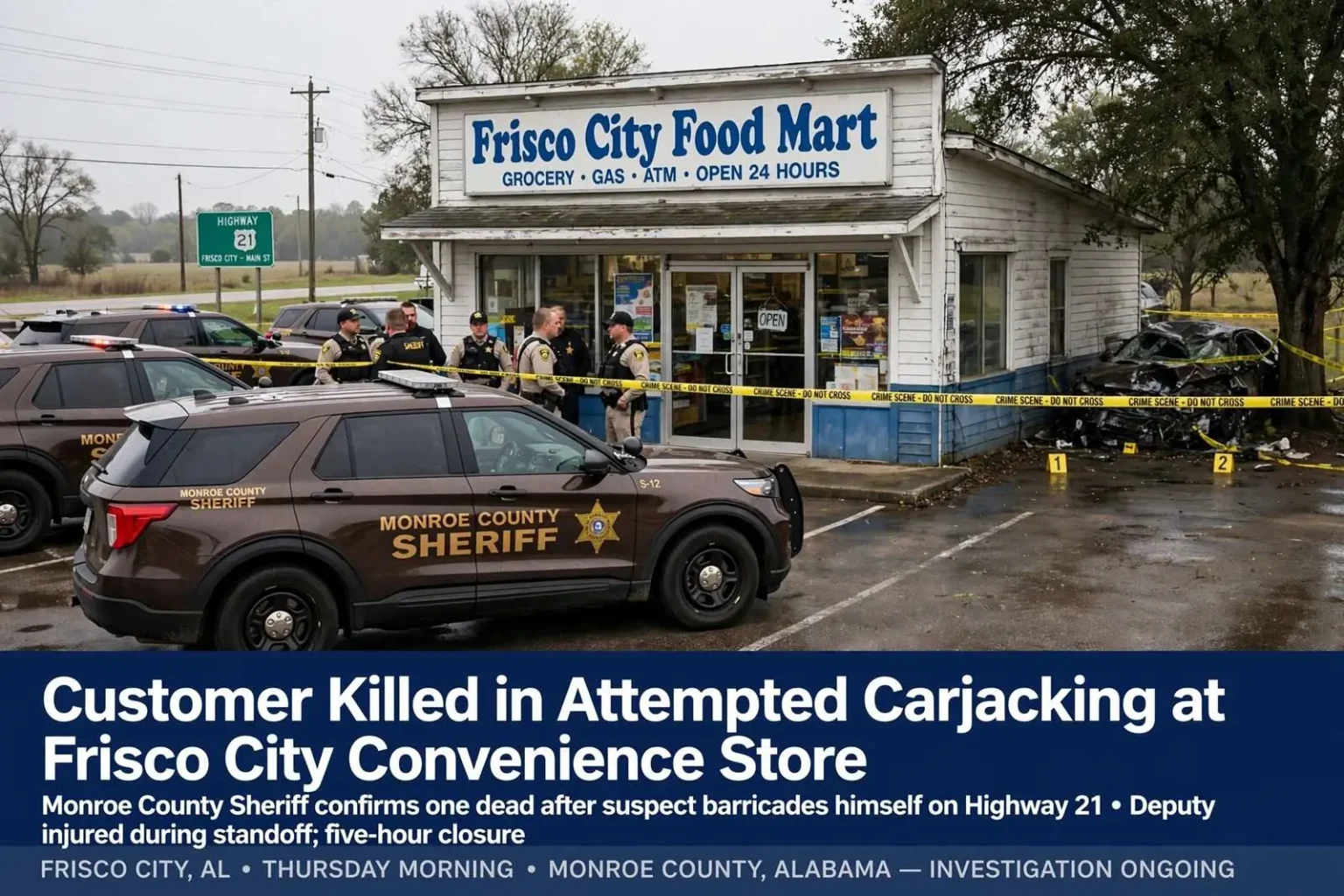
A customer at a Frisco City convenience store is dead following an attempted carjacking Thursday morning, according to Monroe County Sheriff Tom Boatwright. The violent sequence, which unfolded over roughly five hours in the heart of the small Monroe County town, began with a report of a man with a knife and ended with an exchange of gunfire between the suspect and deputies on Highway 21.
The Monroe County Sheriff’s Office said the first 911 call reported a man with a knife blocking the front entrance of the Frisco City Food Mart. As deputies were responding to that initial report, a second call came in indicating the situation had escalated: the suspect had carjacked a vehicle in the store’s parking lot.
Sheriff Boatwright said the suspect, Charles Dale — known locally as “Rat” — got into a customer’s car and fired a shot inside the vehicle, striking and killing the driver. The car then crashed into a tree behind the store, bringing the attempted carjacking to a fatal conclusion within minutes of the first emergency call.
Barricade and Standoff
Rather than flee on foot, the suspect then got into another vehicle in the parking lot and barricaded himself inside with a rifle, the sheriff said, transforming a fatal carjacking into an armed standoff at a busy intersection. Authorities said Dale fired at deputies as they arrived on the scene. One deputy broke a shoulder while taking cover from the gunfire.
Deputies returned fire, striking Dale twice. He was expected to survive his injuries, which Boatwright said were to his eye and shoulder. Once the immediate threat was contained, deputies held the scene for the investigation that followed any officer-involved shooting, securing the store, the crashed vehicle behind it, and the lot where the standoff occurred.
Crime scene tape and a heavy law enforcement presence kept Highway 21 in the heart of Frisco City closed for nearly five hours. The road reopened around 2 p.m. Thursday, restoring the main artery through a town where the highway doubles as the primary commercial corridor and any closure reroutes traffic for miles through rural Monroe County.
A Small Town Confronts Violence
Frisco City, a town of roughly 1,400 residents in the western part of Monroe County, is the kind of community where a convenience store shooting draws the entire town to a standstill. Highway 21 is the road through town, and the Frisco City Food Mart is one of the stops residents rely on daily. News of the morning’s events spread quickly, with residents watching deputies, investigators and emergency vehicles take over the intersection through the late morning hours.
The Monroe County Sheriff’s Office serves a largely rural county whose seat, Monroeville, sits to the east. Deputies there handle long stretches of two-lane highway and small towns where a single incident can consume the department’s resources for a day. Thursday’s response drew deputies to a scene that required them to manage three distinct crime scenes at once: the store entrance where the knife report originated, the crashed car behind the building, and the vehicle where the suspect barricaded himself with a rifle.
Sheriff Points to Mental Health System
In the aftermath, Boatwright said Dale had been in and out of mental health facilities over the years and was known to local law enforcement. The sheriff called the case “a prime example of the failure of the mental health system in Alabama,” a blunt assessment of how the state’s system handles people who cycle repeatedly between treatment, the streets and encounters with deputies.
Alabama has struggled for years with the capacity of its mental health infrastructure. The state’s network of community mental health centers operates with limited funding, and the reduction of long-term psychiatric beds over recent decades has left local law enforcement as the first — and often only — responder when a person in crisis escalates. Sheriffs in rural counties frequently describe holding people with untreated mental illness in county jails because no treatment bed is available, and incidents like Thursday’s turn that system-level failure into a tragedy on a town street.
For Monroe County, the case raises the questions that follow such events across the state: how a person known to law enforcement, with a documented history of mental health treatment, came to be blocking a store entrance with a knife that morning, and what intervention might have prevented the chain of events that killed a customer on an ordinary errand.
The Investigation Ahead
The death of the customer and the shooting of Dale by deputies will both be the subject of investigations in the days ahead. Officer-involved shootings in Alabama are typically reviewed by outside agencies, with the State Bureau of Investigation assisting local sheriffs in reconstructing the sequence of gunfire, and prosecutors ultimately determining whether the use of force was justified. Investigators will collect evidence from the crashed vehicle, the car where Dale barricaded himself, and the accounts of witnesses who were at the Food Mart when the incident began.
Authorities have not released the name of the customer who was killed, pending notification of family. The identity of the victim, and the circumstances that put them in the parking lot at the moment Dale made his move, will likely emerge as the investigation progresses.
What Comes Next for Frisco City
For residents of Frisco City, Thursday’s events will be measured in more than hours. The closure of Highway 21 for nearly five hours cut the town in two, and the images of crime scene tape across the main intersection will linger in a community unaccustomed to fatal violence at its busiest corner. The Food Mart’s parking lot, the tree behind the store, and the stretch of highway where deputies and a suspect exchanged fire will remain part of the town’s recent memory long after the tape comes down.
Sheriff Boatwright’s department will also bear the aftermath. The deputy who broke a shoulder while taking cover is expected to recover, but the department’s response — arriving on a knife report and within minutes facing rifle fire in a crowded parking lot — will be examined in the reviews that follow. Boatwright’s candid comments about the mental health system signal that his office sees the case not as an isolated act of violence but as the predictable result of a system that has failed to treat people like Dale before their crises become emergencies.
As the investigation continues, the town awaits answers about both the customer who died and the sequence of failures that brought Charles Dale to the front door of the Frisco City Food Mart on a Thursday morning.
The timeline of the morning shows how quickly an ordinary disturbance call became a fatal encounter. A report of a man with a knife blocking a store entrance is the kind of call deputies answer routinely in small towns, where disputes outside a business are often resolved with a warning or an arrest for disorderly conduct. The second call — that the suspect had now taken a customer’s car — changed the nature of the response entirely, and by the time deputies reached the Food Mart, a driver was dead and the suspect was armed with a rifle rather than the knife that started it all.
Standoffs of this kind place small sheriff’s departments under immediate strain. A rural office must simultaneously hold a perimeter, evacuate bystanders, treat wounded deputies, coordinate with the county coroner for the deceased driver, and summon additional manpower, all while the suspect remains armed in a vehicle with clear lines of sight to the surrounding lot. That the exchange ended with Dale in custody and no additional casualties will be part of how the response is judged in the reviews that follow.
Carjacking Cases Under Alabama Law
The charges Dale would face in connection with Thursday’s events are among the most serious in Alabama’s criminal code. The theft of a vehicle by force is treated as first-degree robbery, a Class A felony, and the shooting death of the driver inside the vehicle opens the possibility of capital or felony murder charges depending on what prosecutors decide after the investigations conclude. Firing on deputies adds attempted murder counts on top of the homicide, and the rifle used in the barricade carries its own firearms charges for a person with Dale’s history of encounters with law enforcement.
Those determinations will wait on the evidence. Investigators will map the scene, recover the weapons involved, pull surveillance footage if the store or nearby businesses had cameras, and interview the witnesses who were in the parking lot or along Highway 21 when the gunfire started. The deputy-involved shooting will be reconstructed separately, with investigators documenting how many rounds were fired, where Dale was struck, and the sequence between his shots at deputies and the return fire that hit him twice.
Rural Monroe County and the Weight of a Morning
Monroe County’s communities are closely knit, and news of a fatal incident at a neighborhood store travels fast. Frisco City sits along the western edge of the county, with communities like Excel, Beatrice and Vredenburgh nearby, and residents across that corner of the county rely on the same handful of stores and the same stretch of highway for daily errands. A five-hour closure of the main road sends a visible message that something has gone badly wrong, and the sight of deputies working behind tape at the town’s central intersection drew steady attention from residents through the morning and into the afternoon.
The case also lands in the middle of an ongoing statewide conversation about mental health and public safety. Sheriffs across Alabama have become, by default, the front line of the state’s mental health crisis response, and Boatwright’s decision to describe Dale’s history publicly — the repeated stays in mental health facilities, the years known to local law enforcement — frames Thursday’s violence as the endpoint of a long, documented decline that the system did not interrupt. Whether that framing leads to any change in how Monroe County handles similar cases remains to be seen, but the sheriff’s message to state policymakers was unmistakable.
For now, the town’s attention turns to the victim’s family and to the deputy recovering from a broken shoulder, while investigators work through the evidence gathered during five hours behind crime scene tape on Highway 21.