Daphne’s Gold Mine Pawn joins statewide SAFER Together firearm-storage initiative for veterans in crisis
Gold Mine Pawn in Daphne is now offering free, voluntary firearm storage to veterans, first responders, and other community members through Alabama’s SAFER Together suicide-prevention initiative.
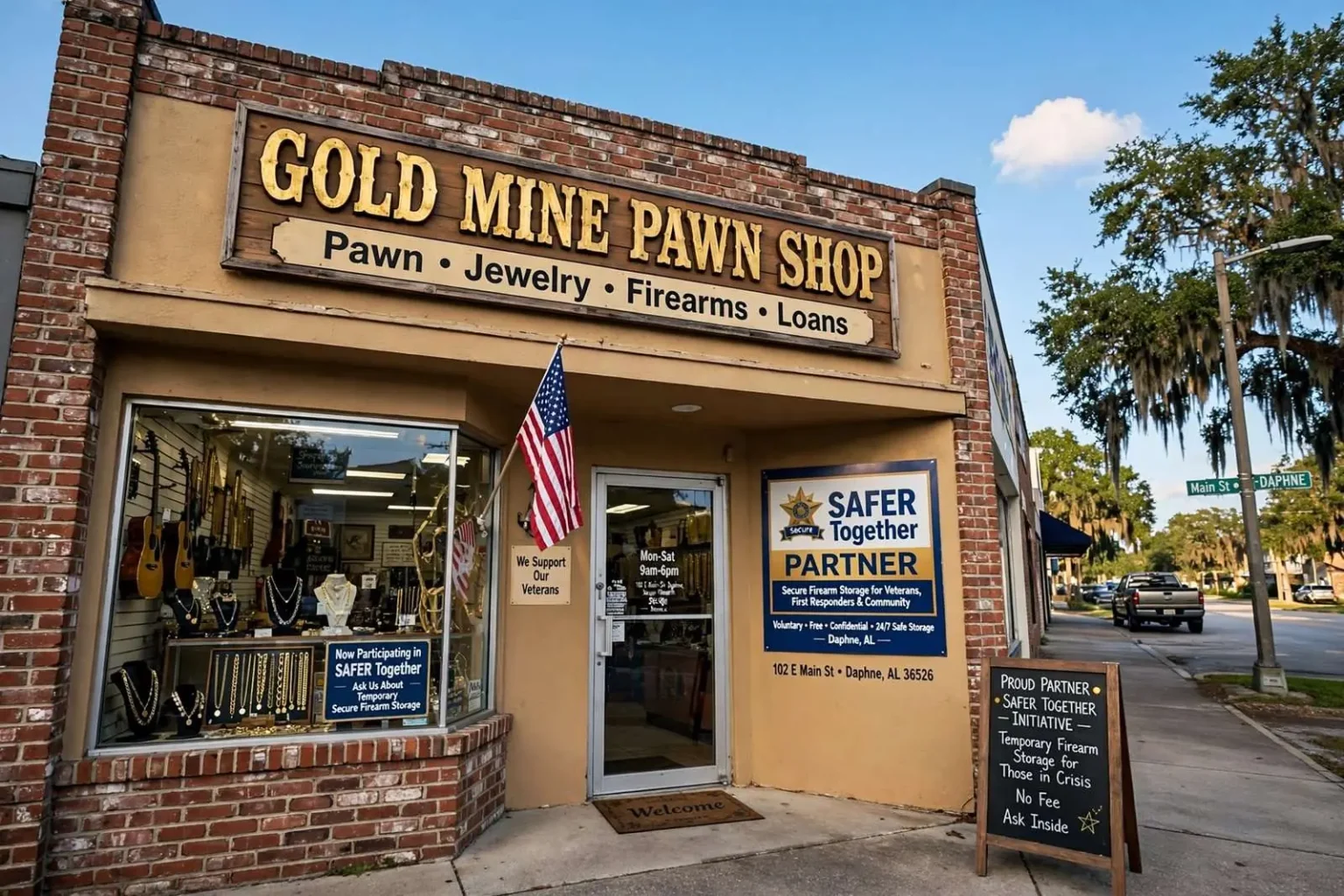
DAPHNE, Ala. — A Daphne pawn shop is now offering veterans, first responders, and other community members a place to temporarily store their firearms away from home, becoming the first business on the Eastern Shore to participate in a statewide suicide-prevention initiative known as SAFER Together.
Gold Mine Pawn Shop, owned by Thomas Hand, is the local participant in the program, which gives people a voluntary, secure place to leave a firearm in storage during a difficult stretch in their lives, with the option to retrieve it later when they feel the moment has passed. The firearm is locked into a safe by the owner, who keeps the only combination, and is released back to the same person on request.
Hand said the decision to join the program came directly out of conversations he has had with veterans and with first responders in the Daphne area about the kinds of crises that can lead a person, in a moment of despair, to act in a way they would not otherwise act. “There’s 21 to 22 veterans a day committing suicide in the United States,” Hand said, citing a number that has been used in public health discussions for years. “That’s a number that I couldn’t ignore.”
How the Firearm Storage Program Works
The mechanics of the program are deliberately simple. A person who wants to use the service brings their firearm to the shop, and a staff member walks them through a storage agreement. The firearm is then placed inside a safe at the shop, locked, and the customer keeps the only combination. The store does not retain a key or a copy of the code, and the firearm is not logged out to any third party.
When the customer is ready, they return to the shop, present identification, open the safe with their combination, and take the firearm home with them. There is no charge for the service, and no time limit is built into the agreement. The point of the program, as Hand described it, is to interrupt a moment of crisis by removing access to a method of harm — not to take ownership of the firearm, and not to require a court order or a medical certification to retrieve it later.
“If they feel like they if they have access to a gun at that point in time, they might do something that they would regret; this is somewhere they can store them,” Hand explained. Inside the safe, alongside the firearm, the shop places a folder of local and national resources for people in crisis, including a handwritten note from another veteran who has been in a similar situation. “I wanted to help the veterans as much as I could and hopefully prevent a bad situation or some type of tragedy from happening,” Hand said.
SAFER Together’s Statewide Reach
SAFER Together, the statewide initiative that Gold Mine Pawn has joined, was developed in response to data showing that veterans and first responders face elevated rates of suicide compared to the general population, and that firearms are the most common method used in those deaths. By offering a low-friction, low-stigma option to get a firearm out of the home temporarily, the program is meant to bridge a gap that many of the people it serves would not otherwise know how to navigate.
The program’s logic is the standard public-health logic of means restriction: in a moment of acute crisis, the availability of a highly lethal method is a significant risk factor, and reducing access to that method, even temporarily, can save a life. The combination of locked storage, voluntary participation, and the absence of any requirement that the customer explain themselves to a clinician or a court is what the program’s designers say makes it workable for people who might not otherwise seek help through a more formal channel.
SAFER Together operates by partnering local businesses — typically gun shops, pawn shops, and firearms retailers — with a network of suicide-prevention and crisis-intervention organizations that provide training, materials, and referrals. The participating businesses agree to host a safe, to follow the program’s storage-and-release protocol, and to provide the resource folder to each customer. The training, the folder, and the protocol are all designed to keep the customer in control of the firearm and to keep the program free of any feature that would deter a person in crisis from using it.
Alabama is one of several states that have developed firearm-storage programs of this kind in recent years, in many cases after sustained conversations with veterans’ groups, firearms retailers, and public-health researchers. The participation of firearms retailers in such programs is, in part, an effort to make sure the program reflects the culture of the community it serves, and that the storage option is offered in a setting that is familiar and non-stigmatizing to the people most likely to use it.
Daphne is one of the larger communities on the Eastern Shore of Mobile Bay, and the broader Eastern Shore has a long tradition of both veterans’ service and firearms ownership. Hand said his shop has served a wide cross-section of that community for years, and that the conversations he has had with customers gave him a clear sense of the demand for a service like SAFER Together. For Hand personally, the issue is one he has carried with him for a long time: he has known veterans who have come back from service changed in ways that are not always visible, and he has seen the kinds of crises that those changes can produce. The decision to host a safe in his shop, he said, is one he sees as consistent with the role a small business plays in a community like Daphne: not just a place to buy and sell, but a place where lives can be saved in a quiet way.
“If we can save one veteran’s life, or change his life or change his direction with this, absolutely it’s paid off,” he said.
Crisis Resources Provided at Every Safe
For anyone in crisis — whether or not they are a veteran, a first responder, or a customer of Gold Mine Pawn — the Suicide and Crisis Lifeline, reachable by dialing or texting 988, provides free, confidential, 24-hour support from trained counselors anywhere in the country. The Lifeline, which has been operational nationwide since 2022, can connect callers to local crisis services, to mobile-response teams where they exist, and to follow-up care in the days after a call.
The folder that Gold Mine Pawn places in its safe alongside the stored firearm includes 988 along with other local and national resources, so that a customer who uses the program has a clear next step if they want to talk to someone about what they are going through. Hand said the program is meant to work alongside the Lifeline, not in place of it: the safe buys time, the Lifeline offers help, and the customer keeps the combination that connects the two.
Anyone in Alabama who is struggling or in crisis can call or text 988 at any time. Veterans can press 1 after dialing 988 to reach the Veterans Crisis Line. The Eastern Shore community also has its own crisis resources, which the shop’s folder lists by name.
Gold Mine Pawn’s participation in SAFER Together is open to any community member who wants to use it, regardless of veteran or first-responder status, and the program’s storage and release procedures are the same for every customer. The shop is located in Daphne, on the Eastern Shore of Mobile Bay in Baldwin County.
What It Takes for a Business to Join
Joining SAFER Together is more than simply clearing a shelf for a safe. Participating businesses agree to a written storage protocol that is consistent across the program, and they receive training from the program’s organizers on how to handle the conversations that come up around the safe. The training is meant to help staff recognize the signs of acute crisis and respond without judgment.
The folder of resources that goes into the safe is, in most cases, the same across participating businesses in a state, with local additions where appropriate. For Alabama, the folder typically includes the 988 number, the Veterans Crisis Line options, and a short note from a veteran who has been in a similar situation — a feature Hand said he sees as the heart of the safe when a customer opens it.
For a small business, the day-to-day impact on operations is small. The safe sits behind the counter, and the only changes are the brief intake and release conversations when a customer brings a firearm in or picks it up. Hand said his staff had embraced the program quickly, and that the small changes to the routine of the shop had been well worth it for the chance to be part of a service that could keep a neighbor alive.
Research Behind Firearm Storage Programs
The research base for out-of-home firearm storage as a suicide-prevention tool draws on a long line of studies in the United States and abroad showing that means-restriction strategies reduce suicide rates during the period in which a method is made less available. The 988 Suicide and Crisis Lifeline, which has been operational nationwide since 2022, was rolled out in part on the understanding that crisis-call infrastructure and means-restriction programs work best when they reinforce each other: the Lifeline reduces the impulse to act, and programs like SAFER Together reduce the lethality of an impulse that does occur.
For veterans and first responders, the case is particularly pointed. Federal data have consistently shown elevated rates of suicide among veterans compared to the general adult population, and first-responder professions have been the subject of similar findings. Hand’s reference to “21 to 22 veterans a day” is a number that has been used in public discussion of the issue, including in materials published by federal veterans’ health agencies. The point of the program is not to argue about the broader question of firearms in American life; it is to give people who already own firearms a simple, voluntary option to get them out of the home when they need to.
SAFER Together and similar programs in other states do not require participants to be assessed by a clinician, to surrender their firearms permanently, or to take any other step they would not have chosen on their own. The model is built on the conviction that the people closest to the crisis are the ones in the best position to decide what to do about it, and that the right role for a program is to make the safer choice as easy as possible when they make it.
Hand said that, in his experience, most of the people who have used or talked to him about the safe are people in a moment of difficulty who wanted a pause button, and who intended to come back for the firearm when the difficulty had passed. The point of the program, he said, is to make sure that the pause button is there when it is needed, and that the moment after the pause is one in which help is available.