DAR Dedicates Historic Marker Honoring Tristan de Luna at Battleship Park
The Tristan de Luna DAR chapter dedicated a historic marker at Battleship Park honoring the Spanish explorer's 1559 Gulf Coast expedition.
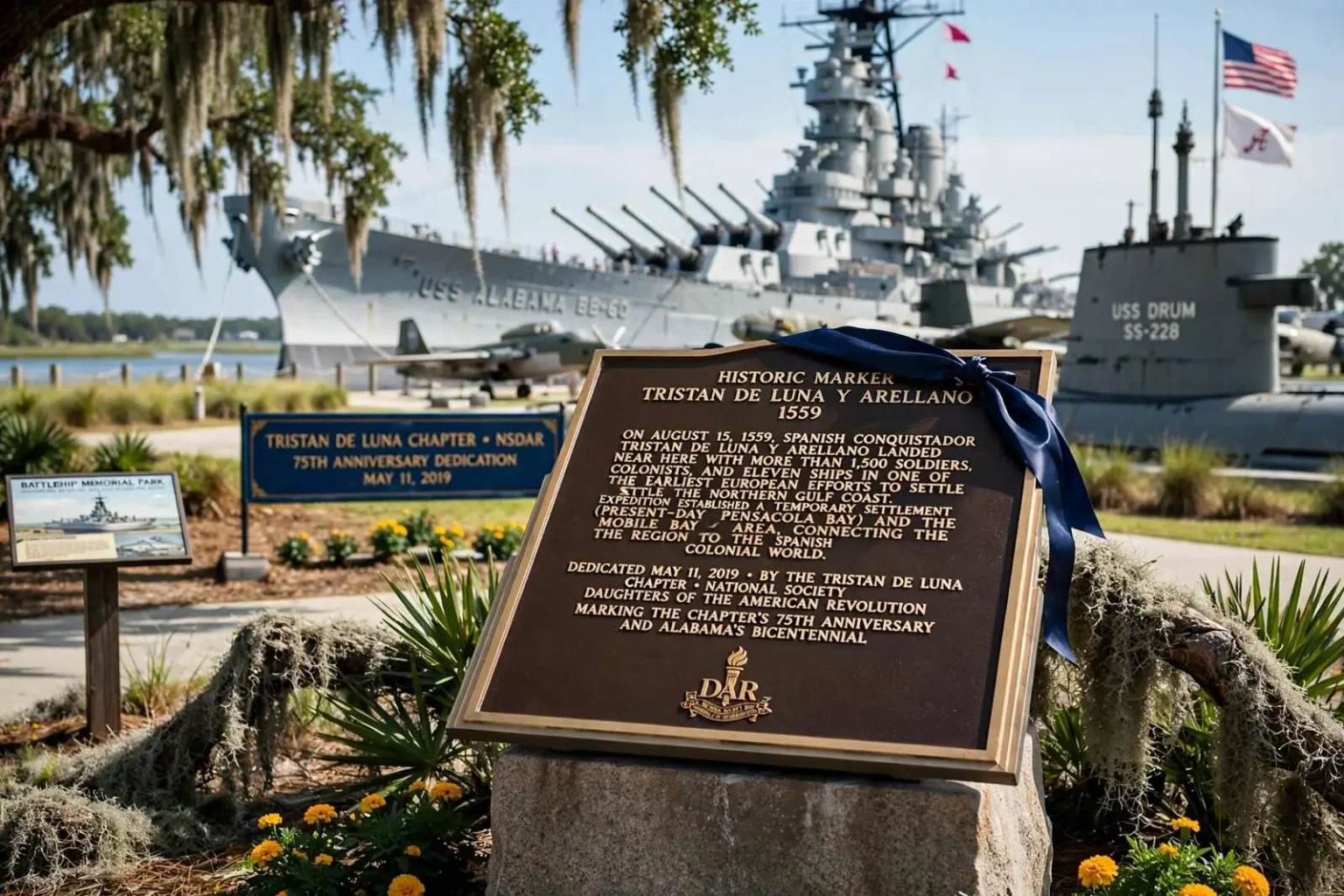
The Tristan de Luna Chapter of the National Society Daughters of the American Revolution marked its 75th anniversary with a gift to local history: a historic marker honoring the Spanish conquistador whose 1559 expedition helped open the northern Gulf Coast to European settlement. The dedication was set for May 11 at 9:30 a.m. at Battleship Park in Mobile, timed to the 200th bicentennial celebration of the State of Alabama. Mary Ruth Andrews of the DAR led the effort to place the marker, which now stands among the displays at the park as a permanent reminder that Mobile’s recorded story begins well before the American era.
For members of the chapter, the marker represents both an anniversary observance and a contribution to a broader civic effort. Across Alabama, bicentennial-era projects emphasized the moments that shaped the state long before statehood, and Gulf Coast historians have argued for decades that the Spanish expeditions of the sixteenth century belong at the front of that story. A marker at one of Mobile’s most visited sites puts that claim in front of the school groups, tourists and veterans’ organizations that pass through Battleship Park every day.
Historic markers of this kind are designed to endure, and the chapter’s choice of subject reflects how closely the region’s identity is tied to its colonial-era beginnings. The text of the marker directs attention to an expedition that predated the founding of Mobile by more than a century and connected the northern Gulf shore to the wider Spanish colonial world stretching from Mexico City to the Caribbean.
Who Was Tristan de Luna?
Tristan de Luna y Arellano was dispatched from New Spain — present-day Mexico — in 1559 with an expedition of more than 1,500 soldiers and colonists, along with horses and eleven ships, to establish a settlement on the northern shore of the Gulf of Mexico. The venture was part of Spain’s effort to secure and populate the Gulf Coast, which the crown regarded as a vulnerable flank of its empire and a possible route toward the interior of the continent.
Judging Mobile Bay a poor harbor, Luna sailed east to Ochuse, today’s Pensacola Bay, where his colonists established a temporary settlement. The choice illustrates how much weight sixteenth-century commanders placed on anchorage: a harbor that could shelter ships and unload supplies mattered as much to a colonial venture as the land itself. Even so, Luna’s connection to the Mobile Bay area remained central to the expedition’s story. He eventually returned to the Mobile Bay area near Bon Secour on the southeastern shore, where he had first landed, anchoring the expedition’s place in the history of what is now Alabama’s coastal county.
The Luna expedition is remembered today as one of the earliest serious European efforts to colonize the northern Gulf Coast, predating the more famous attempts of later decades and generations of permanent settlement that followed. For local historians, that distinction is the point of the marker: Mobile Bay’s colonial-era story does not begin with the French or the Americans, but with Spanish ships, soldiers and settlers who arrived more than four centuries ago and found both promise and hardship on these shores.
Why Battleship Park
Battleship Memorial Park, where the marker was dedicated, is one of the Gulf Coast’s most prominent heritage sites. The park preserves the battleship USS Alabama and the submarine USS Drum, along with aircraft, military hardware and memorials honoring veterans of every American war. Millions of visitors have walked its grounds since the battleship came home to Mobile Bay, and the park has long served as a gathering place for civic ceremonies, school field trips and reunions.
Placing a marker about sixteenth-century Spanish exploration inside a park best known for twentieth-century naval history makes a deliberate statement. It tells visitors that the same waters that carried the USS Alabama across the Pacific also carried Spanish ships centuries earlier, and that the military and maritime heritage of the Gulf Coast runs in a continuous line from the age of sail to the age of steel. For educators in Mobile and Baldwin counties, the marker adds a colonial-era stop to a site that already functions as an outdoor classroom.
The Bicentennial Connection
The dedication’s timing tied the marker to Alabama’s bicentennial, the statewide observance of the 200th anniversary of statehood. Communities across the state used the anniversary to invest in historical markers, restoration projects and educational programs, and the Gulf Coast’s contribution highlighted a simple but often overlooked fact: the region’s European history is older than the state itself by centuries, and older even than the territorial period that produced it.
Local historians have worked for years to highlight Mobile’s colonial-era story during the bicentennial era, pointing out that the city’s French colonial founding, its Spanish period and its early American years all rest on a foundation laid by explorers such as Luna. The DAR chapter’s marker gives that argument a physical presence. A traveler reading the plaque at Battleship Park encounters a timeline that reaches back before the United States, before Alabama, and before the maps that first gave names to Mobile Bay and its neighboring waters.
The bicentennial context also matters for the DAR chapter itself. Founded at the end of the nineteenth century, the National Society Daughters of the American Revolution describes its mission as promoting historic preservation, education and patriotism, and chapters across the country mark anniversaries, place monuments and sponsor educational awards. A bicentennial-era dedication allowed the local chapter to bind its own 75 years of service to the state’s 200-year milestone in a single ceremony.
A Chapter’s 75 Years of Work
Seventy-five years of continuous activity is a significant span for any civic organization. Over that period, the Tristan de Luna Chapter has carried on the DAR’s traditional work in the Mobile area: genealogical research, support for veterans, promotion of constitutional education and the placement of markers that preserve local memory. The chapter takes its name from the same figure honored by the new marker, making the dedication a natural capstone to its anniversary year.
Markers placed by lineage societies and civic groups form a quiet network of public history across Alabama. They stand at courthouses, churches, battlefields, parks and crossroads, recording events and people that might otherwise fade from general knowledge. Each one requires research, fundraising, permission and upkeep — work done largely by volunteers. The Luna marker is the product of that kind of sustained effort, led by Andrews and her fellow members, and it joins a documented record of the chapter’s public contributions to the city it calls home.
What the Marker Says About Mobile’s Place on the Gulf
The story the marker tells is one of geography as much as heroics. Mobile Bay sits at the mouth of the Mobile River system, which drains a vast interior watershed into the Gulf of Mexico. That position made the bay an obvious objective for any power seeking access to the interior of the Southeast, and it explains why so many expeditions and colonization schemes converged on these waters from the sixteenth century onward.
Luna’s judgment of the bay as a poor harbor, followed by his move east to Ochuse, shows how the physical character of the coast shaped decisions from the very beginning of its written history. Later colonizers reached similar conclusions and made their own calculations about where to build forts and towns. The eventual success of Mobile as a port city, centuries after Luna’s ships passed this way, came from the same advantages and drawbacks that the Spanish commander weighed in 1559.
Bon Secour, where Luna had first landed and to which he later returned, remains a name familiar to every resident of the Fort Morgan peninsula. The survival of that place-name across more than four centuries is itself a piece of living history, a linguistic footprint left by Spanish mariners on a coast that now draws millions of visitors each summer.
Preserving a Colonial Story for New Generations
For Mobile residents, the marker offers a small but tangible addition to the public landscape. A family visiting Battleship Park to tour the battleship can now stand a few steps from a summary of the region’s earliest recorded chapter, and a teacher leading a field trip can use the plaque to open a discussion of how European settlement came to the northern Gulf Coast. Historic markers work precisely this way: they put concise, well-researched history into the path of people who were not necessarily looking for it.
The dedication also reinforces the connection between Mobile and Pensacola. The two cities share an intertwined colonial past through the Luna expedition itself — Luna weighed the merits of both bays, and his colonists settled briefly at Ochuse before the venture’s later movements brought the story back to the Mobile Bay area. Regional historians on both sides of the state line have long treated the 1559 expedition as a shared Gulf Coast heritage rather than the property of any one modern city.
As the ceremony at Battleship Park made clear, the marker is both an act of preservation and an invitation. It asks everyone who reads it to look at Mobile Bay with a longer view — past the antebellum mansions and the shipyards, past the World War II heritage enshrined in the park itself, to a moment when Spanish ships stood off an unfamiliar shore and the written history of the Alabama coast began. The Tristan de Luna Chapter’s 75th-anniversary gift ensures that the invitation will remain standing at the water’s edge for decades to come.