Dauphin Island cat named Penny reunites with owner after 13-hour trip to Tennessee
A Dauphin Island cat named Penny was found more than 600 miles away in Tennessee. Her owner made a 13-hour round trip to bring her home.
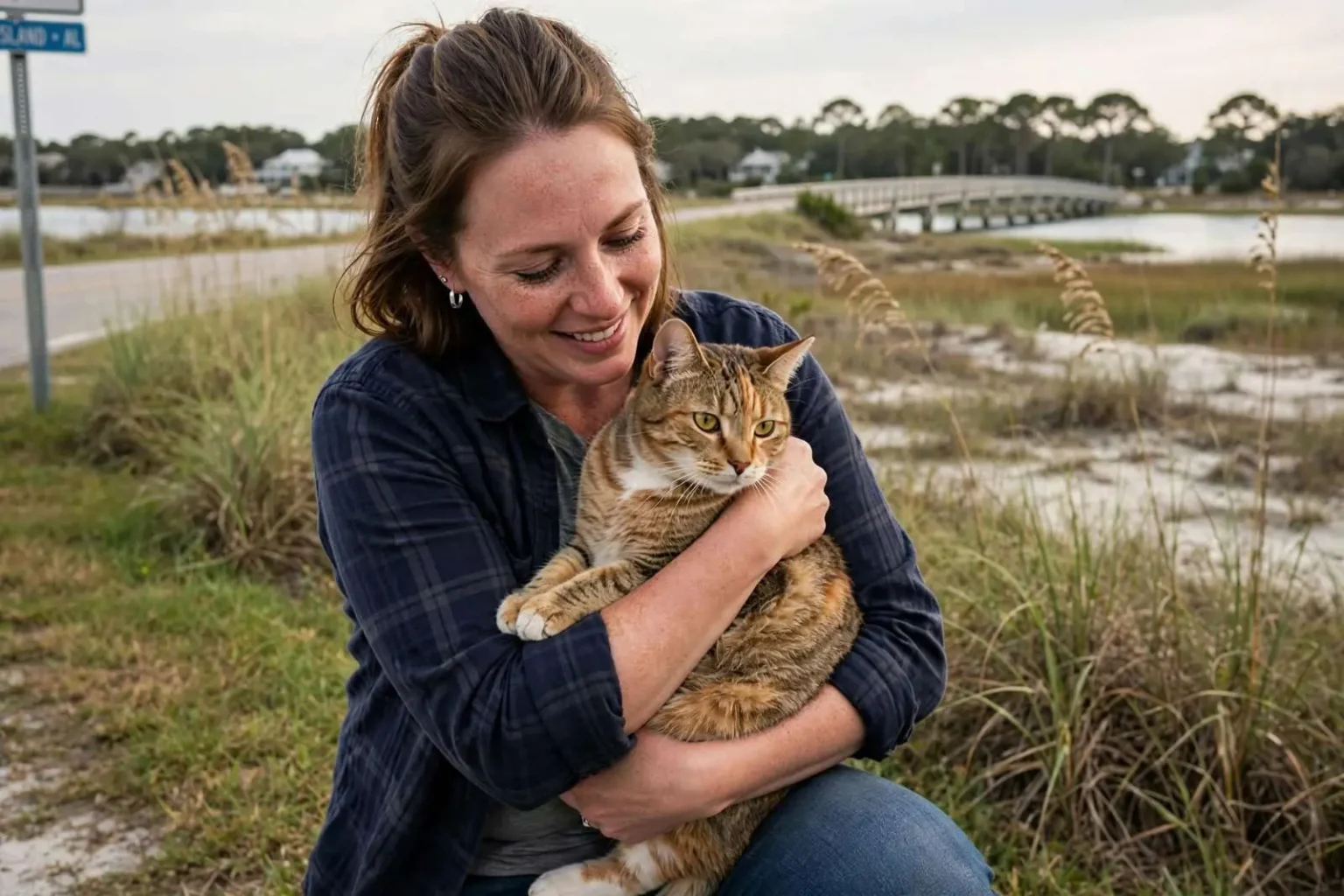
A Dauphin Island cat that went missing from her home turned up more than 600 miles away in Tennessee, leading to a reunion that took her owner more than 13 hours of driving to make happen. The story of Penny’s journey from a barrier island in the Gulf of Mexico to a stranger’s home in Tennessee is the kind of lost-pet saga that unfolds more often than most people realize — and it ended with a drive across three states to bring her home.
Monica Fleming of Dauphin Island said Penny, a house cat, is known to wander, so she was not immediately alarmed when the cat did not come home one day. Dauphin Island, the barrier island community at the mouth of Mobile Bay, is the kind of place where outdoor cats roam freely among beach houses, maritime forests and the small-town streets of the island’s residential east end.
After four days with no sign of Penny, Fleming posted in several Dauphin Island Facebook groups asking for help finding her pet. The island’s social media groups serve as the community’s informal bulletin board — lost pets, found items, storm updates and event announcements all circulate through the same feeds, and residents respond quickly to posts about animals.
Not long after, a woman Fleming had never met reached out with photos. “She had pictures that she sent me, and it was Penny,” Fleming said. The two talked and even video chatted to confirm the cat was really Penny.
The woman told Fleming she had found Penny on the island, apparently without a collar, and assumed the cat had been abandoned, so she took her home. By the time Fleming connected with her, Penny was in Tennessee — more than 600 miles from the island where she was found.
How Penny traveled from Dauphin Island to Tennessee remains a mystery. Cats found wandering on the island sometimes climb into vehicles, boats and trailers headed for the mainland, and the island’s steady traffic of visitors, contractors and ferry riders gives a stowaway cat plenty of opportunities to leave without anyone noticing. Whatever the route, the discovery left Fleming with a very long drive ahead of her.
The Long Drive Home
Fleming said the long drive was worth it. “She is a part of my family, and I would do it for any of my family members,” she said. The round trip took more than 13 hours, but Fleming said it was well worth it to bring Penny home.
The drive from Dauphin Island to central Tennessee covers the length of Alabama and beyond — up the interstate corridors through Montgomery or Birmingham country and north across the state line. For Fleming, the trip meant a full day of travel each way, planned around the coordinates of a stranger’s home where her cat had landed.
Reunions like this one highlight the networks that connect pet owners across state lines. What began with posts in local Facebook groups ended with a stranger willing to hold onto a found cat, verify the owner’s identity through photos and video, and wait for a drive measured in half-days rather than hours.
Lost Pets on a Barrier Island
Dauphin Island’s geography makes it both easy for pets to wander and hard for them to leave unnoticed. The island is connected to the mainland by a single bridge at its eastern end, and the Mobile Bay Ferry connects its southern shore to Fort Morgan across the pass. A cat that wanders off a porch can disappear into the dunes and maritime forest for days, but the island’s small area means most wanderers stay within the community’s watchful sight.
Islanders are accustomed to the comings and goings of animals. The island’s population swells with tourists in summer, and its year-round residents know one another’s dogs and cats well enough that unfamiliar animals get noticed. Posts in the community’s Facebook groups routinely resolve with a neighbor recognizing a pet, but the assumption that a collarless cat must have been abandoned is common — and it can carry a found animal far from home before anyone realizes the pet has an owner.
Penny’s case shows how the story can go wrong in an ordinary way: a known wanderer loses her collar, gets found by a kind stranger, gets adopted out of mistaken necessity, and ends up hundreds of miles away. None of it required the cat to travel on her own — only for her finder to travel first and leave the cat’s true story behind.
What Owners Can Do
Pet professionals point to a short list of safeguards that make reunions like Penny’s faster: collars with current tags, microchips registered with up-to-date contact information, and quick posting of clear photos in local groups the moment a pet goes missing. A microchip, readable by most veterinary clinics and shelters, could have identified Penny the first time she was scanned — though not every well-meaning finder knows to check.
The video chat that Fleming and the finder used to confirm Penny’s identity has become a common tool in long-distance pet reunions, allowing owners to verify distinctive markings and behavior before committing to a long drive. In this case, the confirmation was conclusive: it was Penny.
The reunion closed out a saga that could have ended far worse. Cats that leave home on the Gulf Coast face traffic, predators, storms and the elements, and the odds of a lost cat surviving hundreds of miles of travel are long. Penny’s apparent ride off the island — wherever it came from — delivered her to a home with food and care, and her finder’s honesty made the eventual reunion possible.
For Fleming, the arithmetic came down to family. The round trip consumed more than 13 hours of driving, but the cat waiting at the other end was, in her words, a part of her family — and that was all the reason she needed to make the drive.
The reunion also reflects the unusual role that Facebook groups play in coastal Alabama communities. On an island with a small year-round population, the local groups function as a combined lost-and-found, news wire and neighborhood watch. A post about a missing cat reaches hundreds of residents within hours, and the connections those groups create sometimes extend far beyond the island itself — as they did when a stranger’s photos turned a missing-cat post into a reunion 600 miles away.
Lost-pet stories on the island rarely stay local for long. Dauphin Island’s seasonal visitors bring pets with them, contractors and workers move between the island and the mainland daily, and the ferry adds another path on and off the island. Each movement is a chance for a wandering animal to go with it, which is why islanders treat strays with a first question of ownership rather than adoption.
The Stranger’s Role
The woman who found Penny took her in under a reasonable assumption — a collarless cat wandering an island, with no owner in sight, could well have been abandoned. Island strays are a real phenomenon, and the people who take them in spare the community from animals left to fend for themselves in an environment of traffic, predators and storms.
What distinguished Penny’s finder was her openness when the owner appeared. Rather than resisting, she shared photos, talked with Fleming and joined a video chat to confirm the match, then held onto the cat until the owner could make the trip. The sequence — evidence, verification, reunion — is exactly how animal welfare groups recommend handling a found pet whose status is uncertain.
Stories like this one end differently all too often. Found pets are rehomed, kept or surrendered to shelters when no owner appears, and the distance between an original home and a new one grows until reunion becomes impossible. Penny’s case stayed resolvable because her finder was willing to keep looking for answers, and because Fleming never stopped posting.
Dauphin Island and Its Animals
Dauphin Island’s relationship with its animals is part of its character. The town of roughly 2,000 year-round residents shares its streets, beaches and forests with pets, seabirds, alligators, deer and the wildlife of the Audubon Bird Sanctuary at the island’s eastern end. Cats that wander the island’s lanes move through a landscape where nature is close by at every step.
The island’s community identity — small, self-reliant and tightly networked — shaped how Penny’s story unfolded. Four days of silence from a known wanderer was normal; five was not. Fleming’s posts went out to the community’s groups, and the community answered with the photos that solved the case.
For new residents and seasonal visitors, the story carries a practical lesson: on an island connected to the mainland by one bridge and one ferry, a pet that goes with the flow of traffic can go a very long way. Collars, chips and quick posts are the island’s best tools for keeping its animals close to home.
Home Again
Penny is back on Dauphin Island after her 600-mile detour, restored to the family that spent four days worrying and 13 hours driving. Whether her wanderlust continues is anyone’s guess, but her owner’s commitment is not in question.
The story has circulated among islanders as the kind of tale that could only happen here — a house cat known for wandering, a community of Facebook watchers, a kind stranger three states away and an owner who treated the drive north like any trip made for family. For the people who helped along the way, Penny’s reunion is a small proof of what the network can do: connect a porch on a barrier island to a living room in Tennessee, and bring a cat home.
Fleming’s advice to other pet owners is implicit in her experience: post early, verify carefully and be ready to travel. The distance between a lost pet and a found one, her story shows, can be measured in hundreds of miles — and still be worth every one of them.