Dauphin Island Considered as Site for Military Resort in 2011
Dauphin Island officials said Army and Navy representatives explored the island in 2011 as a possible site for an armed-forces recreation center.
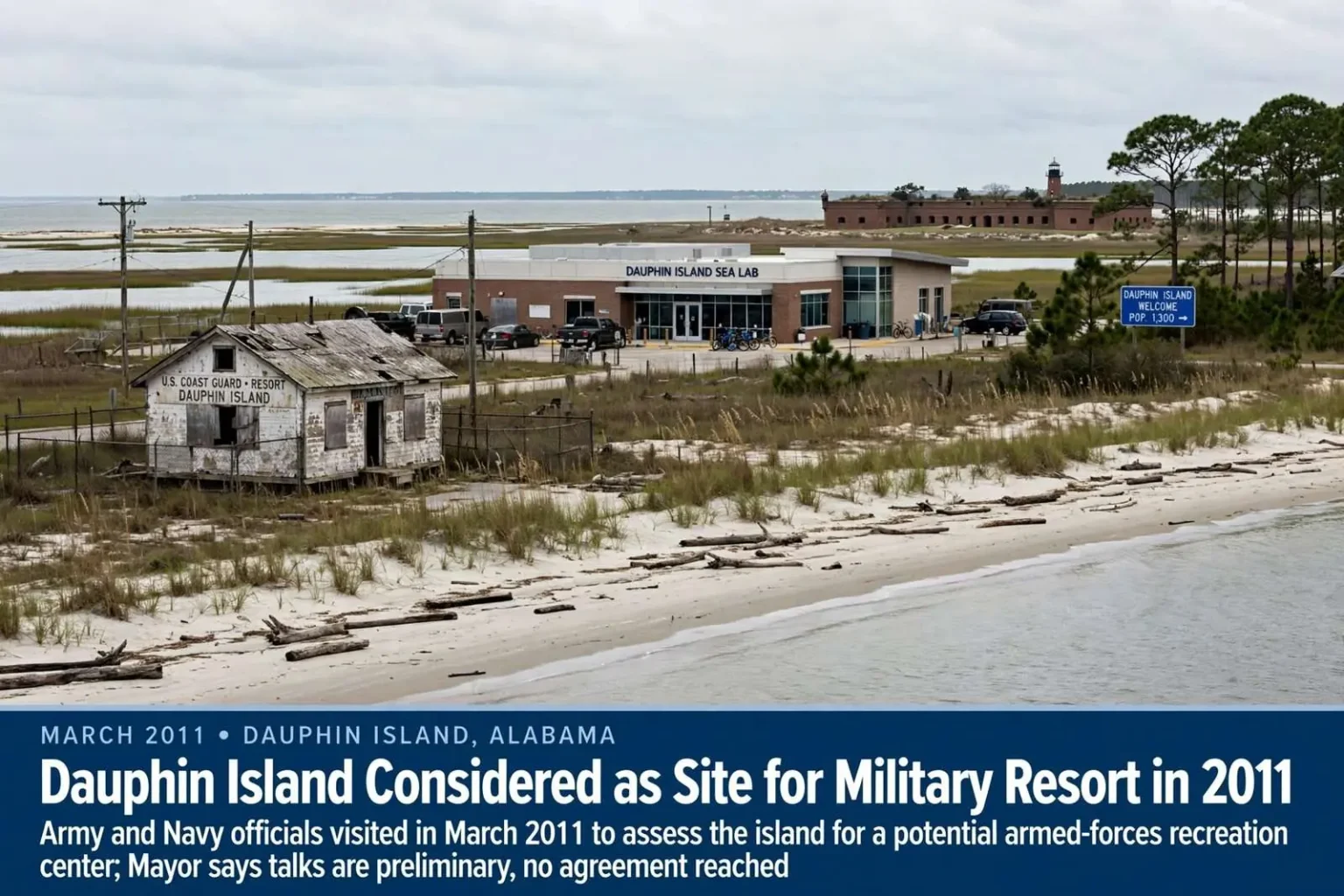
Dauphin Island officials said in March 2011 that Army and Navy representatives had visited the island to explore the possibility of an armed-forces recreation center. Mayor Jeff Collier said the visits were preliminary and no agreement had been made, describing conversations that could shape the island’s visitor economy as it worked to recover from the Deepwater Horizon oil spill’s lingering effects.
A future facility could have ranged from a campground to a hotel, with the potential to bring additional visitors and spending to the island as it recovered from the Gulf oil spill. Military recreation centers — the armed forces recreation system that includes well-known properties at destinations in the United States and abroad — serve active-duty members, reservists, retirees and their families with affordable lodging and recreation, and their guests reliably fill restaurants, bait shops and rental homes in the communities that host them.
For Dauphin Island, a barrier island community at the mouth of Mobile Bay, the timing was significant. The 2010 oil spill had battered the Gulf Coast tourism economy, and island businesses spent the following year working to rebuild the visitor base that sustains them through the summer season. A military recreation facility promised a stream of visitors insulated from the volatility of the general tourism market.
Early discussions only
Officials said representatives were evaluating the island and Mobile County’s available amenities. Collier described the visits as encouraging but stressed that the island had not received a proposal or timetable from the Defense Department. That distinction — between exploratory site visits and an actual proposal — defined the entire episode, and the mayor was careful in his public comments not to raise expectations beyond what the conversations warranted.
The idea drew on the island’s history: remnants of a former Coast Guard military resort remained near the Dauphin Island Sea Lab. Military and federal installations have shaped the island since the nineteenth century, when Fort Gaines guarded the mouth of Mobile Bay and figured decisively in the Battle of Mobile Bay during the Civil War. A twentieth-century Coast Guard presence added another layer to that history, and its remnants stood within steps of the marine science facility that now anchors the island’s research community.
Supporters saw a new recreation center as a way to serve military families while supporting local businesses and tourism. The region’s military ties gave the idea substance: the Gulf Coast is home to major installations within driving distance, from Navy and Coast Guard operations in Mobile and Pensacola to the Air Force bases along the panhandle, and their personnel and retirees make up an enormous potential visitor pool for affordable Gulf-front recreation.
Tourism outlook: Local rental managers said summer bookings were beginning to improve after a slow spring, offering a hopeful sign for the island’s visitor economy. The possible military facility was discussed as a longer-term opportunity rather than an immediate project, one that would take years of planning, funding and federal decision-making before any ground was broken.
How armed forces recreation centers work
The military’s recreation system operates lodging and resort facilities for service members and their families at prices well below commercial rates, funded in part through morale, welfare and recreation programs. Eligibility typically extends across active duty, National Guard and reserve members, military retirees and their families, and in some cases Department of Defense civilians. Facilities range from campgrounds and cottages to full resort hotels at destinations from the mountains to the seashore.
For a host community, the presence of such a facility brings a predictable, values-conscious customer base. Military families travel heavily, favor destinations with beaches and outdoor recreation, and stay longer than typical weekend tourists. Their spending spreads across the local economy — restaurants, marinas, fishing charters, grocery stores and rental management companies all benefit from an installation’s steady guest flow.
Siting a new facility, however, is a federal undertaking. The process involves market studies, land acquisition or long-term agreements, environmental review, congressional funding cycles and the internal priority-setting of each service branch. Preliminary visits like those made to Dauphin Island are the first step in a process that most often does not result in a project — which is why Collier’s careful language about “no agreement” was, in the end, the most important fact of the story.
The island’s recovery context
The spring of 2011 found Dauphin Island’s tourism economy in a delicate state. The oil spill of the previous year had driven away visitors during the crucial summer months even in periods when oil was not present on the island’s beaches, and the national media coverage of the disaster lingered in travelers’ minds long after cleanup crews finished their work. Rental managers reported a slow spring, with bookings beginning to recover as Memorial Day approached.
The island’s economy is built almost entirely on that visitor base. Its population of roughly 1,300 year-round residents supports restaurants, shops, campgrounds and vacation rentals that depend on summer crowds, spring break fishing trips and the duck-hunting and birding seasons that bring visitors in the cooler months. The Audubon Bird Sanctuary on the island’s eastern end draws birders from across the country during migration, one of the few fixed points in an otherwise seasonal economy.
A military recreation facility, had it been developed, would have addressed the industry’s chronic weakness: the long shoulder seasons and winter months when visitor spending thins out. Military families travel year-round, school schedules permitting, and a steady stream of eligible guests could have smoothed the revenue curve that local businesses ride each year.
The Sea Lab and the island’s institutional anchors
The Dauphin Island Sea Lab, near where the old Coast Guard resort remnants stood, is itself one of the island’s economic and institutional anchors. The marine sciences consortium, created by the state legislature, hosts university courses, research programs and the public Estuarium aquarium, bringing students, scientists and families to the island throughout the year. Its presence illustrated the kind of institutional visitor base that sustains the island between tourist seasons.
Fort Gaines, the Civil War-era fort at the island’s eastern tip, plays a similar role in the island’s heritage tourism. The well-preserved fortification, site of Admiral David Farragut’s famous “Damn the torpedoes” moment in August 1864, draws history-minded visitors and school groups and hosts reenactments that fill local campsites and rentals each summer.
Those anchors — the Sea Lab, Fort Gaines, the ferry connection to Fort Morgan across the bay — formed the amenity base that visiting military officials were said to be evaluating. An armed forces recreation center would have joined an existing ecosystem of attractions rather than standing alone, a fact that supporters cited in making their case for the idea’s potential.
What such a facility would have meant for Mobile County
Beyond the island itself, the proposal’s logic extended to the wider county. Visitors drawn to a Gulf-front military recreation center would arrive through Mobile, crossing the Dauphin Island Bridge and passing through the south Mobile County communities on the way. Spending at marine suppliers, restaurants and groceries along that route, and the ferry traffic connecting the island to the Baldwin County shore at Fort Morgan, would all have grown with the facility’s guest base.
County and state economic development officials watched such discussions closely because military-affiliated projects tend to prove durable once established. Unlike seasonal tourism operators, a recreation installation’s visitor flow continues through economic downturns, and its operations bring year-round employment — front desk and hospitality staff, maintenance, lifeguards and program coordinators — to a small community’s workforce.
The campground-to-hotel range discussed by officials reflected the flexibility in military recreation planning. Facilities of that type elsewhere in the system began as modest campgrounds with bathhouses and rental cabins, adding cottages, pools and conference space as demand grew. A phased approach of that kind would have limited the island’s exposure in the project’s early years — though, again, no such plan had been proposed by the Defense Department when the visits occurred.
Why preliminary discussions rarely become projects
Federal recreation projects face long odds between the exploratory stage and construction. Military construction budgets are contested annually, and morale and welfare facilities compete with operational priorities for every dollar. Sites must pass suitability reviews — hurricane exposure, infrastructure capacity, evacuation planning — that weigh heavily on low-lying barrier islands, whatever their appeal as destinations.
Dauphin Island’s geography presents exactly those considerations. The island has absorbed hurricane strikes and overwash events repeatedly through its history, and any large-scale lodging development there requires elevated construction, robust insurance and reliable evacuation logistics. The Dauphin Island Bridge, rebuilt after Hurricane Katrina, is the island’s only road link to the mainland, a constraint planners would have had to account for in any federal decision.
None of those factors surfaced as deal-breakers in the public discussion of 2011 — because, as Collier emphasized, the discussion never reached that stage. The visits were evaluations, the island’s amenities were the subject of the review, and the ball remained in the Defense Department’s court. No proposal or timetable had been received, and none followed in the period the record shows.
The record and the caveat
This account documents preliminary 2011 discussions. It does not establish that a military resort was approved, built or operated on Dauphin Island. That distinction matters for readers encountering the story years later: what exists in the record is a mayor’s account of encouraging visits, officials’ descriptions of a possible range of facilities, and a community’s hopes during a recovery year — not a completed project.
The episode remains a revealing snapshot of the island’s economy at a particular moment. In the spring of 2011, with summer bookings beginning to improve after a slow season, Dauphin Island’s leaders were actively seeking every avenue to strengthen the visitor base that supports the town — and the prospect of military families vacationing on the island was one of the ideas on the table.
The remnants of the old Coast Guard resort near the Sea Lab still tell the earlier chapter of that story: the island’s connection to the armed forces is longstanding, and the 2011 discussions were, in a sense, an attempt to write a new page in it. Whether future proposals emerge is a question the record leaves open.