Dauphin Street Drunks Set to Host 8th Annual Peg Leg Pub Crawl Through Downtown Mobile
The Dauphin Street Drunks host their 8th Annual Peg Leg Pub Crawl through downtown Mobile's LoDa district with live music.
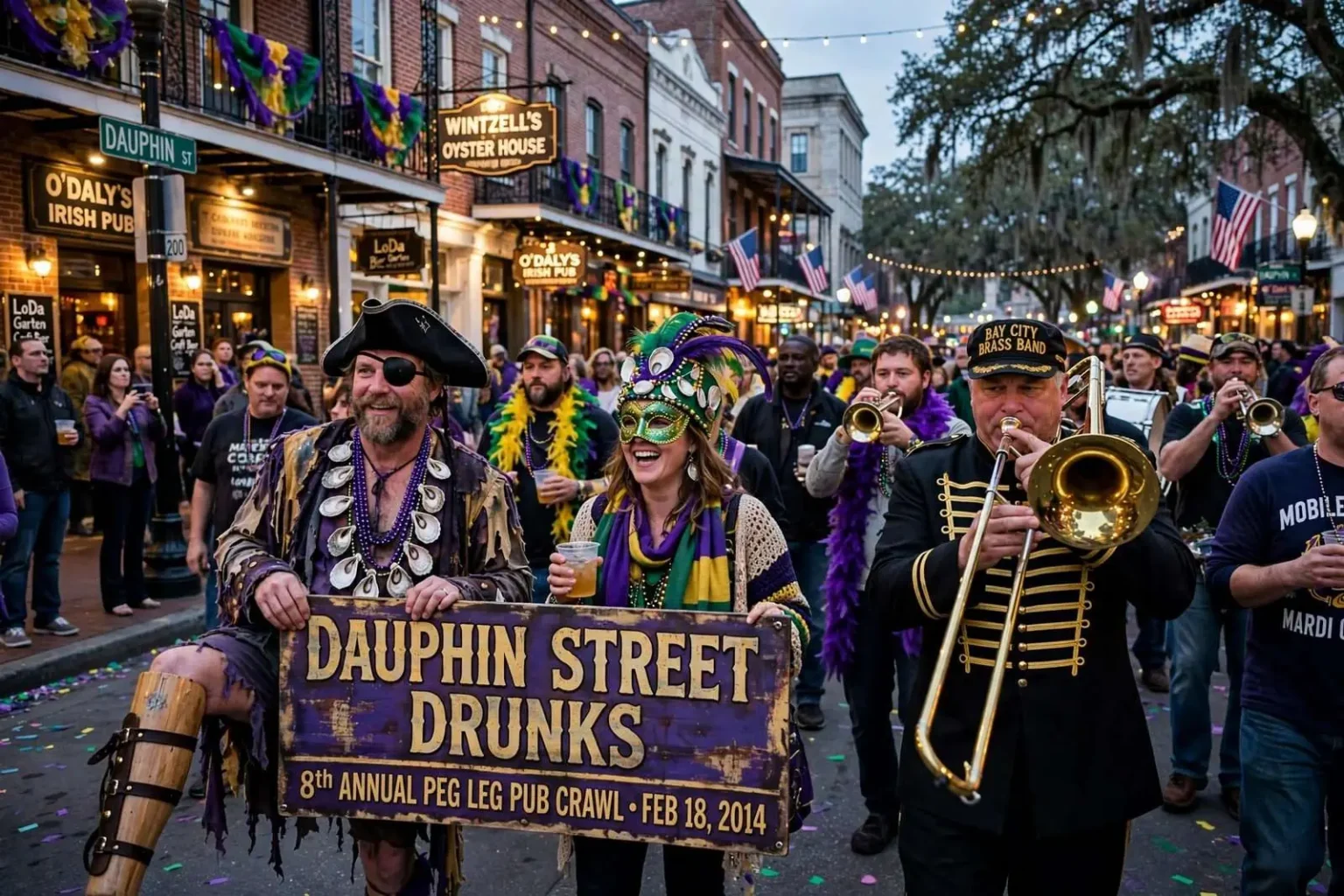
The Dauphin Street Drunks, one of Mobile’s most colorful Mardi Gras marching organizations, are gearing up for their 8th Annual Peg Leg Pub Crawl on Tuesday, February 18, 2014. The event promises an evening of revelry through the heart of downtown Mobile’s Lower Dauphin Street entertainment district. What began years ago as a loose-knit stroll among friends has grown into one of the most anticipated openings to the Carnival calendar, drawing marchers, musicians and curious onlookers into the streets weeks before the first floats roll. For the Drunks, the crawl is both a warm-up and a statement: Mardi Gras in Mobile is not confined to parade routes and ticketed ballrooms, but lives just as loudly in the bars, sidewalks and squares of the historic downtown.
The Peg Leg Pub Crawl takes its name from the peg-legged spirit of the city’s earliest revelers and from the Drunks’ own roving style of celebration. Unlike a traditional parade with fixed floats and a reviewing stand, the crawl moves on foot, at the pace of the crowd, and stops wherever the doors are open. That format has made it a favorite among Mobilians who prefer their Carnival up close, and it has helped the event carve out a niche alongside the city’s more formal procession schedule.
The Route: A Tour of Downtown Mobile’s Best Bars
The crawl kicks off at 6 p.m. at The Garage before heading east along Dauphin Street through a gauntlet of popular watering holes. Participants will make stops at OK Bike Shop, Moe’s BBQ, Cafe 615, Wintzell’s Oyster House, O’Daly’s Irish Pub, AMB, Haberdasher, Hayley’s, The Brickyard, Cabo, and LoDa Bier Garten before crossing Bienville Square. The stretch along Dauphin places marchers in the middle of the LoDa district, the blocks of Lower Dauphin Street that have become the center of downtown nightlife, lined with restored storefronts, galleries and restaurants a short walk from the waterfront.
Bienville Square, the leafy park at the corner of Dauphin and North Bienville streets, serves as the natural halfway point of the evening. Named for the French colonial founder of Mobile, the square has long been a gathering place for public events, and on crawl night it fills with stragglers catching up with the main body of marchers. From there, the crawl turns down Royal Street with visits to Joe Cain Cafe, Serda’s Coffee, and Veet’s. Serda’s, a fixture of the downtown coffee scene, and the Joe Cain Cafe, named for the city’s most famous Carnival figure, give the route a distinctly Mobile flavor as it threads between the office towers and historic buildings of the central business district.
The evening wraps up on Conti Street with stops at B-Bob’s and Gabriel’s before ending at The Bar and Blind Mule. The final blocks give the night a fitting finish, with the last stops clustered close enough together that the crowd can drift from one to the next as the hour grows late. By the time the marchers reach the end of the route, the crawl has covered most of the downtown core on foot, a circuit that touches well over a dozen establishments in a single evening.
A Mardi Gras Tradition Like No Other
The Dauphin Street Drunks will be joined by the Wild Mauvillians, who are known for their prized oyster shell necklaces, along with other special guests. The oyster shell throws, strung by hand and handed out along the route, have become one of the most recognizable calling cards of any marching group in the city. Members of the public are welcome to join the festivities in costume or street clothes, and impromptu krewes often form along the way. That openness is central to the crawl’s character; there is no membership list, no ticket and no registration, only a starting time and a route that anyone can fall in with.
The Bay City Brass Band will provide live music as the group makes its way through the district. A brass band on the march is one of the oldest sounds in Mobile’s Carnival vocabulary, and the band’s second-line style keeps the crowd moving between stops even when the line at the bar stretches out the door. The music, the costumes and the sheer size of the crowd tend to draw spectators out of restaurants and apartments along the route, many of whom end up joining the procession on the spot.
The DSDs hold a distinguished place in Mobile’s Mardi Gras traditions as one of five marching organizations that follow Chief Slacabamorinico’s coal cart in the Joe Cain Day Procession. The other groups include the Society of Bums, the Mistresses of Joe Cain, the Wild Mauvillians, and the Secret Misters of Joe Cain. Together, these organizations represent some of the most celebrated Mardi Gras traditions in the country.
Joe Cain Day, held on the Sunday before Fat Tuesday, honors Joseph Stillwell Cain, the Mobile clerk who revived Carnival celebrations in the years just after the Civil War when the city’s prewar mystic societies had gone dormant. Cain paraded through the ruined city in a decorated charcoal wagon, costumed as Chief Slacabamorinico, a fictional Chickasaw chief he claimed had never surrendered to Union forces. The gesture caught on, and the character of Old Slac remains the central figure of the day that bears his name. The marching societies that trail the coal cart each February — the DSDs among them — carry that story forward with deliberately homespun costumes and a rowdy, do-it-yourself style that stands apart from the masked elegance of the traditional krewes.
Roots of the Oldest Carnival in America
The annual pub crawl has been compared to the spirit of the historic Cowbellion de Rakin Society’s legendary all-night promenades, which helped establish Mobile as the birthplace of American Mardi Gras celebrations. The Cowbellions, organized in the early 1830s, marched on New Year’s Eve with cowbells, rakes and hoes, and their processions predate the famous krewes of New Orleans — a group of former Cowbellions carried the model to Louisiana in the 1850s. Mobile’s Carnival claim runs back even further, to the colonial era, giving the city a standing as the oldest Mardi Gras celebration on the American continent.
Against that long history, the Dauphin Street Drunks are relative newcomers, but the pub crawl’s dependence on foot power and neighborhood bars makes it a closer cousin to those early promenades than to any modern parade. There are no tractors pulling floats and no themed throws stamped with a krewe crest — just marchers, a brass band, and a map of downtown saloons. The comparison is one the group wears proudly.
For locals and visitors alike, the Peg Leg Pub Crawl has become an essential way to kick off the Mardi Gras season in downtown Mobile. The event lands in the middle of a Carnival calendar that stretches from early January’s social season through Fat Tuesday itself, and it fills a slot that belongs entirely to the marching societies. Businesses along the route plan for the crowds, downtown residents mark the date, and each year a new wave of first-timers discovers that in Mobile, Mardi Gras season is not a single day but a way of life that begins on foot, on Dauphin Street, with a peg leg in the crowd.
The stop-by-stop format is what sets the crawl apart from every other event on Mobile’s Carnival calendar. At each bar along the way the crowd thins and refills as marchers pause for a drink, a bite or a round of photographs before the brass band strikes up again on the sidewalk outside. Wintzell’s Oyster House, a downtown institution famous for its oysters and its walls covered in folksy sayings, and O’Daly’s Irish Pub are among the best-known stops, but the route deliberately mixes old-line establishments with newer spots, giving participants a walking tour of how far the LoDa nightlife scene has come since downtown’s revival began.
What Participants Should Know
Because the crawl is entirely on foot and stretches from The Garage on the western end of Dauphin Street to the Conti Street blocks near the river, comfortable shoes are the first piece of equipment most veterans recommend. The route runs along public sidewalks the whole way, and marchers are expected to obey crossing signals at the busier intersections, particularly where the route crosses Bienville Square and turns onto Royal Street. The event takes place in the evening in mid-February, when Mobile’s temperatures can swing from mild afternoons to chilly nights, so layers and costumes that work over jackets are a practical choice.
Marching organizations like the Dauphin Street Drunks occupy a special niche in Mobile’s Carnival hierarchy. The city’s parade schedule is dominated by mystic societies with decades or even centuries of history, elaborate floats and masked balls, but the marching units operate on a smaller scale and closer to the ground. They walk rather than ride, they interact directly with the crowd, and they depend on the streets themselves — bars, squares and sidewalks — for their staging areas. That intimacy has made them a growing part of the Mardi Gras experience, and the five groups that follow the coal cart on Joe Cain Day are the most visible example of the form.
The pub crawl’s mid-February date also gives it a practical advantage for downtown businesses. It falls ahead of the heaviest stretch of the parade season, bringing an early wave of visitors into LoDa restaurants and bars at a time of year when the streets are otherwise between events. Owners along Dauphin, Royal and Conti streets have come to count on the crowd, and the crawl’s steady growth over eight years has mirrored the district’s own resurgence as the center of downtown entertainment.