Davidson High School Resumed Classes After Student Death in 2008
A 2008 WKRG report documented Davidson High School students returning to class after the death of a fellow student.
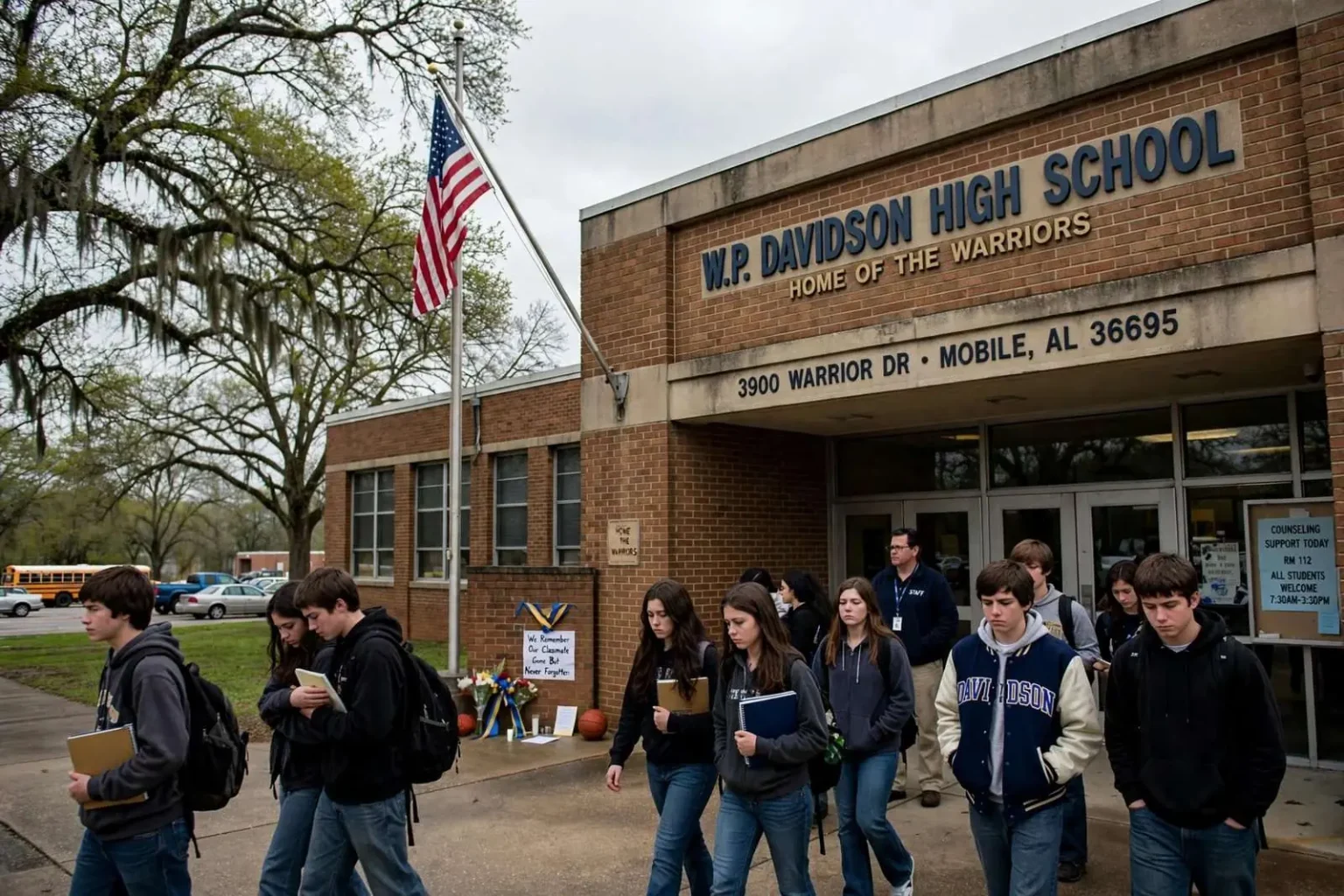
Davidson High School students returned to class in March 2008 after the death of a fellow student, according to a local station’s report from that week. The story captured a school community working through the first days after a loss, as teenagers attempted to pick up familiar routines while carrying grief that was anything but routine. Reporters spoke with students on campus, and what they described was shock: the disorienting experience of walking the same hallways knowing that a classmate would not be among them.
Students interviewed by the station described the difficulty of resuming their routines while the loss was still fresh. Some said the event had affected the whole school community, a sentiment that reflected how tightly connected student bodies are in practice. In a school the size of Davidson, where students share classes, teams, buses and after-school hours across four years, the death of one student touches a remarkably wide circle of peers, teachers and staff.
One friend of the student remembered playing basketball and spending time together, the ordinary recollections that friends reach for when they try to talk about someone they have lost. Such memories are often what classmates hold onto in the days after a death, and several of the students who spoke to the station framed their grief in exactly those terms, through shared time and shared activities rather than any single dramatic account.
The school in context: Davidson High in Mobile
W.P. Davidson High School sits in western Mobile and is one of the long-standing public high schools in the Mobile County Public School System, the largest district in Alabama. The school draws students from established west Mobile neighborhoods and serves the full range of a comprehensive American high school: academics, athletics, band, clubs and the everyday social world of several hundred teenagers moving through the same building each day.
In March 2008, that everyday world was interrupted. A student’s death during the school year is one of the hardest events a secondary school handles, arriving without warning and touching students at an age when many are experiencing a close loss for the first time. The decision for students to return to class reflects the standard understanding among educators that routine and structure help young people after a crisis, even when the routine feels strange at first.
High schools in that situation typically lean on guidance counselors, district crisis teams and outside support personnel to be present on campus. Teachers are asked to watch for students who are struggling, to allow conversations where appropriate, and to keep the school day predictable. None of that erases the grief; it gives the grief somewhere to sit while the community begins to absorb what has happened.
What students said
The interviews the station conducted gave voice to the student side of that recovery. The descriptions of shock were consistent: classmates reported feeling stunned, going through the motions, and seeing the loss reflected in the faces around them. The friend who recalled basketball games and time spent together offered the kind of specific, human memory that anchors grief, and the report preserved it as part of the record of that week.
Other students told the station that the death had affected the school community broadly, not just the student’s immediate circle. That observation matches what school counselors observe routinely: a student death ripples through an entire campus, reaching classmates who knew the student well, those who barely knew them, and younger and older students who identify with the loss in different ways.
Talking to reporters, as several Davidson students did, is itself part of how communities process events like this. Speaking about a lost friend, naming the activities they shared, and acknowledging the shock aloud are the ordinary ways teenagers support one another when adults are still arranging formal support. The 2008 report stands as a small record of that process at one Mobile high school.
How schools help students through a loss
The days after a student death are governed by a body of practice that school districts have developed over decades. Mobile County schools, like districts across the country, maintain crisis response plans that can be activated on a campus, bringing additional counselors and mental health professionals to a school when a death occurs. The goals are consistent: support grieving students, identify those at elevated risk, and keep the campus functioning calmly.
Educators generally encourage honesty with students about what has happened, appropriate to their age, while limiting sensational details. Classrooms are given room to talk in the early days, and quiet spaces are provided for students who need them. Teachers and coaches, who often know students well, become important observers in the weeks that follow, watching for changes in behavior, attendance or mood that suggest a student needs individual help.
The return to routine that Davidson students described in March 2008 is part of the same design. Structure, familiar schedules and the presence of trusted adults give adolescents stability while they grieve, and activity helps: the basketball games and shared time that the student’s friend remembered are the same activities that a school community returns to as it heals.
Grief among teenagers
Adolescents experience loss in ways that differ from both children and adults. Teenagers understand the permanence of death fully, but they are still building the vocabulary and the support networks to express what they feel, and peer relationships carry unusual weight at that age. The death of a classmate can therefore unsettle a student’s whole sense of security, raising questions about fairness, vulnerability and mortality that many are confronting seriously for the first time.
Grief in teenagers also moves in waves. A student may seem fine in the morning, be overwhelmed by an ordinary reminder at lunch, and appear composed again by the last bell. Schools and families respond best when they allow that unevenness rather than expecting a straight line of recovery, and when they keep checking in over the weeks after a death rather than only in the first days.
Peer support does much of the real work. Classmates sit together at lunch, share memories, and watch out for one another in informal ways that no adult program can replicate. The student recollections preserved in the 2008 report, the basketball games, the time together, the shared shock, are exactly the material of that peer process, which is why local coverage of a school’s return to class often centers the students’ own words.
A lasting resource for readers
Because reports about student deaths can be difficult reading, particularly for those affected by similar losses, the historical record of the Davidson story carries a standing note: anyone in immediate danger or considering self-harm should contact emergency services or the 988 Suicide & Crisis Lifeline in the United States, which connects callers with trained counselors at any hour.
That guidance reflects what schools and public health agencies have emphasized since the period the report describes: deaths in a school community are moments when support matters most, and help should be easy to reach. Friends and family members who worry about someone are encouraged to ask directly, listen without judgment, and connect the person with professional help rather than managing the concern alone.
This article is a historical summary of a 2008 local news report about students at Davidson High School returning to class after the death of a fellow student. It preserves the students’ descriptions of shock and grief and the recollections of a friend who remembered playing basketball and spending time together. Current school operations and staff at the school have changed in the years since the report.
The wider school community responds
When a student dies during the school year, the response extends well beyond the guidance office. Administrators coordinate with the district office on messaging to families, athletic programs and student organizations decide how to honor the classmate, and teachers adjust their classrooms in the small ways that acknowledge what everyone in the building knows. In the weeks after March 2008, Davidson’s faculty and staff were carrying that dual responsibility: teaching their classes while remaining attentive to students who were struggling.
Parents, too, become part of the response network. The days after a student death often prompt family conversations about grief, safety and mental health, and school communications typically encourage parents to talk with their children, monitor their reactions, and reach out to counselors with concerns. Adolescents frequently process loss at home in ways they do not show at school, particularly in the evenings and weeks after the initial shock.
The broader Mobile community felt such losses through the connections that radiate outward from a high school. Former teachers, coaches who had worked with the student, relatives with children in the same classes, and neighbors who knew the family all belong to the circle that a death touches. Local coverage like the 2008 report exists because that circle is wide, and because the community has a stake in how its schools respond.
Why the routine matters
The image of students walking back into Davidson High School in March 2008, a few days into a grief they had not yet learned to carry, captures something true about schools in crisis. The routine of a school day, the bell schedule, the classes, the lunch periods, the practices after school, is not an evasion of grief but a container for it. Educators who respond to student deaths consistently describe the value of that predictability for young people whose world has just become less predictable.
The student memories that the station recorded, basketball games and ordinary time together, show the other half of that truth: what sustains a grieving community of teenagers is the continuation of the activities that gave their friendships shape. Returning to those activities, first heavily and then more lightly, is how a school community moves through a loss while keeping the memory of the student present in it.
Eighteen years later, the 2008 report remains a record of one Mobile school’s hardest week, preserved in the words of the students who lived it. Its lasting value is the honesty of those words and the reminder they carry that help, from counselors, from crisis lines like 988, and from friends and family, is the resource that matters most when a school community loses one of its own.