Davidson High School Students Sweat Through First Day Without Air Conditioning
More than 1,500 Davidson High School students returned for their first day of classes without air conditioning after storms likely knocked out the system.
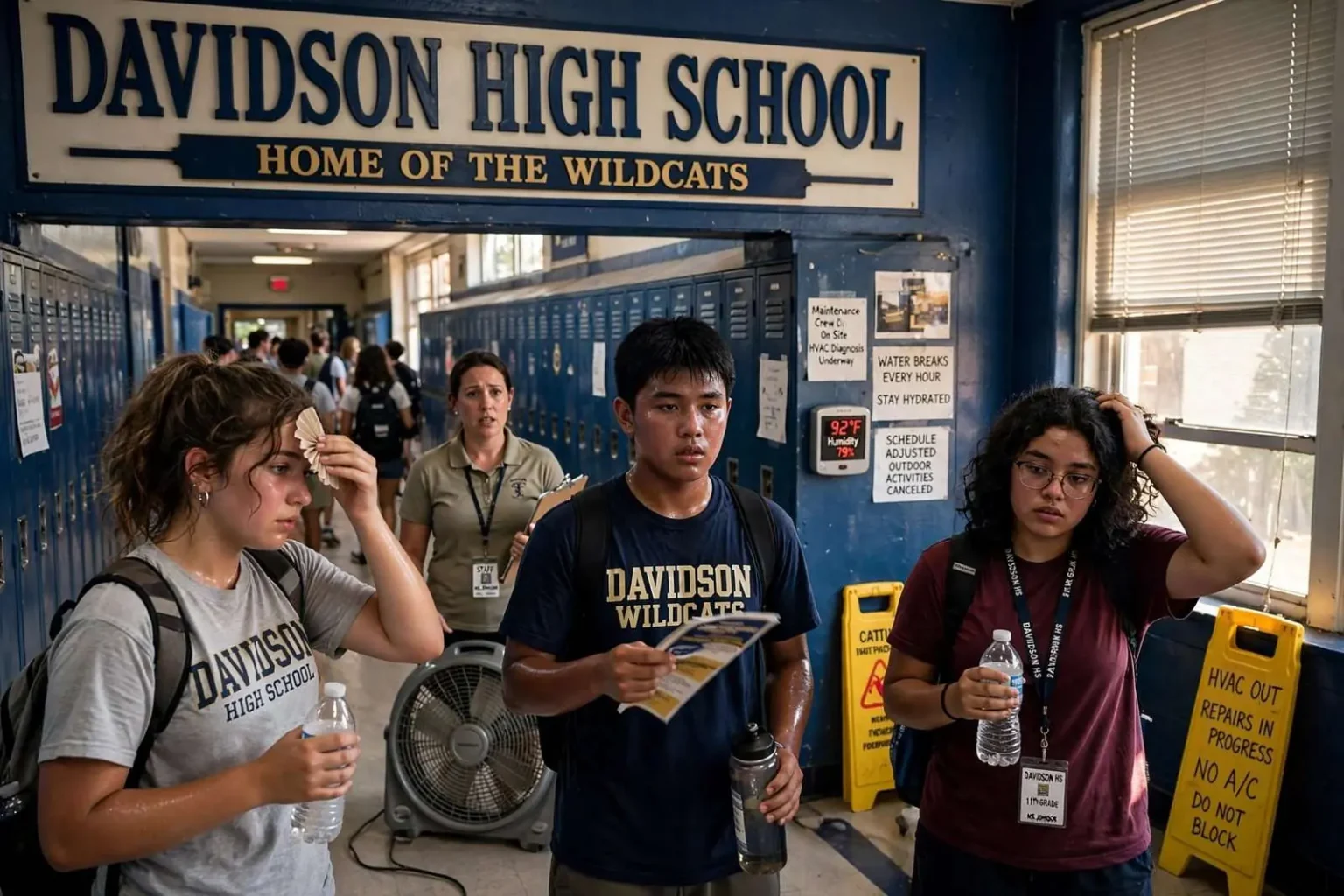
Students at Davidson High School got a hot welcome back to class this week, returning for their first day of the new school year to find the building without air conditioning.
Several storms carrying high winds swept through the Mobile area over the weekend, and school officials believe the severe weather likely played a role in the outage. The timing could hardly have been worse: after a summer of vacation schedules, students filed back into classrooms just as one of the campus’s most essential systems sat dead.
“Our A/C went out due to what we think was lightning,” said Rena Phillips, spokeswoman for Mobile County Public Schools. The explanation fit the weekend’s weather, which produced damaging winds and frequent lightning across the Mobile area as summer thunderstorm season reached its peak.
More than 1,500 students at the school were left to make the best of the situation, staying in class through the heat rather than being sent home. The decision to hold school reflected a calculation districts make in these situations: a day without air conditioning is uncomfortable, but it beats losing instructional time at the start of a year.
Conditions inside the building
Phillips described conditions as uncomfortable but manageable. “It’s hot, but it’s not unbearable,” she said, offering the district’s public assessment of a day that tested both the building’s ventilation and everyone’s patience.
Teachers adjusted in the ways Gulf Coast classrooms always have when the systems fail: blinds drawn against the sun, fans positioned where extension cords allowed, water breaks worked into the schedule, and lessons paced around the hottest hours. Students dressed lighter than usual, and hallways that normally hum with activity grew quieter as the building warmed through the day.
Maintenance crews were dispatched to the campus and were working to diagnose and repair the system as quickly as possible, though no firm timeline was given for when full air conditioning would be restored. Diagnosing lightning damage to a large commercial HVAC system can take time, since the fault may lie in control boards, compressors or electrical components that must be tested one by one.
The school system’s maintenance operation serves hundreds of campuses across the county, and when a storm damages multiple schools at once, crews are triaged by severity. A total outage at a school of Davidson’s size puts the campus near the top of that list.
The Gulf Coast timing problem
The timing was especially unwelcome for a school system already contending with Gulf Coast humidity during the first weeks of the academic year, when classrooms can heat up quickly without functioning air conditioning, particularly in buildings with limited natural airflow.
Mobile County’s public schools start their year in early August, among the hottest and most humid weeks of the calendar. Daytime temperatures regularly climb into the 90s, and the humidity that defines the Gulf Coast makes even high-80s days oppressive in a sealed masonry building. Air conditioning in this region is not an amenity; it is the difference between a functioning school and an unusable one.
That reality makes late-summer storms the district’s recurring adversary. Alabama’s thunderstorm season delivers lightning, wind and outages precisely when schools can least afford them, and the first weeks of the school year are when the consequences of any equipment failure are most visible to the most people.
Modern schools are designed to be cooled continuously; many have windows that do not open or open only marginally, and their ventilation systems depend on the same electrical infrastructure that lightning disrupts. When the cooling fails, the building holds heat the way a closed car does, and the day becomes a slow negotiation with the thermometer.
Aging systems and storm vulnerability
Mobile County Public Schools, like many districts along the Gulf Coast, relies on aging HVAC infrastructure at some of its older campuses, which can be vulnerable to storm damage and lightning strikes during Alabama’s active summer thunderstorm season.
Districts across the region face the same equation. HVAC replacement for a high school costs millions, equipment lives are measured in decades, and deferred maintenance accumulates in the form of exactly this kind of failure. Lightning strikes are indiscriminate, but a newer, better-grounded system is more likely to survive one, which is why capital planning officials count storm resilience among the arguments for replacement cycles.
Outages like the one at Davidson High School underscore the maintenance demands facing school systems that must keep large, decades-old buildings operating smoothly through some of the hottest months of the year.
District officials did not indicate whether other campuses suffered similar storm-related damage over the weekend, though the system’s maintenance teams were presumably working through reports from across the county. A single weekend of severe weather can leave a school district with a list of repairs spanning roofs, fences, technology and climate systems.
What the first days looked like
For Davidson’s students and teachers, the immediate question was practical: how long the outage would last. District officials committed crews to the repair but stopped short of a completion date, leaving families to prepare their children for more hot days and teachers to plan around a building whose temperature was out of their control.
Schools in the district have weathered similar situations before, and the standard playbook holds: hydrate constantly, keep activity light, rotate students through whatever cooler spaces exist, and monitor for the signs of heat exhaustion that would force a change of plans. Nurses and administrators watch the room temperatures closely, and districts generally have thresholds at which they would dismiss early or cancel classes rather than hold students in unsafe heat.
That Davidson stayed open through the first day suggested conditions stayed within tolerable ranges, matching the district’s “uncomfortable but manageable” characterization. The alternative — sending more than 1,500 students home on the first day of school — would have disrupted families’ schedules and cost instructional time in a year just beginning.
The district’s communications team kept the message simple and public: the outage was storm-related, the cause was believed to be lightning, repairs were underway, and parents would be updated as the system came back online.
Why it matters
A first-day air conditioning failure is a small story with a large footprint. It touches every family at the school, tests the district’s maintenance response, and illustrates the infrastructure challenges that Gulf Coast school systems manage continuously — storm seasons, aging buildings, and the gap between what comfort requires and what budgets allow.
For the students of Davidson High School, the episode made for a memorable start to the year: a first day spent fanning through Algebra and English while crews worked somewhere above the ceiling to bring the cold air back. For the district, it was another reminder that along the Gulf Coast, the school year begins in the furnace of August, and everything — from roofs to compressors to lightning protection — has to work the week the students return.
Once repairs were complete, the expectation was simple: the building cools, the routines resume, and the storm becomes a story told about the year things got hot at Davidson.
The district behind the school
Davidson High School is one of the large traditional high schools in the Mobile County Public School System, the largest school district in Alabama by enrollment and one of the largest employers in the region. The system spans the City of Mobile and the surrounding county, operating dozens of elementary, middle and high schools across a geography that runs from downtown neighborhoods to the suburban corridors of west Mobile.
Davidson, located in west Mobile, serves a broad attendance zone and fields well-known programs in academics, band and athletics — the kinds of programs that depend on facilities being in working order, from gyms to band rooms to the classrooms where more than 1,500 students spend their days.
Running a district of that scale means running a fleet of buildings of wildly different ages. Some campuses have been rebuilt within recent decades; others carry systems installed long ago and patched since. The maintenance department’s job is to keep every one of them functional, and storm events like the one that preceded Davidson’s first day are when that job becomes most visible.
How schools handle heat emergencies
Education officials across the Gulf South have developed protocols for exactly this scenario. Heat is treated as a safety issue, not an inconvenience: staff are trained to recognize heat exhaustion, students with medical conditions are flagged for extra attention, and administrators track indoor conditions hour by hour when cooling is down.
If a building cannot be kept within safe ranges, districts move to early dismissal or cancellation, accepting the instructional and logistical costs because student health comes first. Davidson’s ability to hold classes through the outage suggests conditions stayed short of that line, but the contingency existed every hour the system was down.
Parents, for their part, watch these situations closely. A first-day outage generates calls, emails and social media chatter, and district communications staff — Phillips among them — serve as the bridge between families’ concerns and the maintenance crews’ progress. The reassurance that repairs were underway and conditions were manageable is exactly the message districts craft for such episodes.
The episode closed with the outcome everyone at the school wanted: crews on the roof and in the mechanical rooms, repairs advancing, and a district committed to having Davidson’s classrooms back to normal as quickly as the work allowed — so the rest of the new school year could begin in the conditions Gulf Coast students are supposed to take for granted.