Davidson High School Robotics Team Represents Mobile at Obama’s Final White House Science Fair
Three W.P. Davidson High School students traveled to Washington for the White House Science Fair, showcasing the largest K-12 engineering program in.
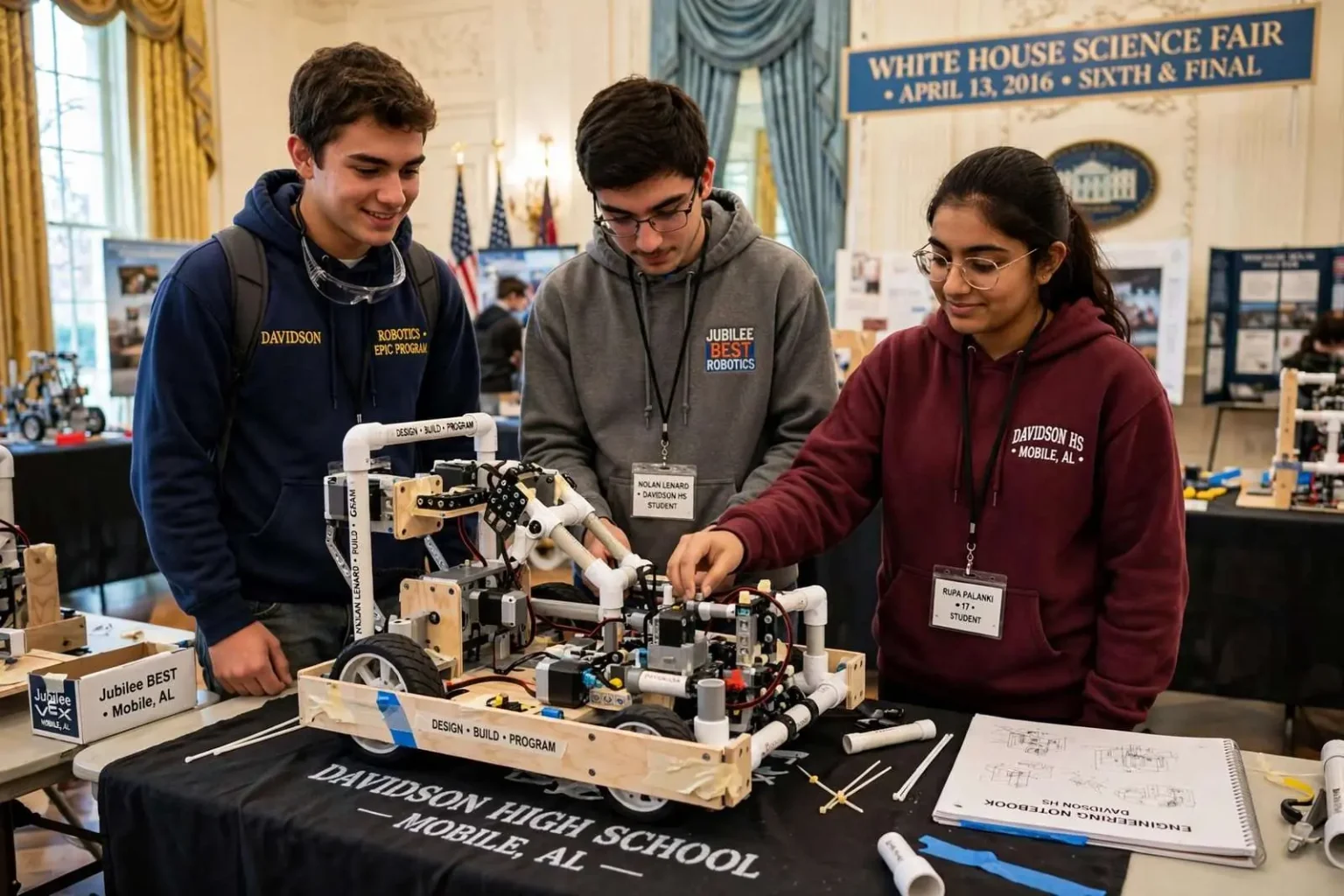
A robotics team from W.P. Davidson High School in Mobile traveled to Washington, D.C. this week for one of the biggest honors a student engineering program can receive: a spot at President Barack Obama’s sixth and final White House Science Fair.
Three Davidson students, Jacob Bosarge, 17, Nolan Lenard, 16, and Rupa Palanki, 17, arrived at the White House to set up their exhibit and test their robot ahead of the April 13 event, where the president recognized the work of Jubilee BEST Robotics, the regional program Davidson’s team competes under.
Robin Fenton, hub director of Jubilee BEST, escorted the students through the setup process. The team was scheduled to return April 14 to meet with Alabama Sens. Richard Shelby and Jeff Sessions and U.S. Rep. Bradley Byrne.
The invitation placed a Mobile public school’s robot in a room with the country’s most celebrated student projects — and placed the Jubilee BEST program itself, which operates quietly on the Gulf Coast every fall, in front of a national audience.
Getting to Washington
Getting to Washington wasn’t guaranteed. The team had just one week to raise the roughly $30,000 needed to cover transportation, hotel rooms and meals for about 45 participants making the trip. They hit that goal thanks to support from the Mobile and South Alabama community.
The week-long sprint — donations from businesses, families and residents who follow the program — meant a delegation the size of a small school’s enrollment could make the trip together: the competing students, the teammates who built and programmed alongside them, the mentors and the faculty who run the program. In a district where field trips of that scale are rare, the fundraising itself counted as a demonstration of what the program means to the region.
The White House Science Fair drew more than 100 of the nation’s top science, technology, engineering and math students, showcasing robots, prototypes and other projects aimed at tackling challenges from climate change to cancer research.
The fair has been a signature of the Obama administration’s science outreach since its first year, an event where the president tours student exhibits, asks questions and uses the gathering to press for investment in STEM education. Being among the hundred-plus exhibits meant Davidson’s robot shared a stage with projects from every corner of the country — and meant three Mobile students describing their work to the president of the United States.
From a struggling program to the state’s largest engineering curriculum
Davidson’s robotics program has come a long way since 2004, when the school first decided to enter the BEST Robotics competition. At the time, the program had no tools to build a robot, no dedicated workspace and no engineering classes. Students and faculty turned to the community for donations to get the effort off the ground.
That initial push eventually led the school to create its EPIC Program, short for Engineering Pathways Integrated Curriculum. Today, Davidson is home to the largest K-12 engineering program in Alabama. Students there have access to 3D printers, CNC machines and advanced simulation software, and the school’s faculty and students now mentor other schools throughout the Gulf Coast region and Alabama’s Black Belt to help build interest in engineering.
The arc from 2004 to the White House runs through a simple sequence: a competition entry without equipment, a community that supplied it, a curriculum built on what the competition taught, and a laboratory that now trains the teachers and students of other schools. The mentoring reach into the Black Belt — the mostly rural west Alabama counties where school districts rarely can fund engineering instruction of their own — extends the program’s impact far beyond its own enrollment.
The program’s success has translated into competition results as well. Davidson has won the overall BEST Award at the Jubilee BEST Robotics Competition and placed second overall at the South’s BEST regional championship, making it the highest-ranking team in the state.
The distinction matters because the BEST Award does not go to the best robot. It goes to the best overall program — robot performance, engineering notebook, marketing presentation, exhibit booth and sportsmanship combined — which is why Davidson’s placement at South’s BEST, hosted at Auburn University against champions from across the Southeast, marked the team as more than a one-year machine-building success.
What BEST Robotics involves
BEST Robotics challenges middle and high school students to build a functioning machine capable of performing specific tasks within a matter of minutes, using a kit of raw materials that includes plywood, PVC pipe, aluminum, piano wire and a VEX control system.
Teams get just six weeks to design, build and program their robot. The competition’s mission is to get students excited about engineering, science and technology, and to steer more of them toward careers in those fields.
Along the way, teams also have to analyze and solve problems using the engineering design process, keep engineering notebooks, build a mock company and marketing presentation, and construct an exhibit booth to explain their work to the public.
The constraints are the teaching. No prefabricated kits, no off-the-shelf drivetrains — a student team that arrives with plywood and PVC pipe must decide what the game demands, design for it, and live with the compromises the six-week calendar forces. The notebook records every decision and dead end; the mock company teaches students to pitch their engineering the way an industry team pitches a design review; the booth makes them explain it to strangers. For many participants, the six weeks compress more real engineering practice than any classroom unit they will take.
The format also explains why the program grew into a curriculum. The skills BEST demands — design under constraint, documentation, presentation, teamwork — map directly onto the pathway courses Davidson layered into EPIC, and students who discover them in a fall competition season can pursue them for four years in class.
Jubilee BEST on the Gulf Coast
Each year, Jubilee BEST brings together roughly 40 teams from local middle and high schools, about 1,100 students and more than 5,000 community members at the Mitchell Center in a competition designed to mirror real-world industry and engineering work.
Teams receive their kits in September and have 42 days to complete their robots before competition day, which also includes “Shark Tank”-style spring games.
The Mitchell Center, on the University of South Alabama campus, turns game day into something between a sporting event and a trade show — bleachers of students, volunteer referees, mentors with radios, and exhibit booths ringing the floor where the teams sell their programs to the public. The 5,000-person crowd is the point: the program treats engineering as a spectator event, complete with the noise, because students who see a gymnasium cheer a robot match learn early that technical work carries prestige.
What the White House visit means back home
For the Mobile County Public School System, the invitation validated a bet the district made more than a decade ago: that a comprehensive high school could build a magnet-scale engineering program without a magnet school’s selection process, by letting a student competition grow into a curriculum. Davidson’s EPIC students take engineering courses alongside the school’s full general population, and the program’s graduates feed directly into the engineering colleges at South Alabama, Auburn and beyond.
The delegation’s schedule made the point to Alabama’s political leadership as well. The April 14 meetings with Shelby, Sessions and Byrne — arranged for the day after the fair — gave three students who spent a Saturday in the East Room the chance to describe, in a Senate and congressional office, what a 42-day build season and a Black Belt mentoring network look like from the student side. Federal support for STEM education runs through decisions made in those offices, and few arguments for it are as concrete as a Mobile-built robot that earned a White House exhibit spot.
A final fair, and a program that continues
The April 13 event was the sixth and final science fair of the Obama presidency, which gave the occasion an additional weight for everyone in the room. For Jubilee BEST, the recognition placed the regional hub — one of many BEST hubs across the country, run largely by volunteers and industry mentors — alongside the national programs the White House wanted to spotlight as models for STEM engagement.
The students who made the trip — Bosarge, Lenard and Palanki — represented the latest class of a program that has been turning out engineers since before they were born. The 45 participants who traveled, the 40 teams who compete each September at the Mitchell Center and the schools across the Black Belt that Davidson mentors all share the same origin story: a school with no tools in 2004, a community that provided them, and a competition that proved what follows when it does.
Back on Boardman Avenue, the machines that made the trip will return to the classroom lab where students print parts on 3D printers, cut frames on CNC machines and simulate designs in software — the infrastructure the program’s earliest members could only have imagined. The next build season’s kits will arrive in September, the 42-day clock will start again, and the pipeline that carried three Mobile students to the White House will carry its next class wherever the engineering leads.