Deadly Snow Road Crash Left a West Mobile Neighborhood in the Dark
A deadly Snow Road crash near Airport Boulevard killed Holly Duval, 34, and knocked out power to about 1,300 West Mobile customers.
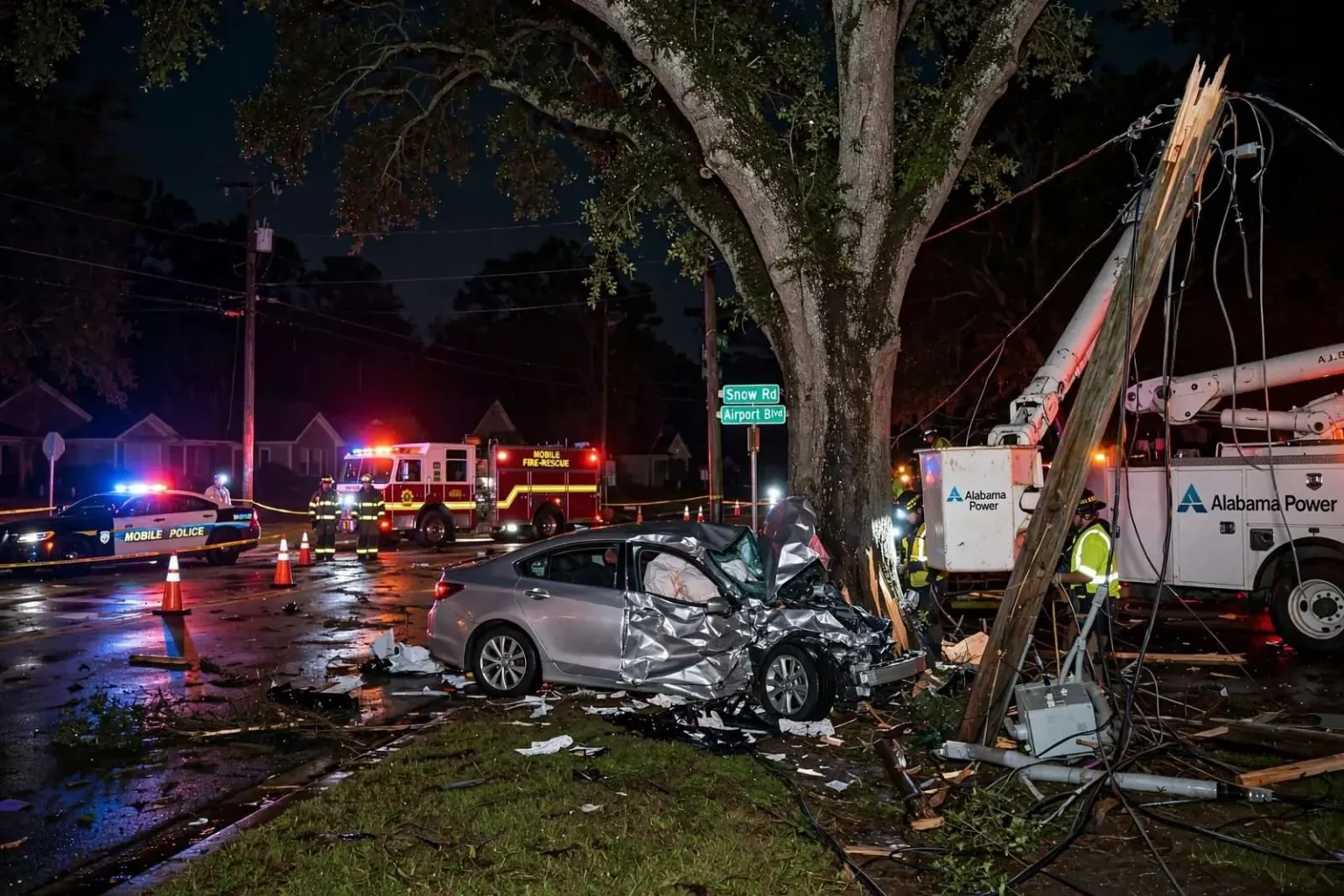
MOBILE, Ala. — A fatal crash on Snow Road near Airport Boulevard killed a 34-year-old woman and briefly cut power to roughly 1,300 homes and businesses in West Mobile, according to state troopers and Mobile police.
Mobile police said the crash occurred around 9:41 p.m. on a Tuesday night in the area of Airport and Snow roads, a busy crossroads in the western part of the city. The vehicle struck a tree, and the impact damaged nearby utility equipment, sending a surge of darkness through the surrounding neighborhoods.
Alabama Power’s outage map showed about 1,300 customers without electricity for slightly more than an hour while crews made emergency repairs. Crews worked through the night to restore service, and the map cleared shortly after the repairs were completed.
The victim
The Alabama Law Enforcement Agency identified the driver who was killed as 34-year-old Holly Duval. Troopers said her car left the road and struck a tree in the crash that damaged the nearby utility equipment.
ALEA troopers continued their investigation into what caused the vehicle to run off the roadway. Authorities did not release additional details about the circumstances of the wreck, and investigators have not said whether speed, impairment, a medical emergency or another factor was involved.
The Alabama Law Enforcement Agency’s Highway Patrol Division handles crash investigations on state and federal routes across Mobile County, and its troopers reconstruct serious wrecks while local police manage traffic and scene security. The intersection area was closed while emergency crews worked, complicating late-night travel through the corridor.
Why utility crashes black out whole neighborhoods
Crashes that damage utility poles or lines are among the most disruptive incidents for West Mobile neighborhoods, where overhead distribution lines follow major collector roads like Snow Road and Airport Boulevard. A single pole carries lines serving dozens or hundreds of homes, so one off-road collision can darken a wide footprint in an instant.
When a car strikes a pole or pulls lines down, Alabama Power crews must de-energize the affected circuits before repairs can begin, both for their own safety and for the safety of anyone at the crash scene. Downed lines are treated as live until crews verify otherwise, and first responders keep bystanders away from the wreckage while the utility works.
The hour-long outage that followed the Snow Road crash was relatively brief by the standards of pole-strike incidents. Repairs can stretch much longer when a pole snaps entirely or when lines fall across roads, requiring bucket trucks, new poles and coordination with police on traffic control. West Mobile residents have experienced both kinds through the years, particularly during storm season.
The roads where it happened
Snow Road runs through the heart of West Mobile, a corridor of subdivisions, schools and small businesses that has grown steadily as the city spread westward toward the county line. Airport Boulevard, which crosses it, is one of the major east-west arteries in the city, carrying commuters between the airport district and the communities beyond Schillinger Road.
The intersection area sits among neighborhoods that rely on both roads daily, and the stretch where the crash occurred has the characteristics of a collector road — connecting local streets to the bigger arterials, carrying school traffic in the mornings and evening commuters after dark. Late-night crashes on such roads tend to occur on straight stretches where drivers, alone and traveling fast, run off the right side of the pavement.
Trees close to the roadway are a persistent hazard on older corridors like Snow Road, where development grew up around established tree lines. While a tree strike is only one of many possible crash outcomes, striking a fixed object of that size is among the most dangerous, and state crash data across Alabama consistently lists collisions with fixed objects among the most fatal crash types.
How the response unfolded
The 9:41 p.m. call brought Mobile police, fire-rescue and Alabama Power crews to the scene within minutes. Officers found the car off the road and against a tree, with damage to the utility equipment nearby, and began managing the scene as the extent of the outage became clear.
Alabama Power’s online outage map, which customers follow during storms and outages alike, reflected the scope of the damage: roughly 1,300 customers dark in the surrounding area. Crews made the emergency repairs to the damaged equipment, and power was restored a little more than an hour after the crash.
Police maintained control of the scene while ALEA troopers conducted their investigation, a division of labor standard in fatal crashes within the city when state routes are involved. The investigation will ultimately produce a report documenting the roadway conditions, the vehicle’s path and whatever evidence indicates why the car left the road.
Emergency dispatchers routed the first calls within seconds of the impact, and the response included firefighters who checked the vehicle, officers who secured the roadway and utility workers who assessed the damaged equipment. The coordination among those agencies is rehearsed constantly in Mobile County, where wrecks involving power infrastructure happen multiple times a year, and it showed in how quickly the scene was made safe and the circuit restored.
West Mobile’s growth and its power grid
The reason a single wreck can darken 1,300 customers in West Mobile lies in how the area developed. As Mobile’s population pushed west through the late twentieth century, subdivisions spread along collector roads like Snow Road, and the electric grid followed the same corridors. Overhead distribution lines strung along these rights-of-way serve the neighborhoods that branch off them, concentrating a community’s electricity on a handful of poles per mile.
That design is efficient and economical, but it concentrates risk. Utilities across the Gulf South balance the cost of burying lines against the frequency of outage causes — storms, falling trees and vehicle strikes chief among them. In practice, most distribution lines in established neighborhoods like these remain overhead, and every pole on a collector road represents a vulnerability that a single driver’s mistake can expose.
Alabama Power crews who responded to Snow Road that night performed the sequence utilities drill constantly: secure the scene, confirm lines are de-energized, replace or repair the damaged equipment, and restore the circuit. An hour from dark to restored power reflects a routine repair; the same crash with a snapped pole could have taken much of a night.
The toll of nighttime run-off-road crashes
Troopers investigating why Duval’s car left the road will work through the standard questions: speed, seatbelt use, impairment, distraction, medical events and roadway conditions. The answers determine not just the official record but whether any traffic charges could follow, and they matter to the family and to the neighborhood that witnessed the aftermath.
Run-off-road crashes at night are among the most common fatal crash patterns on Alabama roads outside the interstates. Darkness removes the visual cues that help drivers judge curves and lane position, fatigue is at its peak late in the evening, and rural and suburban collector roads often lack the lighting and clear zones that give drivers a second chance. When a car departs the pavement at highway speed, the outcome is decided by whatever it meets first.
West Mobile’s corridors have seen fatal crashes of this kind before, and each one renews local attention to the stretches of road where trees stand close to the pavement. Transportation planners describe clear zones — the graded, obstacle-free space beside the roadway — as a key safety feature, but older corridors built through established neighborhoods rarely have room to create them retroactively.
A family’s loss, a neighborhood’s inconvenience
The outage that followed the crash was an inconvenience measured in hours; the loss of Holly Duval is measured on a different scale entirely. A 34-year-old driver was killed on a road she had likely traveled many times, and the investigation into why her car left it will proceed with the care fatal crashes receive.
For the residents and businesses that lost power that Tuesday night, the episode was a small demonstration of how connected the infrastructure of a neighborhood is — how a single vehicle, on a single stretch of Snow Road, can reach a thousand homes at once. For the crews who restored the power and the troopers who investigated the wreck, it was one more night’s work in the routine of a growing corridor.
The intersection of Airport and Snow roads is patrolled regularly, and both roads have seen sidewalk, drainage and signal improvements in recent years as the corridor’s traffic counts have climbed. Still, the fundamental geometry of a tree-lined collector road at night does not change, and drivers moving through that crossroads late in the evening encounter the same conditions Duval’s car faced. Traffic investigators note that the roads themselves rarely explain a crash; the road simply records the outcome of whatever happened in the seconds before impact.
What remains is the investigation itself. ALEA troopers will complete their reconstruction, issue their findings, and close the file on a crash that lasted seconds on Snow Road but left a family grieving and a West Mobile neighborhood briefly in the dark.