Decades Later, Woman Found in Grand Bay Creek in 1976 Still Unidentified, Detective Says
A woman found shot in a Grand Bay creek in 1976 has never been identified, and a Mobile County detective is re-examining the case for DNA leads.
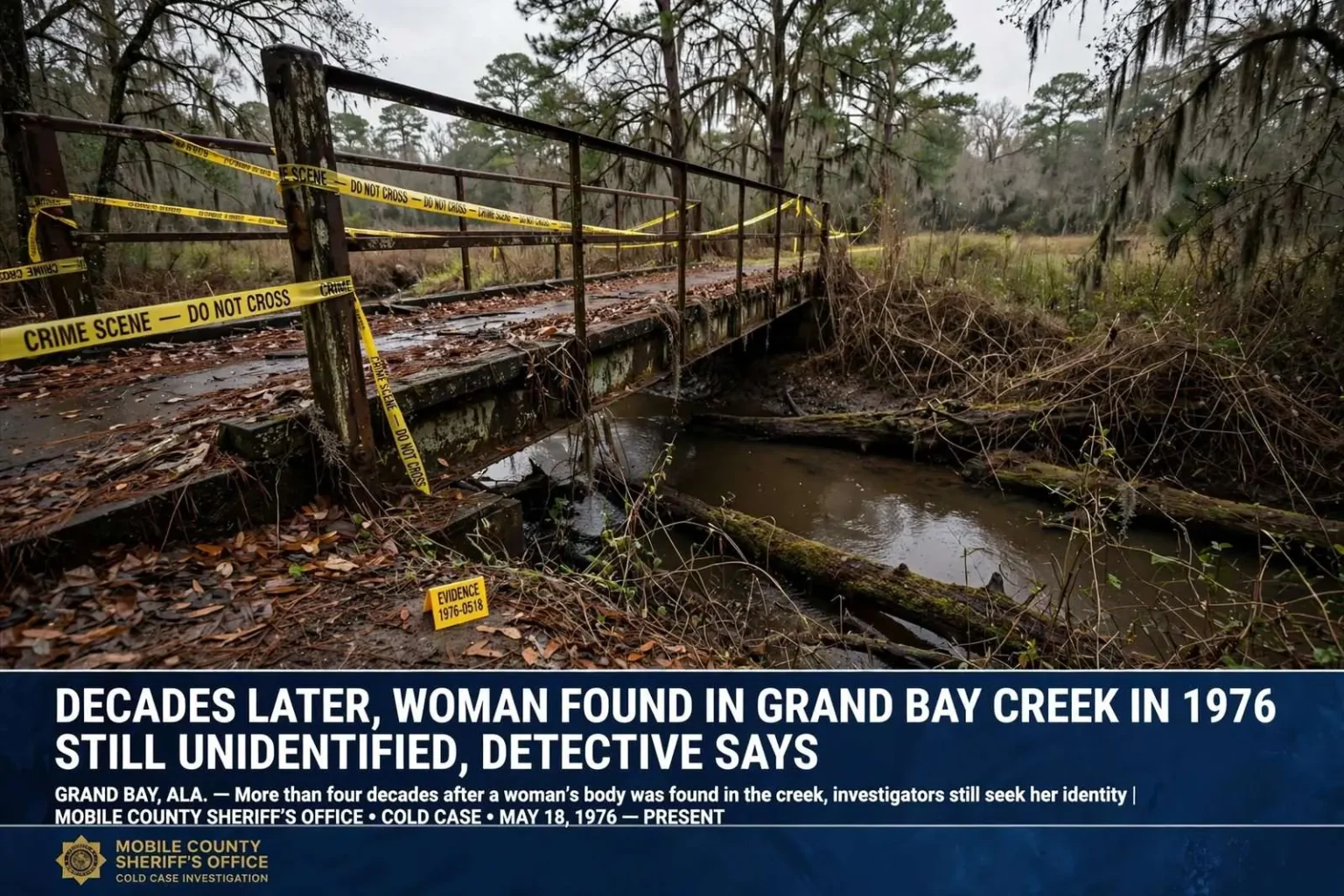
GRAND BAY, Ala. — More than four decades after a woman’s body was found in a creek south of Grand Bay, investigators still do not know who she was, and no one has ever been arrested in her killing, according to the Mobile County Sheriff’s Office. On May 18, 1976, two boys fishing in a creek that runs under Potter Tract Road found the woman floating face down in the water, said Detective J.T. Thornton, who is re-examining the case.
The discovery has haunted the community on Mobile County’s western edge ever since. A woman with no name, pulled from a rural creek by children who were simply out fishing, became one of the region’s oldest unidentified-victim cases — a homicide in which even the most basic question, who she was, has gone unanswered for longer than most of her potential relatives have been alive.
Details of the 1976 Killing
Thornton said the woman had been shot once, at close range, in the back of the head. Her dentures had been removed and her hands cut off, and plastic bags were wrapped around her arms and head. Investigators believe the bags were meant to keep blood from spilling into the trunk of a car, Thornton said, and blood patterns on the roadway suggested one person likely dragged the body from a vehicle and threw it off the Potter Tract Road bridge into the creek.
The condition of the body was no accident, in the detective’s assessment. Removing the dentures and cutting off the hands stripped away the two most reliable means of identification available to 1976 investigators — dental records and fingerprints — and the reading of the scene suggests deliberation rather than panic. Whoever left her there took steps, before the shooting or after, to make certain the woman could not be traced from the creek bank.
The blood evidence told its own story. Patterns on the roadway pointed to a single individual dragging the body from a vehicle and heaving it over the bridge railing, painting a picture of one person physically capable of the act and apparently alone at the moment of disposal. Whether that person acted with accomplices elsewhere in the crime’s chain — the abduction, the killing itself — has never been established.
The victim was estimated to be between 50 and 65 years old, but no missing-person report ever matched the body — something Thornton described as highly unusual. In the ordinary course of such cases, families report a missing mother, aunt or neighbor within days, and investigators work the match from both ends: the unidentified body on one side, the unanswered report on the other. Here, that second end of the thread appears to be missing entirely, and four decades of enquiries have failed to connect her to any report filed anywhere.
That absence has shaped the investigation from the start. A woman in her fifties or sixties does not typically vanish from other people’s lives without notice — she has children, siblings, co-workers, neighbors, a church, a doctor. The lack of any matching report has led investigators across the decades to consider possibilities they cannot confirm: a woman estranged from family, a drifter, someone whose disappearance was noted by no one with standing to file a report. None of those theories has ever produced her name.
A Possible Break That Never Closed the Case
Eighteen years later, a woman’s body found in a pond near the Alabama-Mississippi line — with dentures removed and hands cut off — was identified as Irma Williams, who had been killed in nearby Moss Point, Mississippi. Her son, shipyard worker Henderson James Williams, was convicted in 1996 and died in prison 12 years later.
The parallels were chilling enough to demand attention: two middle-aged women, killed within a short drive of each other eighteen years apart, both denied their dentures and their hands in ways that impeded identification. He was never charged in the 1976 killing, and investigators were never able to build the evidence that would connect him to the Grand Bay victim despite the striking methodological echoes between the two cases.
The comparison nonetheless remains the most productive lead the case has generated. Investigators studying the 1976 murder have weighed whether the same person could have committed both crimes, and whether the younger case — which ended in a conviction — might illuminate the older one. But suspicion is not evidence, and no forensic link between Henderson Williams and the creek victim has ever been established.
Thornton said he recently came across a cast that investigators made of the victim’s mouth in 1976, made in an attempt to match her missing dentures, and he hopes it may contain DNA that could finally identify the woman. Evidence-collection practices in 1976 predate modern DNA analysis by decades, and items preserved for one purpose often turn out to hold biological material their original collectors never imagined could be tested.
The cast represents exactly the kind of overlooked artifact that has broken open cold cases across the country in recent years. Advances in testing now allow analysts to extract usable DNA profiles from samples that would have been useless a generation ago, and genetic genealogy — the technique that builds family-tree leads from DNA profiles uploaded to public databases — has identified suspects and victims in cases that sat unsolved for forty and fifty years.
Should the cast yield a usable profile, the next step would be an attempt to match it against DNA databases of missing persons’ relatives and, if no direct match emerges, against the expanding consumer genealogy pools that have made family-tree identification possible. Either path could restore the woman’s name and, with it, open the door to the investigation of who killed her — an investigation that has been waiting, essentially frozen, since the Ford administration.
Identifying the victim would also transform the case in a quieter way. Unidentified victims are investigated in the abstract; named ones have hometowns, schools, relatives and histories that generate records, memories and leads. The simple restoration of a name has repeatedly proven to be the pivot on which decades-old homicide investigations turn.
Grand Bay and the Long Reach of an Unsolved Case
Grand Bay sits in the western corner of Mobile County, a rural community of farms, small businesses and close-knit neighborhoods strung along the old Highway 90 corridor a few miles east of the Mississippi line. In 1976 the area was even more sparsely settled than today, and the creek beneath Potter Tract Road ran through country where a stranger’s car at a bridge crossing would have been a noticed event — one reason investigators have long believed someone in the area saw something that night or in the days after.
The case has outlasted the natural fading of memory. Witnesses who were young adults in 1976 are now in their sixties and seventies; some have died; recollections have blurred. Cold case detectives work against exactly that erosion, which is why Thornton’s re-examination has focused on physical evidence — the kind that does not age — rather than on reconstructing a witness pool that has largely dispersed.
The Mobile County Sheriff’s Office maintains its cold cases as open files, and detectives periodically return to them as technology and manpower allow. The Grand Bay creek case is among the oldest in the county’s collection, and its enduring anonymity — no name, no arrest, no closure for any family — has made it a recurring subject when the office revisits its unsolved homicides.
“There’s got to be some sort of closure for this lady,” Thornton said. “To just leave her floating face down in the water is unacceptable.”
The detective’s framing captures what drives most cold case work: the conviction that a victim’s claim on justice does not expire. Across the country, investigators have reopened cases decades old on that principle, and the results have included identifications, arrests and convictions in killings that seemed permanently buried. The tools now available — DNA extraction from degraded evidence, genetic genealogy, digitized records from other states — simply did not exist for the generations of detectives who worked the file before Thornton.
The woman herself remains the case’s central mystery. She was old enough that her absence should have been noticed, killed with a brutality that suggests rage or determination, and disposed of with a calculation that suggests planning. Whoever she was, someone transported her to a rural bridge, ended her life at close range and stripped her of the means to be identified — and then vanished into a 1976 landscape without cameras, cell phones or the digital trails that make modern homicides traceable.
Anyone with information about the case — the identity of the woman, the events of mid-May 1976 near Potter Tract Road, or the whereabouts of anyone connected to the creek that spring — is urged to contact the Mobile County Sheriff’s Office or leave an anonymous tip through area crime stoppers. Four and a half decades on, the sheriff’s office is still listening, and the woman in the creek is still waiting for her name.