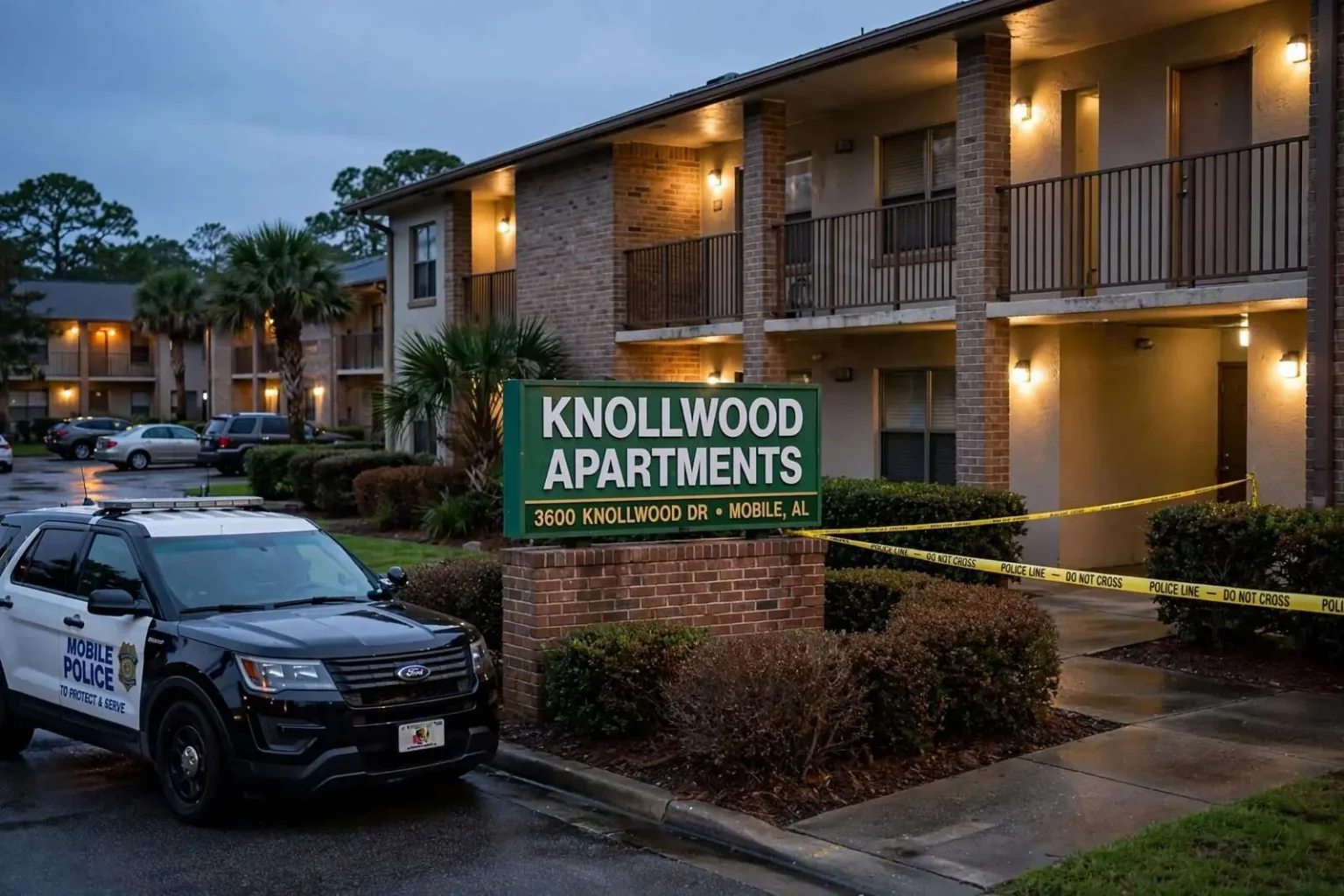
A 28-year-old Decatur woman was arrested Tuesday night after authorities said she assaulted another woman at an apartment complex in Mobile, according to Mobile Police Department records. Frankie Bridges was taken into custody at the Knollwood Apartments on Knollwood Drive after officers were dispatched to the scene around 6:30 p.m. She was transported to the Mobile County Metro Jail following her arrest and booked on a charge of second-degree assault.
According to the arrest records, Bridges is accused of physically assaulting a female victim who was known to her. The victim was reported to have suffered a minor injury in the encounter but declined medical treatment when it was offered, a detail that typically indicates injuries that are painful but not immediately life-threatening. Officers who responded to the complex found the parties involved, established the circumstances of the altercation, and placed Bridges under arrest without further trouble reported at the scene.
The case will now move into the Mobile County court system, where it will be reviewed and handled alongside the thousands of felony filings the district attorney’s office processes each year. Second-degree assault is a felony under Alabama law, and the charge carries the possibility of prison time, fines, and a lasting criminal record if a conviction is entered. Like all defendants, Bridges is entitled to a bond hearing and an initial appearance before a judge, where the conditions of her release pending trial will be determined.
Police departments across Mobile County respond to a steady stream of assault calls each week, and incidents between people who know each other — family members, neighbors, friends, or acquaintances — make up a substantial share of them. Officers on these calls are tasked with sorting out competing accounts, checking for injuries, and determining whether the elements of a crime are present before making an arrest. In this case, MPD records indicate the determination was made to charge the visiting Decatur woman rather than anyone at the residence.
What Second-Degree Assault Means in Alabama
Alabama law divides assault into three degrees, with the classification driven by the seriousness of the injury, the means used, and the status of the victim. First-degree assault, a Class B felony, generally involves causing serious physical injury or using a deadly weapon in the attack. Third-degree assault is a misdemeanor that typically involves recklessly causing physical injury or negligently causing injury with a deadly weapon. Second-degree assault sits between the two as a Class C felony, covering conduct such as intentionally causing physical injury to another person with a deadly weapon or dangerous instrument, or causing physical injury under circumstances the statute specifies.
A Class C felony in Alabama carries a potential sentence of up to ten years in prison and fines that can reach $15,000 for a first offense. Judges have sentencing discretion shaped by the facts of the case, the defendant’s prior record, and Alabama’s sentencing guidelines, which steer the range of punishment for offenders without violent histories. Prosecutors also retain the ability to negotiate pleas to lesser offenses when the evidence or circumstances warrant it, which happens in a large share of assault cases that reach the court system.
Charging decisions at the felony level are rarely the end of the story. After an arrest like this one, the file goes to the district attorney’s office, which reviews the officers’ reports, any witness statements, and the availability of evidence before deciding whether to present the case to a grand jury, offer a plea agreement, or pursue the charge as filed. Victims in assault cases are also consulted under Alabama’s victims’ rights provisions, and their input on how the case proceeds can influence the outcome.
For defendants who cannot afford an attorney, the court appoints counsel, and the arraignment process begins with formal notice of the charge. From there the case proceeds through motions, potential plea negotiations, and possibly trial. Many first-time felony defendants in Alabama are also eligible for consideration of deferred prosecution or other alternative resolutions, though the availability of those options depends heavily on the prosecutor’s assessment of the case and the defendant’s record.
The Knollwood Area and Police Response in West Mobile
The Knollwood Apartments sit in the western portion of Mobile, an area of the city characterized by dense apartment communities, older commercial corridors, and busy thoroughfares that connect the neighborhoods to downtown and to the Interstate 65 corridor. Apartment complexes in this part of the city account for a meaningful portion of the police calls for service in the area, ranging from noise complaints and welfare checks to more serious incidents like the assault reported Tuesday night.
Mobile is divided into police precincts, and officers assigned to a given area patrol it regularly, developing familiarity with the neighborhoods, the businesses, and the recurring problem locations. That geographic assignment system is intended to build relationships between officers and residents and to speed response times when calls come in. When a serious incident like an assault occurs, precinct officers are usually the first on scene, followed by investigators if the case requires further follow-up.
Responding officers on an assault call have several immediate responsibilities. They separate the parties, render aid if anyone is hurt, interview witnesses while their memories are fresh, photograph any visible injuries, and document the scene. They also check for prior calls to the same address, which can be relevant both to the charging decision and to any protective measures a victim might need. The report generated at the scene becomes the foundation of the case file that prosecutors later review.
From Arrest to Jail Booking
Once an arrest is made in Mobile County, the defendant is typically transported to the Mobile County Metro Jail on Bishop L. W. Downing Street, the primary intake facility for people arrested within the county. The booking process includes recording the defendant’s identifying information, photographing and fingerprinting, running criminal history checks, and conducting a health screening. The jail also holds people awaiting trial who cannot make bond, alongside those serving shorter sentences.
Jail operations in Mobile County have been a subject of public attention over the years, with the facility regularly housing a population well above its designed capacity. The sheriff’s office that runs the jail has periodically discussed expansion plans and management changes as it works to handle the volume of arrests that flow through the system daily. For the people booked in, the process from arrest to first court appearance generally happens within a few days, though the full life of a felony case stretches far longer.
For residents of the Knollwood community and surrounding neighborhoods, an arrest like Tuesday night’s is a reminder of how quickly a dispute can escalate into a criminal matter with lasting consequences. Police encourage anyone who witnesses a violent altercation to call 911 immediately rather than intervene directly, and to provide descriptions of those involved and any vehicles leaving the area. Witnesses who come forward promptly give investigators the best chance of building an accurate account of what happened.
Assault cases involving people who know one another also raise questions about safety planning for the victim. Advocates in Mobile County work with people who have been threatened or hurt by someone they know, helping them understand protective order options through the district court and connecting them with local resources. Alabama’s protective order process allows a judge to order a respondent to stay away from a petitioner’s home, workplace, and vehicle, and violations of those orders carry their own criminal penalties.
What Happens Next in the Case
In the days and weeks ahead, the case against Bridges will appear on the Mobile County court docket. An initial appearance will be held, where the charge is formally presented and bond conditions are set. From there, the case enters the pretrial phase, during which defense counsel may file motions, review the evidence through the discovery process, and engage in negotiations with the district attorney’s office. If the case is not resolved by agreement, it proceeds toward trial.
Felony assault prosecutions can take many months to reach resolution in a busy jurisdiction like Mobile County, where the courts balance a full calendar of criminal, civil, and family matters. Continuances are common as attorneys prepare, witnesses become available, or plea discussions continue. The victim in the case will be notified of key proceedings under Alabama law and has the right to be heard at sentencing if a conviction occurs.
For the immediate neighborhood, the incident closed as quickly as it opened, with officers clearing the scene after the arrest was made. No ongoing threat to the wider community was reported in connection with the call, and the Mobile Police Department did not indicate that additional suspects were being sought. Anyone with information relevant to the case can contact the Mobile Police Department directly or leave an anonymous tip through the department’s tip line.
Residents who see a dispute escalating are reminded that early calls to police often prevent injuries. Officers would rather respond to a loud argument than to an assault scene after the fact, and the department consistently encourages people to report concerning behavior before it turns violent. Tuesday night’s arrest reflected that same principle in reverse — a quick response, a victim who declined treatment but survived the encounter, and a suspect now answering to the charge in the county’s court system.