
Delta Adds to A220 Order as Mobile’s Newest Airbus Line Prepares to Hire
Delta has ordered 15 additional Airbus A220s for a total of 90, as construction and hiring begin for Mobile's second final assembly line.
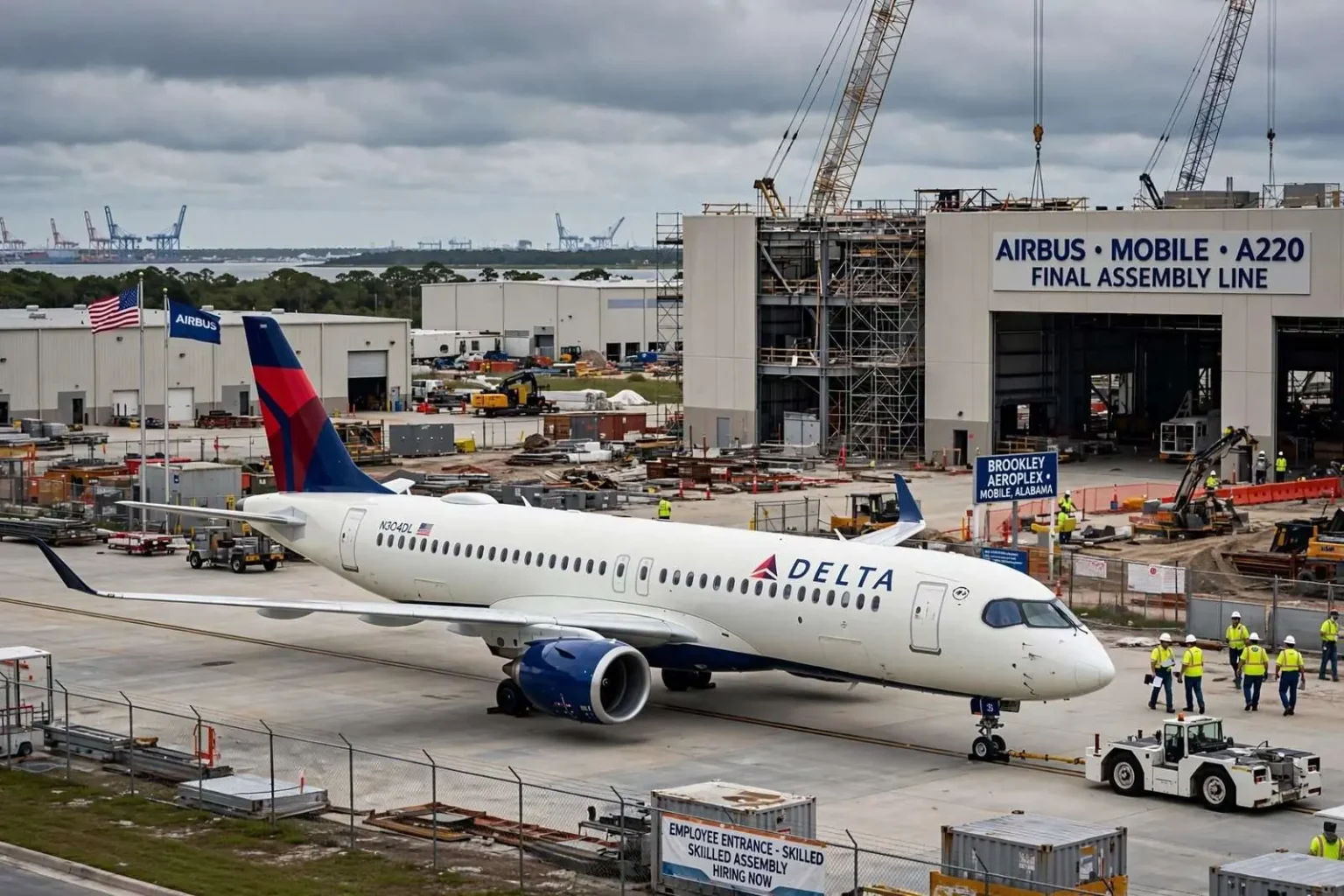
Mobile’s second Airbus final assembly line has not yet turned out a single aircraft, but the order book for the jet it will build keeps growing. Airbus announced Wednesday that Delta Air Lines has ordered 15 more A220s, bringing the carrier’s total commitment to 90 aircraft to be built for the airline. The fresh order lands as construction on the Mobile assembly line prepares to begin and hiring accelerates for the skilled workers who will staff it.
“We look forward to taking our first A220-300 in 2020 at the Airbus assembly facility in Mobile, Alabama,” said Gil West, Delta’s chief operating officer. The statement underscored the airline’s expectation that its smallest jets in the fleet will be delivered from the Gulf Coast, not just from the program’s original production site in Mirabel, Quebec, where the A220 has been assembled since its development as the Bombardier C Series.
Construction and Hiring Both Ramping Up
Construction on the A220 assembly line is scheduled to begin next week. Airbus said it will start hiring this week for several skilled positions tied to the program, including aircraft structure and installation mechanics, installers for aircraft cabin furnishings, and aircraft electricians. Those roles represent the backbone of any final assembly line, where major structural sections are joined, systems are routed and installed, and cabins are fitted out before an aircraft rolls out for painting, testing and delivery.
The hiring push comes at a moment when Mobile’s aviation workforce is already among the deepest in the region. Airbus established its first American final assembly line at the Brookley Aeroplex in 2015 and has steadily expanded the campus, drawing a cluster of suppliers and aviation service firms to the area around Mobile’s downtown airport. Local training pipelines, including programs developed with two-year colleges and workforce boards along the Gulf Coast, have been built specifically to feed assembly-line jobs of the kind now being posted.
The A220 line is the second final assembly line Airbus has established at its Mobile campus, following the A320 family line that opened earlier and made the city one of a small group of places worldwide assembling major commercial aircraft. That distinction matters for the region’s economy: final assembly lines anchor supply chains, generate steady payroll across hundreds of workers, and signal to other aerospace companies that the Gulf Coast can support the most demanding manufacturing work in the industry.
Why the A220 Matters to Delta
For Delta, the enlarged A220 commitment reflects the jet’s role as the backbone of its narrow-body renewal. The A220 family, spanning the smaller A220-100 and the longer A220-300, was designed for the 100-to-150-seat segment with a range that lets airlines fly longer, thinner routes than older regional jets could handle economically. Delta has positioned the type on both short hops and transcontinental sectors, citing fuel burn savings of roughly 20 percent or more compared with the aircraft it replaces, a margin that compounds meaningfully across a fleet of 90 jets.
The aircraft’s economics are central to its appeal. The A220 was the first commercial jet designed around Pratt & Whitney’s geared turbofan engine family, which delivers substantially lower fuel consumption and quieter operation than the previous generation. For a carrier flying thousands of segments a week, that efficiency translates directly into route profitability on markets that would otherwise be marginal. Cabin design also plays a role: wider seats in a standard three-by-two configuration and larger windows have made the type popular with passengers, giving Delta a marketing edge on the routes where it flies.
Building the jets in Mobile shortens the delivery pipeline for the airline. Delta already takes A321s from the Mobile A320 family line, and adding A220 assembly means its two most important narrow-body programs will both be produced on American soil. For the airline’s scheduling planners and maintenance operation, receiving new aircraft from a nearby plant simplifies logistics compared with importing airframes from Europe or Canada, and it gives Delta a stake in the Gulf Coast’s growing aerospace labor pool.
Mobile’s Ascent in Commercial Aerospace
The Mobile campus’s expansion is the latest chapter in an effort that began more than a decade ago when the city, county and state assembled an incentive package to lure Airbus to the former Brookley Air Force Base. The site, closed as a military installation in the 1960s, was redeveloped as the Brookley Aeroplex and had long been viewed by economic developers as an underused asset: a deepwater port city with an airport, rail access and an interstate connection, sitting on the Gulf of Mexico. Airbus’s decision to build there turned the theory into reality, and the subsequent arrival of supplier facilities around the aeroplex validated the strategy.
The A220’s arrival also fills out the product range assembled in Alabama. With the A320 family line producing the workhorse single-aisle jets that dominate the middle of the market, and the A220 covering the smaller end, Mobile now touches the segments where most of the world’s airline orders concentrate. The company’s long-stated goal has been for Mobile to serve American and other customers across both families, and the Delta order gives the new line a flagship customer from day one.
The economic ripple effects extend beyond the assembly hall. Each final assembly job supports employment at supplier plants that fabricate subassemblies, in the trucking and logistics firms that move sections and parts, and in the service businesses that grow around a large industrial payroll. Workforce analysts in the region have pointed to aerospace as one of the highest-paying manufacturing sectors on the Gulf Coast, and the positions Airbus is now posting — structure mechanics, cabin installers and electricians — typically come with training pathways that workers can carry across the industry.
What Comes Next
With construction set to begin within days and hiring already open, the next milestones are physical ones: steel rising at the campus, production tooling arriving, and the first hired classes moving through training before the line’s first aircraft enters assembly. Airbus has not announced the exact date the first Mobile-built A220-300 will roll out, but Delta’s statement that it expects its first delivery in 2020 gives the program a clear target, and meeting it will require the hiring and construction to stay on schedule.
For Mobile residents, the practical effect is a steady stream of skilled manufacturing openings at a company that has become one of the region’s anchor employers. Job seekers with aviation experience — or with the mechanical aptitude that the company’s training programs can build on — are the target audience for the current posting. The pattern set by the A320 line, where hiring came in waves ahead of each production milestone, is expected to repeat as the A220 line moves toward its first deliveries.
The Delta order also sends a signal to the broader aerospace market about confidence in the Mobile operation. Airlines place orders for jets years ahead of delivery, and committing to 90 aircraft — with the newest 15 confirmed while the Alabama line is still under construction — amounts to a public bet that the Gulf Coast plant will deliver on time and to standard. For a city that two decades ago had no commercial aerospace manufacturing to speak of, the announcement marks another step in Mobile’s transformation into one of the industry’s significant American production centers.
Between the construction start next week, the hiring already underway and a customer order book that keeps expanding, the second Airbus final assembly line is arriving at a moment of momentum. When the first Mobile-built A220-300 is handed to Delta, it will close the loop on a project that began with a bet on Brookley and now underpins a growing share of the region’s industrial economy.
Delta’s deepened commitment also reflects the competitive positioning of the A220 against rivals in the small single-aisle market, where airlines are replacing aging regional jets and early-generation narrow-bodies. The 90-aircraft total puts the Atlanta-based carrier among the type’s largest customers worldwide and gives it flexibility across both the A220-100 and the stretched A220-300, which it can deploy interchangeably on routes of different lengths and demand levels. Industry observers have noted that once an airline reaches the scale Delta has with the type, crew training, maintenance inventory and scheduling all become easier to manage, which tends to encourage further orders rather than a switch to a competing model.
The timing of the announcement, coming in the same week that construction permits the line’s physical start, underscores how closely Airbus’s commercial and industrial tracks are running together in Mobile. Order momentum gives the company confidence to build; a modern, efficient plant gives airlines confidence to order. For the Gulf Coast workforce now being recruited, that alignment is good news: a well-subscribed program is far more likely to sustain steady production, and steady production is what turns a round of hiring into a durable career path in one of Alabama’s fastest-growing industries.


