Deputies Clear Semmes Walmart After Anonymous Bomb Threat; Nothing Found
The Mobile County Sheriff's Office searched the Semmes Walmart after an anonymous bomb threat. Nothing was found and the store reopened.
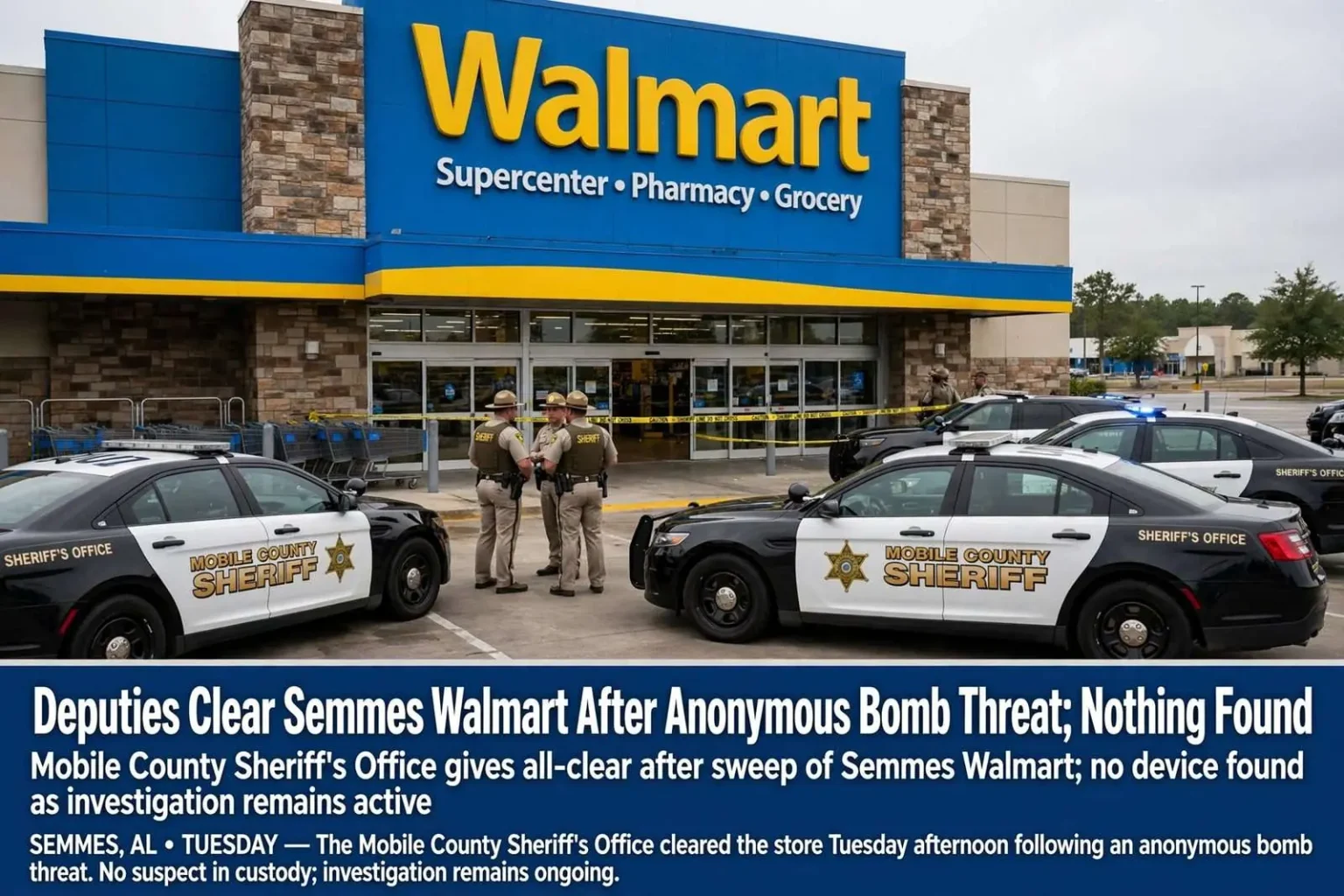
The Mobile County Sheriff’s Office responded to a bomb threat at the Semmes Walmart, sweeping the store before giving employees and shoppers the all-clear. Authorities said an anonymous caller claimed a bomb had been placed inside the store, prompting a coordinated search of the building on one of the busiest retail corridors in western Mobile County. Deputies searched the structure and found nothing, and the store was cleared for customers and employees to return.
No suspect was in custody as of Tuesday afternoon. The sheriff’s office said it was still working to determine whether the threat was credible, and the investigation remained active. While the search ended without any device being located, the response disrupted shopping for hundreds of customers and put deputies, store managers, and emergency dispatchers through the standard — and resource-intensive — playbook that follows every reported bomb threat in the county.
How a Bomb Threat Response Unfolds
When a call like the one made to the Semmes Walmart comes in, dispatchers immediately route the information to deputies in the field while store personnel begin moving shoppers and employees out of the affected area. The decision to evacuate or search in place depends on the specificity of the threat, the size of the building, and what responders know about the caller. Large-format retail stores like Walmart present a particular challenge: tens of thousands of square feet of shelving, stockrooms, loading docks, and blind corners that cannot be cleared quickly.
Sheriff’s deputies conducting the sweep generally work with store management and, when warranted, fire and emergency medical personnel staged nearby. They focus first on high-risk areas — places where an object could be concealed and where a device would do the most harm — before moving through less critical sections. In this case, the sweep produced no device, and authorities gave the all-clear for employees and customers to return to the store.
The Law in Alabama
Under Alabama law, making a false report of a bomb or other destructive device is a serious crime. A person who reports a false bomb threat can face felony charges, and the potential consequences increase when the threat triggers an evacuation, ties up emergency resources, or causes injuries. Terroristic threat statutes in the state are written to cover exactly this scenario — a communication intended to cause fear or the evacuation of a building, whether or not any device actually exists.
Investigators also have tools available that did not exist a generation ago. Store surveillance systems, cell phone records, and payment and loyalty data can often identify a caller or place a suspect at the scene, and police departments and sheriff’s offices across the region have made arrests in similar cases after tracing calls made from parking lots, pay phones in the era before cell phones, or devices connected to a specific account. The anonymity of a threatening call is rarely as complete as the caller assumes.
Bomb threats against retail stores, schools, and government buildings carry costs beyond the immediate response. Deputies pulled away from patrol zones leave other parts of the county with thinner coverage, and the store loses revenue for every minute it remains closed. That is why law enforcement agencies across Alabama treat every threat as real until proven otherwise — and why they pursue the people who make them.
Semmes and the Sheriff’s Jurisdiction
Semmes, incorporated as a city in 2011 after decades as a fast-growing community west of Mobile, sits along U.S. 98 and Moffett Road, corridors lined with the retail and service businesses that serve the area’s residential growth. Its Walmart is one of the largest commercial destinations in the city, drawing shoppers from Semmes, Wilmer, and surrounding rural areas of western Mobile County. Because Semmes does not operate its own large police department, the Mobile County Sheriff’s Office provides primary law enforcement services to the municipality — which is why deputies, not city officers, led the response to Tuesday’s threat.
The Sheriff’s Office covers a sprawling jurisdiction that includes both densely populated suburbs near the city limits and rural communities stretching toward the Mississippi line. Deputies there routinely handle everything from traffic crashes and property crimes to threats like this one, and the agency maintains specialized support through its investigations division for cases requiring follow-up. A threat case that begins with an anonymous call typically moves into that division once the immediate scene work is done.
What Authorities Are Still Working to Determine
As of Tuesday afternoon, the sheriff’s office had not said whether the caller made any demands, used a specific method to contact the store, or referenced anything that could suggest detailed knowledge of the building. Those details matter to investigators. A threat with specific, credible-sounding details is treated differently from a vague one, and the language of a call can help investigators profile the person behind it — whether a juvenile acting impulsively, a disgruntled employee or former employee, or someone attempting to disrupt business for another reason.
The question of credibility that the agency said it was still weighing is a standard part of threat assessment. Even after a search finds nothing, investigators continue evaluating whether the caller may have had access to the building at another time, whether a device could have been removed, and whether the call fits into a pattern of similar threats in the region. Businesses in the Mobile area, as elsewhere, occasionally experience clusters of false threats, and investigators compare notes across jurisdictions when that happens.
Guidance for Businesses and the Public
Law enforcement agencies across the Gulf Coast regularly remind businesses that bomb threats should always be reported immediately, never dismissed as pranks. Store employees are trained to note as much as they can about a call — the caller’s voice, background noise, exact wording, and the time — because those details become the foundation of the investigation. Customers who see unattended bags or suspicious items in a store are encouraged to alert staff rather than investigate on their own.
For residents of Semmes and western Mobile County, the episode ended the way these incidents usually do: with a long, careful search, a nervous afternoon for workers and shoppers, and an eventual all-clear. The sheriff’s office has asked anyone with information about the call to come forward, and the investigation remained active as of Tuesday afternoon. Anyone with tips can contact the Mobile County Sheriff’s Office, and callers who wish to remain anonymous can do so through the agency’s tip lines — the same anonymity the original caller counted on is available, investigators note, to the people who can help identify them.
A Familiar Pattern for Retail Security
Threats against big-box stores have become an unfortunate staple of the modern retail environment, and Walmart locations in particular have been frequent targets across the country because of their size, their visibility, and the sheer number of them. Security teams for national retailers maintain their own protocols that mesh with local law enforcement responses — employee accountability rosters, camera systems that can be reviewed quickly, and corporate incident lines that escalate a threat to regional loss-prevention specialists within minutes.
In a typical response, the store’s manager or asset protection coordinator relays the threat to 911, and the first deputy on scene assumes incident command until the search concludes. Employees are moved to a designated assembly area where they can be accounted for, while arriving customers are turned away and redirected. The length of the search depends on the store’s size; a Supercenter can take an hour or more to clear properly. Throughout, dispatchers log the timeline, which later becomes part of the investigative record — and, if an arrest is made, part of the evidence presented to prosecutors.
The Cost to the Community
Beyond the immediate disruption, false threats impose real costs on the community that pays for its emergency services. Every deputy dispatched to the scene is a deputy not available for other calls, and in a county the size of Mobile, response times elsewhere in the district stretch out for the duration of the incident. Fire and EMS units that stage on standby, dispatchers managing the surge of radio traffic, and investigators who spend days working the case afterward all represent public resources devoted to a call that, in this instance, produced no device and no injuries.
There is also a human cost that is harder to quantify. Employees who spent their shift evacuating mid-task, customers whose children watched deputies sweep the aisles, and shoppers who now think twice before entering the store all carry away some measure of anxiety. Researchers who study threat behavior note that each incident that ends without consequences — as this one had by Tuesday afternoon, with no suspect in custody — can embolden copycats. That is why agencies publicize the potential felony charges and follow through on prosecutions when they identify a caller.
For now, the Semmes Walmart is back open, its shelves restocked and its parking lot full again, while the Mobile County Sheriff’s Office continues working the case behind the scenes. Anyone with information about the anonymous call is asked to contact the agency, and investigators say even small details — the sound of a voice, the time of the call, anything a customer or employee may have noticed before the evacuation — could help close out a case that began with a phone call and ended, thankfully, with an all-clear.