Deputies Kill Man Who Opened Fire on Them in Baldwin County’s Perdido Community
A man opened fire on two Baldwin County deputies in the Perdido community before dawn; deputies returned fire, killing him.
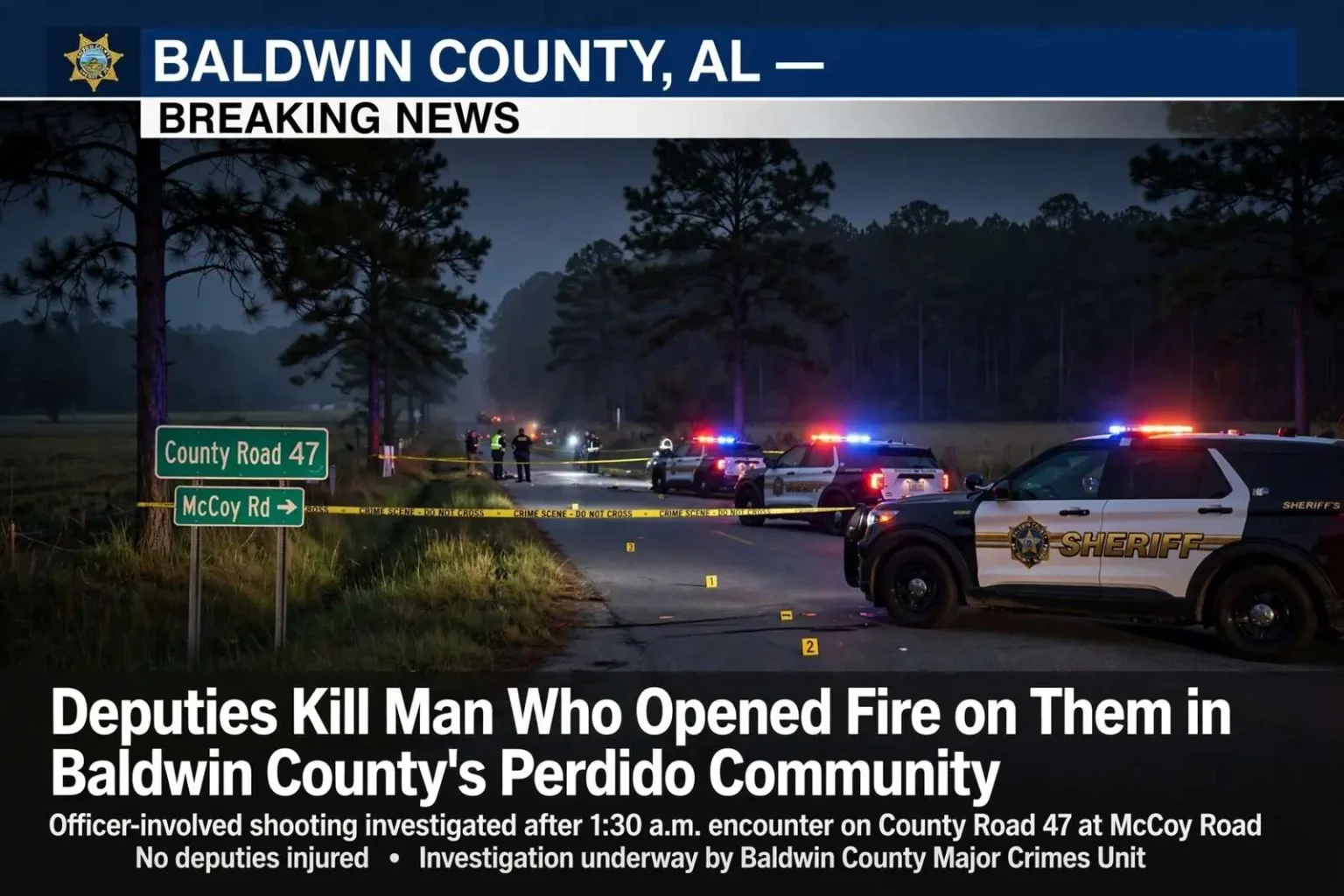
BALDWIN COUNTY, Ala. — A man was shot and killed by Baldwin County sheriff’s deputies early Wednesday after authorities say he opened fire on them during an encounter in the rural Perdido community. The shooting, which took place in the pre-dawn darkness of one of the county’s most rural corners, left investigators with the careful work that follows every officer-involved shooting: documenting a scene, accounting for evidence and walking the community through what happened.
According to the Baldwin County Sheriff’s Office, two deputies on patrol contacted a suspicious person walking along County Road 47 at McCoy Road at about 1:30 a.m. The area is a crossroads of farmland and forest in the county’s northwestern reaches, where the road grid runs through acreage rather than subdivisions and where a person walking at that hour stands out sharply against the ordinary emptiness of the night. Deputies stopped to identify the man — a routine contact that deputies conduct constantly on rural roads, checking welfare and investigating anything that seems out of place.
While deputies were attempting to identify him, officials said the man produced a gun and fired at the deputies, who returned fire and killed him. The exchange, compressed into seconds, transformed a suspicious-person call into a fatal shooting. In accounts of such encounters, investigators will reconstruct the sequence from physical evidence — shell casings, bullet paths, the positions of vehicles and people — along with radio traffic and any recordings from the deputies’ equipment. The agency’s public account of the event, issued the same day, described the deputies’ actions as a response to being fired upon.
No deputies hurt; investigation begins
Neither deputy was injured in the exchange of gunfire, the agency said. Both deputies were placed on the administrative status that follows any shooting by an officer, pending the outcome of the review. Their names, and the name of the man who was killed, were not immediately released — a sequence that has become standard practice while next-of-kin notifications are made and investigators gather the facts that give a name context. Authorities did not immediately release the identity of the man who was killed or the identities of the deputies involved.
The shooting is being investigated by the multi-agency Baldwin County Major Crimes Unit, which handles officer-involved shootings in the county. The unit exists precisely for moments like this: by pooling investigators from multiple agencies, it removes the appearance of an agency investigating its own officers and puts the inquiry in the hands of detectives who work these scenes regularly. The investigation will examine whether the deputies’ actions were consistent with state law and departmental policy on the use of deadly force, a determination that ultimately goes to the district attorney for review.
That review typically proceeds in stages. Investigators process the scene and the evidence, interview the deputies involved and any witnesses, and collect records from the sheriff’s office — training files, radio logs and prior contacts with the individual, if any. Findings are then presented to the district attorney, who decides whether the use of force was legally justified under Alabama law, which permits deadly force in defense of self or others against a threat of death or serious physical injury. The process can take weeks or months, and agencies generally release their full account only when the review concludes.
The Perdido community and rural policing
Perdido sits in the rural northwest of Baldwin County, one of the fastest-growing counties in Alabama, though growth in the county has concentrated in its southern corridors along Interstate 10 and the Gulf shores. The northern communities — Perdido, Bay Minette’s outskirts, the piney woods toward the Monroe County line — remain the Baldwin County of another era: small churches, family land, and long stretches of road where the most common calls are thefts, domestics and traffic. Deputies patrolling those roads know that the distance between a mundane contact and a dangerous one is measured in seconds, and the encounter at County Road 47 and McCoy Road illustrated the point in the starkest terms.
Suspicious-person calls in rural areas carry their own logic. A person walking along a rural highway at 1:30 a.m. may be stranded, intoxicated, experiencing a crisis, or deliberately avoiding notice — and deputies cannot know which until they make contact. Standard procedure is to stop, identify the person, and check for outstanding warrants or flags. Those contacts resolve thousands of times a year without incident; the times they do not are the ones that end in reviews like the one now underway.
The sheriff’s office’s decision to route the case to the Major Crimes Unit reflects a practice that has taken hold across Alabama and the nation. Officer-involved shootings generate intense public scrutiny, and the credibility of the outcome depends on the independence and rigor of the investigation. Multi-agency units, with investigators who have no stake in the involved officer’s agency, are designed to provide both. Their reports, when completed, typically document the evidence in detail and form the basis for the district attorney’s public determination.
What the community can expect
In the days ahead, residents of the Perdido area are likely to see continued law enforcement activity along County Road 47 as investigators return to the scene and canvass for cameras or witnesses. Anyone who saw or heard the encounter — including drivers who passed earlier in the night — is typically asked to contact the sheriff’s office or the Major Crimes Unit directly. Rural residents sometimes hold pieces of evidence they don’t recognize as such: a dashboard camera’s timestamp, a security light’s motion activation, a memory of a vehicle in the area.
The identity of the man who was killed, once released, will add the biographical context that names always bring — who he was, where he was from, and what, if anything, is known about how he came to be walking a rural road in the middle of the night. Until then, the account remains the one the sheriff’s office provided: two deputies, a suspicious person, a gun produced and fired, a return of fire, and a man dead in the dark on a Baldwin County crossroads. The Major Crimes Unit’s investigation will now fill in everything the first reports leave out, and the district attorney will ultimately say whether the deputies’ actions that night were within the law.
Inside an officer-involved shooting investigation
The work of the Major Crimes Unit at a scene like the one on County Road 47 follows a demanding protocol. Investigators establish a perimeter and hold it until every piece of physical evidence is photographed in place: the casings that mark where shots were fired and from what positions, the vehicles and their damage, the weapons involved, and the geography of the roadway itself. A shooting reconstruction may include laser mapping of bullet trajectories and measurements that, combined later with autopsy findings, allow investigators to describe the encounter with precision — who was standing where, in what order events unfolded, and how many shots were fired from which direction.
The deputies involved are interviewed separately after the immediate aftermath, following the standard cooling-off period that departments observe to let the physiological effects of a life-threatening encounter subside. Their statements are matched against the physical evidence, and any body camera or dash camera footage is examined frame by frame. Investigators also look backward: Was the man known to the agency? Were there prior calls at that location? Was there anything in his recent history that speaks to the encounter? And they look outward, canvassing the rural neighborhood for anyone who heard gunfire or saw a vehicle in the hours before 1:30 a.m.
The result, when the work is done, is a file that answers the questions the community most wants addressed: why deputies stopped the man, how the gunfire began, and whether the deputies had any alternative course available. In Alabama, the legal standard evaluates whether a reasonable officer in the same position would have perceived a threat of death or serious injury — a test applied to the split-second circumstances deputies faced, not to the calm of hindsight.
Deputies, training and the split second
The two deputies involved will carry the weight of the encounter regardless of the outcome. Law enforcement training devotes extensive hours to exactly this scenario — the contact that turns violent — but no amount of training makes the decision to fire an uncomplicated one. Officers involved in shootings routinely describe the following days as disorienting: administrative leave, interviews, the scrutiny of an investigation and the slow return to normal duty, all while the community forms its judgments. Departments across Alabama have expanded mental health support for officers after critical incidents, recognizing that the toll of a shooting does not end when the paperwork does.
For the sheriff’s office, the incident will also prompt its own administrative review, separate from the criminal inquiry — an examination of policy, tactics and training that asks whether anything about the response should change. That review runs in parallel with the Major Crimes Unit’s work and the district attorney’s determination, and its findings, like the others, will become part of the public record in time.
The Perdido community, meanwhile, is left with the questions that follow every fatal shooting in a small place. The crossroads where the encounter occurred will return to its ordinary quiet, but the investigation into that night will continue — methodically, with the independence the Major Crimes Unit was created to provide — until it can tell the full story of how a suspicious-person contact on a dark Baldwin County road became the county’s latest officer-involved shooting.