DeSantis signs order banning vaccine passports in Florida
Florida Gov. Ron DeSantis signed an order banning vaccine passports for travel and businesses, citing privacy concerns and drawing mixed reaction in.
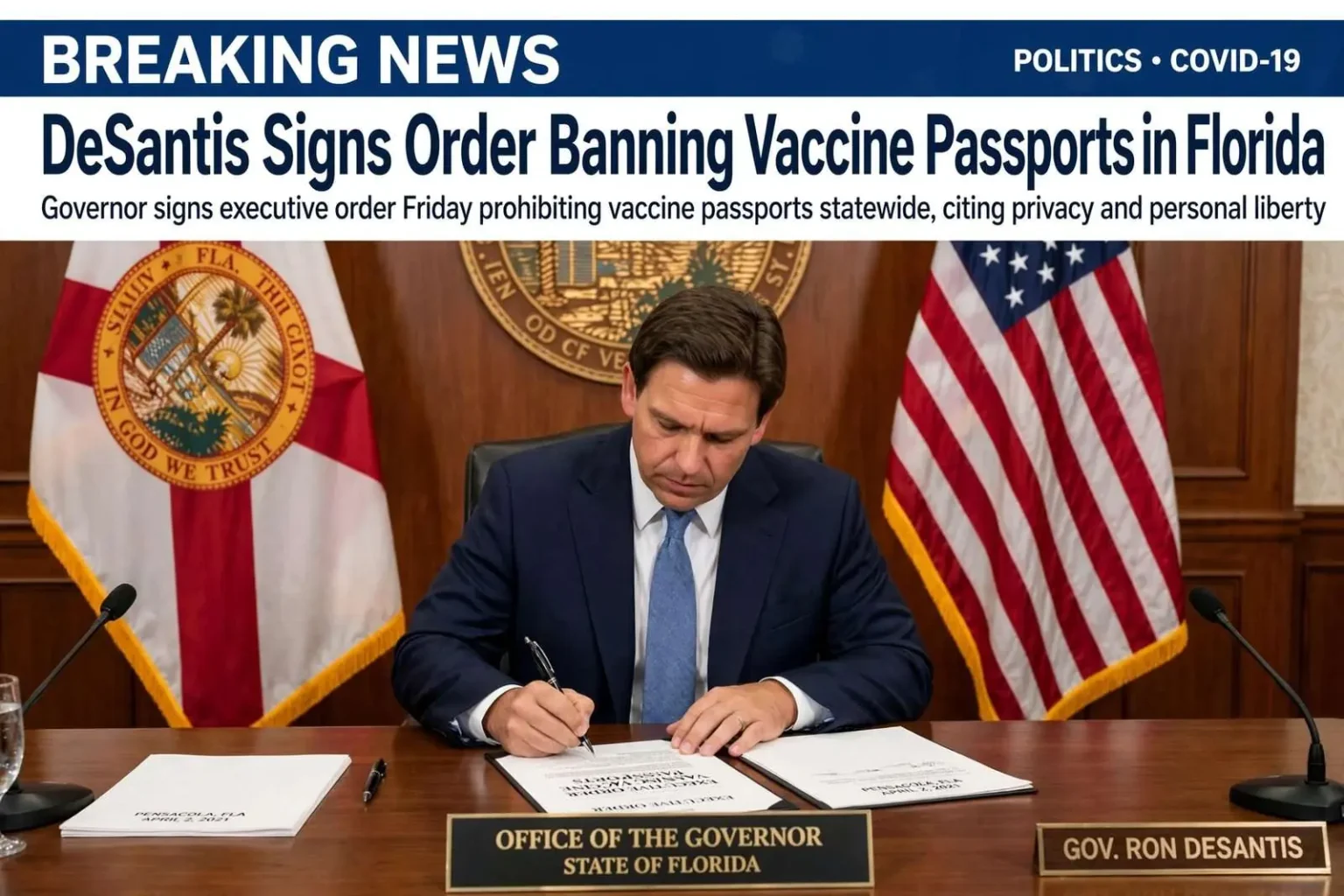
PENSACOLA, Fla. — Florida Gov. Ron DeSantis signed an executive order Friday banning vaccine passports in the state, moving decisively as federal leaders debated the idea. A vaccine passport could be a digital proof of vaccination stored on a phone — a credential a business or venue might scan at the door — and under the order, the ban applies not only to travel but also to businesses. With the signing, Florida became one of the first states in the nation to prohibit government and private entities from requiring customers to show proof of a COVID-19 vaccination before receiving service.
The question of whether someone would need to show proof of vaccination to enter an airport, stadium or restaurant had become a flashpoint across the country in the early months of 2021, as vaccination campaigns accelerated and businesses weighed their own policies. Airlines, cruise lines, sports franchises and theme park operators all faced pressure to consider health credentials, while civil liberties groups and some business owners raised objections to the idea of conditioning everyday commerce on medical paperwork. Florida, with its massive tourism economy, sat at the center of that debate.
“I mean give me a break,” DeSantis said at a news conference. “I think this is something that has huge privacy implications. It is not necessary to do. You wanna go to a movie theater. Should you have to show that? No. You want to go to a game? No. You want to go to a theme park? No.”
The governor’s argument framed the passports as a privacy risk rather than a public health tool, and he cast the executive order as a defense of ordinary commerce. Florida’s economy leans heavily on tourists, retirees and seasonal visitors, and requiring digital health credentials — he argued — would add friction to travel and entertainment while creating databases of personal medical information that did not previously exist. The order effectively settled the question for Florida businesses: whatever other states or the federal government might do, no vaccine passport would be required in Florida.
A National Debate Reaching the Gulf Coast
The debate was not confined to Florida. Some other countries moved to require proof of vaccination for entry to restaurants, venues and international travel, adopting digital and paper credential systems as they reopened. The Biden administration, for its part, pushed for federal standards for the private sector without creating or mandating passports — signaling that any credential system would be developed and adopted by private industry rather than issued by the government, and leaving businesses to decide whether to ask for proof of vaccination at all.
That middle position satisfied few people on either side. Public health advocates argued that verifiable vaccination status could speed the reopening of travel and large venues, while opponents saw any standardized credential as a step toward forced disclosure of private medical decisions. Into that argument stepped governors, legislatures and state health departments across the country, some moving to create their own credential systems and others — like Florida — moving to forbid them outright.
In Pensacola, the westernmost city in the Florida Panhandle and a community whose daily life is closely tied to neighboring Alabama, residents were divided. “He should leave it open though because if you want to like show that you got vaccinated you can show it,” one resident said, reflecting a view that voluntary proof of vaccination should remain an option for those who wanted the reassurance. Another argued the opposite, saying businesses should be free to set their own rules — a position that accepted the governor’s outcome but arrived at it by a different road, trusting private owners rather than state government to draw the line.
The split opinion in Pensacola mirrored the split across the Gulf Coast region, where communities straddle state lines and feel the effects of policy differences on both sides. Residents of the Pensacola area cross into Alabama routinely for work, shopping and travel, and any system of health credentials adopted in one state but not the other would create visible differences in daily life — a restaurant requiring proof on one side of the line and not the other, an airport process that changed at the state border.
What the Order Actually Did
Executive orders carry the force of law for state agencies and set policy direction for how existing statutes are enforced, and DeSantis’s order directed state agencies not to issue or recognize vaccine passports while barring businesses from requiring them from customers. The order stopped short of restricting businesses that voluntarily offered perks to vaccinated customers, a distinction the governor acknowledged as he balanced the privacy argument against Florida’s longstanding deference to private enterprise. Lawmakers in the Florida Legislature followed the order with legislation to codify the ban, extending it into state law in the session that followed.
For Florida’s tourism industry, the order removed an uncertainty that had been hanging over the summer season. Theme parks, cruise terminals and hotel operators in Orlando, Tampa and along the coasts had been watching the credential debate closely, aware that their guests — families, retirees, international visitors — would respond very differently to a vaccination requirement than to a mask advisory. By taking mandatory passports off the table, the state signaled that Florida would compete for visitors on openness rather than on health screening, a calculation the governor tied directly to the state’s recovery from the pandemic-era downturn.
Critics of the order, including some public health professionals, countered that vaccination credentials had proven workable elsewhere and that voluntary systems could have protected vulnerable workers and customers without the privacy overreach the governor described. They noted that businesses already verify age, membership and tickets through digital systems, and argued that vaccination status could have been handled the same way. The counterargument found little traction in Tallahassee, where the governor’s position enjoyed strong support among legislative Republicans and much of the state’s business community.
Privacy, Commerce and the Politics of Proof
The privacy argument DeSantis advanced rested on a straightforward concern: that a widely used vaccination credential would become a de facto national ID, collecting health data in systems that could be repurposed later. Skeptics of that view noted that vaccination records already exist in state registries and that any passport would simply be a way of presenting them, but the distinction mattered little politically. By the spring of 2021, vaccine passports had become a proxy for larger arguments about government power, personal liberty and how quickly the country should declare the pandemic over.
The governor’s news conference framing — the movie theater, the game, the theme park — deliberately chose everyday settings over high-stakes ones. Few disputed that hospitals or nursing homes might reasonably ask for vaccination status; the argument was about ordinary life, and by keeping the examples ordinary, DeSantis positioned the order as a defense of normalcy rather than a statement about public health policy. It was an argument aimed as much at the national debate as at Florida’s own residents.
Florida’s move also anticipated a patchwork that has since defined pandemic-era policy in the United States. With no single federal credential and states splitting in opposite directions, travelers and businesses have navigated a map where requirements change at the state line. Gulf Coast residents know this reality well: the region’s economy runs on interstate travel, from Pensacola Beach tourism that draws Alabama families to Mobile workers commuting across the Perdido, and differences in state rules show up quickly in daily routines.
What It Means for the Region
For northwest Florida, the order meant businesses from Pensacola Beach bars to the Pensacola International Airport could not require proof of vaccination, whatever their owners might have preferred. Travelers flying out of the Panhandle would face no state-level credential requirement, and the region’s busy summer tourism season — the economic engine of the coastal counties — would proceed without the complication of health screening at the door. Businesses that wanted to encourage vaccination could still do so through education and voluntary incentives, but the gate check was off the table.
Residents’ reactions in Pensacola suggested the debate would continue regardless of what the government decided. The resident who wanted the option to show a vaccination card represented the travelers who saw credentials as a convenience, and the one who sided with businesses’ freedom to choose represented a different strain of the same liberty argument. Between those positions sat the practical questions that would play out over the following months: how venues handled crowds without credentials, how airlines and cruise lines adapted their own policies, and how quickly the region’s tourism economy returned to pre-pandemic rhythms.
What the executive order settled, at least for Florida, was the boundary of government policy: no passports, no mandates, and no requirement that a phone become a medical record at the door of a theater, stadium or theme park. The larger argument — about privacy, commerce and public health in a post-emergency phase of the pandemic — continued everywhere else, with the Gulf Coast watching closely from the middle of it.