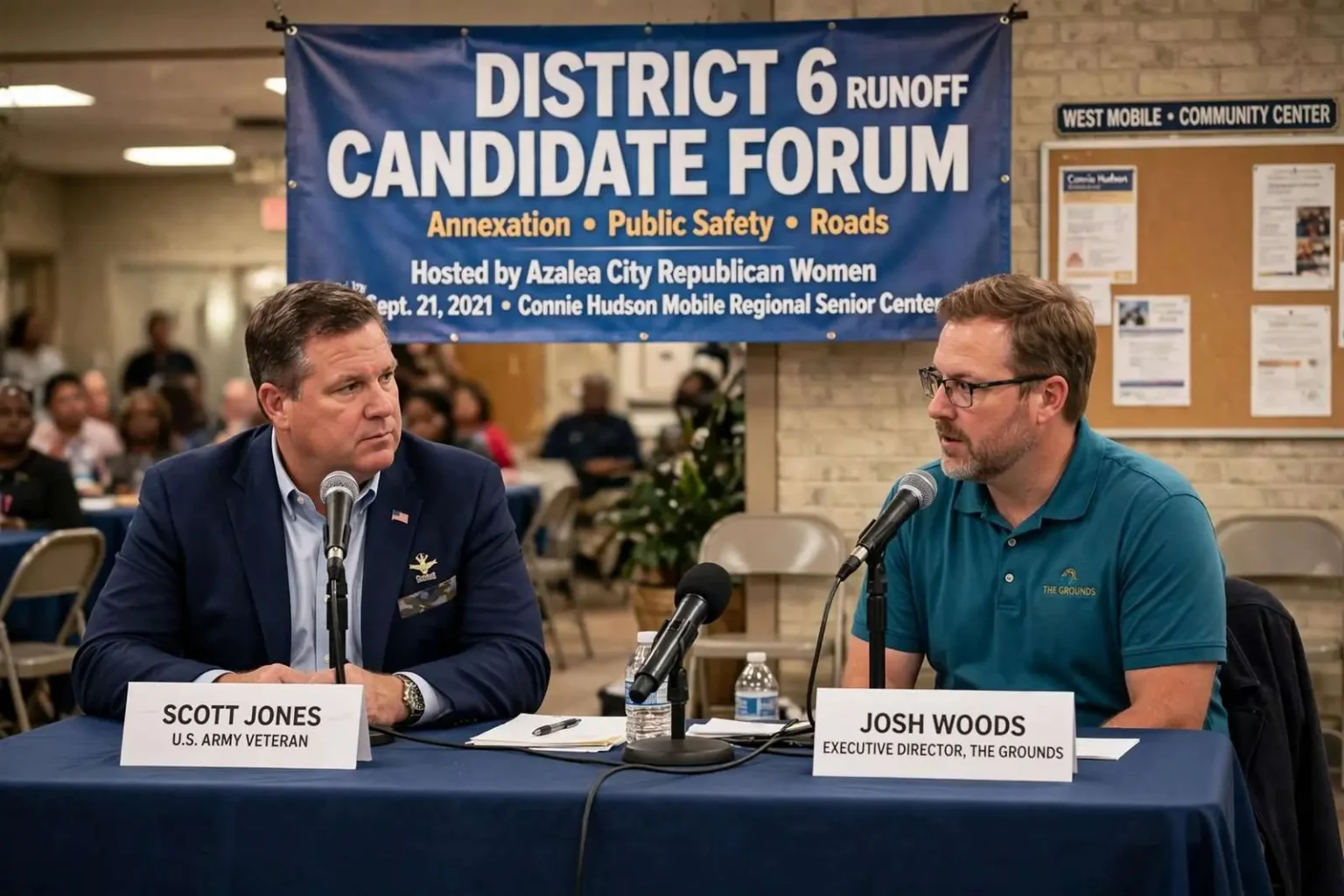
Annexation, public safety and traffic congestion took center stage Tuesday evening as the two candidates vying for the Mobile City Council District 6 seat faced off in a candidate forum ahead of their Oct. 5 runoff election.
The Azalea City Republican Women hosted Scott Jones and Josh Woods at the Connie Hudson Mobile Regional Senior Center, giving West Mobile voters a chance to hear directly from the two finalists before deciding who will represent the district on the council.
Annexation has loomed over nearly every council race in the 2021 election cycle, and both candidates said they support bringing more of unincorporated West Mobile into the city as a way to grow the population and the tax base. The issue traces back to 2019, when Mayor Sandy Stimpson first proposed letting roughly 13,000 West Mobile residents vote in a referendum on joining the city. The council fell short of the supermajority needed to send the referendum to voters, with the four White council members supporting it and the three Black members opposed. Current District 6 Councilwoman Bess Rich was among those who voted in favor.
Stimpson and other city leaders have argued that because the referendum failed and Mobile’s population has not crossed the 200,000 mark, the city has forfeited roughly $100 million in federal funding tied to population thresholds.
Jones, a U.S. Army veteran, told the crowd he accepts those estimates and that annexation “has to happen,” arguing the additional revenue could help address long-standing infrastructure problems in the district. “What could District 6 do with a third of those funds?” he asked. Woods, executive director at The Grounds, agreed annexation is part of a broader growth strategy for the city. “Growth is kind of an equation,” he said. “In order to see growth in population, you have to grow from within, but to get to an excellent future, to improve the quality of life for residents, you have to add annexation to the equation.”
On public safety, both candidates said supporting police officers and firefighters has to be a council priority. Woods called it a “team issue” and said the city needs to give first responders the resources they need, noting that Mobile firefighters still ride three to a truck in some stations. “We have to give them everything they need,” he said.
Jones described public safety as a “multi-faceted problem” that starts with fixing conditions at Mobile Metro Jail, including diverting people struggling with mental illness away from incarceration while still holding people accused of crimes accountable. He also called for the city to revive community policing. “Community policing is police in the community,” Jones said. “You know who they are and they know who you are. Right now, police don’t engage…. Police have to get back in your neighborhood.”
Traffic congestion and road conditions dominated the infrastructure discussion, with both candidates pointing to Cottage Hill, Hillcrest and Grelot roads as trouble spots. Jones said he would push to keep District 6’s full $3 million allocation under the city’s Capital Improvement Plan rather than seeing it redirected elsewhere. “CIP funds from this district have to stay in this district,” he said. “That $3 million goes a long way.” He added that, if elected, he would meet with leaders in each neighborhood to prioritize projects, but expects potholes, drainage and traffic along Hillcrest and Cottage Hill to rank near the top.
Woods said he would serve as a “voice for all of District 6” on infrastructure concerns and framed traffic as more than a convenience issue. “That’s a public safety issue you care about,” he said. “Traffic is a safety issue.”
The runoff was triggered after neither candidate cleared 50 percent in the Aug. 24 general municipal election. Jones led the field with 2,500 votes, or 43 percent, while Woods finished second with 2,162 votes, or 37 percent. Third-place finisher Tony Dugaish, who collected 661 votes, or 11 percent, has since thrown his support behind Woods.
Jones has picked up a string of endorsements from past District 6 representatives. Rich, along with former councilwoman and current Mobile County Commissioner Connie Hudson and former councilwoman Jane Baxter Conkin, issued a joint statement backing his campaign. “Scott truly exemplifies servant leadership in every respect,” Hudson said in the statement, citing his military career, community involvement and commitment to faith and family. Rich pointed to his experience as president of the Ridgefield subdivision’s homeowners association. “Scott’s maturity and experience as a neighborhood association president, along with his organizational skills, will be a great asset to our district,” she said. “He is responsive, transparent, and a man of core principles who I am proud to support and endorse.” Conkin said she believes Jones would treat the council seat as a full-time job. “He will make it his mission to continue full time with integrity, leadership and hard work,” she said. “He has a wonderful, friendly, caring personality making it easy to endorse and support him.”
At the forum, Jones noted his support spans every person who has previously held the District 6 seat. He has also been endorsed by the local firefighters association and the Police Benevolent Association. Woods, meanwhile, pointed to Dugaish’s backing as evidence his campaign is gaining momentum heading into the Oct. 5 runoff.
This story unfolds across the distinctive landscape of South Alabama, a region defined by its pine forests, winding rivers, and Gulf Coastal Plain geography. The area’s communities—from the port city of Mobile to the agricultural heartlands of the Black Belt—share interconnected economies and histories shaped by timber, agriculture, shipping, and more recently, aerospace and advanced manufacturing. Local governance across county lines often coordinates on regional planning, workforce development, and infrastructure projects that affect residents throughout the southern tier of the state. The geography itself shapes daily life: low-lying coastal plains face hurricane exposure, while inland counties contend with river flooding and rural transportation challenges. Understanding the setting helps explain why local decisions carry weight far beyond municipal boundaries.
The institutions involved operate within Alabama’s framework of local governance, where county commissions, municipal councils, and independent boards each hold specific authorities granted by state statute. These bodies navigate budget cycles tied to ad valorem taxes, state allocations, and federal grants, balancing mandated services with community priorities. Intergovernmental agreements and regional councils of governments frequently facilitate cooperation on shared challenges like transportation corridors, waste management, and economic development recruitment. Public meetings and open records laws provide avenues for residents to follow decisions, while state agencies—from the Alabama Department of Environmental Management to the Department of Transportation—exercise regulatory and funding roles that ripple down to the local level. The interplay between local autonomy and state oversight is a recurring theme in how South Alabama communities address growth and change.
Economic activity in South Alabama reflects both deep-rooted industries and emerging sectors. The region’s forest products industry remains a cornerstone, while the Port of Mobile anchors global trade connections. Aerospace manufacturing has grown significantly around the Mobile Aeroplex at Brookley, and automotive suppliers feed assembly plants across the Southeast. Workforce development initiatives through community colleges and the Alabama Industrial Development Training program aim to align skills with employer needs. Broadband expansion and highway improvements—including the I-10 Mobile River Bridge project and I-65 corridor enhancements—address longstanding connectivity gaps that affect business recruitment and quality of life. Small businesses, agriculture, tourism, and the service sector round out a diverse regional economy that has weathered national downturns through a mix of resilience and adaptation.
Healthcare delivery in the region contends with the dynamics of a largely rural service area anchored by regional medical centers. USA Health’s University Hospital and Children’s & Women’s Hospital in Mobile provide tertiary care, while community hospitals in Baldwin, Escambia, Monroe, Clarke, and other counties serve as critical access points. The expansion of telehealth, federally qualified health centers, and rural health clinics addresses provider shortages that have long challenged underserved areas. Public health departments coordinate on immunization, disease surveillance, maternal health, and emergency preparedness, often in partnership with the Alabama Department of Public Health and federal HRSA-supported programs. Access to care remains a defining issue for the region, influencing everything from economic development pitches to quality-of-life rankings that prospective residents weigh when deciding where to live and work.
Public safety across South Alabama depends on layered coordination among municipal police, county sheriffs, state troopers, and federal partners. Sheriffs’ offices in rural counties often serve as the primary law enforcement presence, while city departments handle municipal policing and community outreach. Emergency management agencies at the county and state level plan for hurricanes, flooding, and other hazards, coordinating shelters, evacuations, and recovery aid. Fire districts, volunteer rescue squads, and emergency medical services bridge gaps in coverage where paid staffing is thin. The Alabama Law Enforcement Agency and programs like AMBER Alert and the state fusion center extend resources regionally. How these agencies communicate and cooperate—through joint task forces, mutual aid compacts, and shared dispatch systems—directly affects response times and community trust in the places where people live and work.
Sport occupies a central place in South Alabama’s community life, from Friday-night high school football that draws whole towns to the sidelines, to college athletics at the University of South Alabama and across the state. Mobile’s longstanding role as a cradle of football talent—producing legends who went on to the professional ranks—is a point of regional pride, reinforced by events like the Senior Bowl, which has showcased NFL hopefuls in the city for decades. Youth leagues, recreation departments, and booster clubs sustain participation at the grassroots level, while the area’s coastal setting supports fishing tournaments, regattas, and beach athletics that reflect the local environment. The economic and social lift from sporting events—hotel stays, restaurant traffic, and civic visibility—makes athletics a quiet but steady contributor to the regional identity and to the small-business economy that surrounds game days.
Animal welfare organizations across South Alabama operate with limited resources and a steady stream of need. Municipal animal shelters in Mobile, Baldwin, and neighboring counties manage intake, adoption, and reunification efforts, often partnering with nonprofit rescues that provide foster networks, spay-neuter assistance, and transport to out-of-region adopters. Volunteer-driven groups fill gaps that public funding cannot, relying on donations, fundraisers, and grant support to keep operations running. The Gulf Coast’s position as both a tourist destination and a growing residential region has increased demand for pet services, while rural areas contend with stray and feral populations that strain capacity. Community education on responsible ownership, microchipping, and low-cost veterinary care has emerged as a practical lever for reducing shelter overcrowding. Efforts like local giving campaigns demonstrate how resident participation can translate directly into care for animals that might otherwise go without.
As this situation continues to develop, stakeholders across the affected communities will monitor outcomes and adjust responses accordingly. The interconnected nature of South Alabama’s counties means that decisions in one jurisdiction often ripple outward, affecting neighbors in ways that underscore the value of regional communication and coordinated planning. Residents seeking to stay informed can engage with local government meetings, school board sessions, and community forums where these matters are discussed in public. The ongoing dialogue between officials, experts, and citizens reflects the democratic processes through which the region navigates change while preserving the character and resilience that define its communities. Continued attention from local news outlets helps ensure that decisions remain transparent and that the people most affected have the information they need to participate in shaping what happens next.