
DNA Confirms Danniella Vian Was in Car Pulled From Bayou Sara
DNA tests confirmed the remains in a car pulled from Bayou Sara were missing mother Danniella Vian, last seen in July 2018.
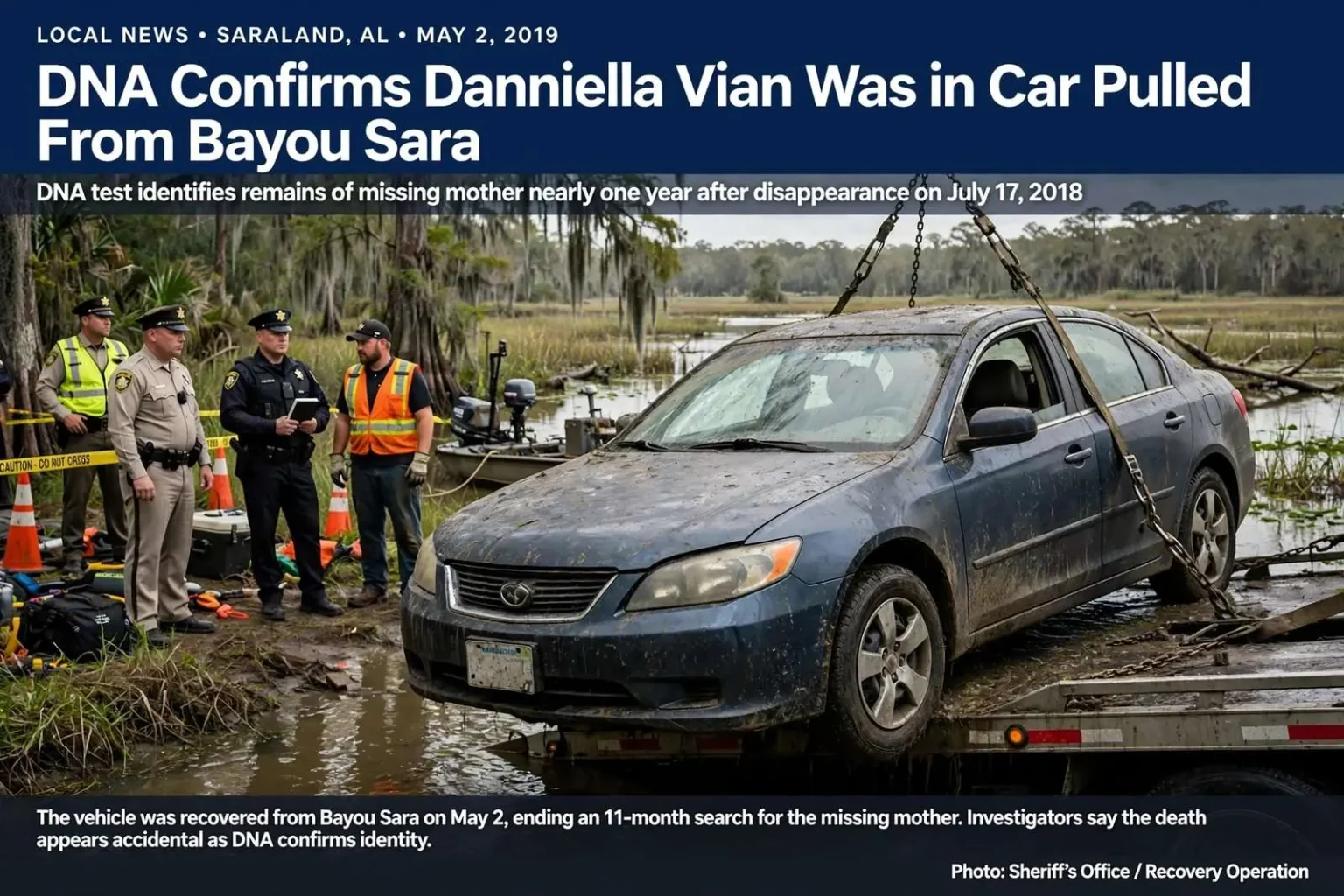
The remains found inside a car pulled from Bayou Sara in May have been identified as those of missing mother Danniella Vian, according to DNA test results. The identification closes the central question in a case that has haunted her family and the Saraland community for close to a year: what became of a young mother who vanished during what should have been an ordinary night out with friends in July 2018.
Vian’s vehicle was recovered from the water on May 2, when crews pulled it from the bayou that winds through the area north of Mobile. Investigators have said her death was likely the result of an accident. The DNA test results confirmed what investigators had suspected from the moment the car was found — that the remains inside the vehicle belonged to Vian, who had been reported missing nearly a year earlier, after she disappeared during a night out with friends on July 17, 2018.
The confirmation brought a measure of closure to a case that had remained unsolved for close to a year. For Vian’s family, the finding ended a cycle of searching, hoping and waiting that began the day she was reported missing, replacing it with an answer that is painful but definitive. For the investigators who pursued the case across those months, it provided the resolution they had been working toward since the search began.
Cases in which a missing person’s vehicle is found in water are among the most difficult investigators handle. When a car leaves the roadway and enters a bayou, canal or river, the vehicle can settle in water deep or murky enough to hide it from routine view, and unless someone witnesses the departure from the road or a searcher’s sonar passes directly over the site, the car can remain undetected while the person inside is the subject of an active but fruitless search on land. Divers and sonar teams face limited visibility, soft bottoms, snags and debris that make every search slow and painstaking.
The gap between the July 2018 disappearance and the May recovery of the vehicle illustrates that difficulty. Searches in such cases typically move through phases — canvassing the last known route, checking with people the missing person contacted, distributing information to the public, and searching bodies of water along likely paths. Bayou Sara and the network of waterways around it present a large and tangled search area, with bridges and road crossings where a vehicle leaving the roadway at night could enter the water unnoticed.
How DNA identification works
The identification of remains found in submerged vehicles relies on DNA analysis conducted by forensic laboratories, a process that takes time even under the best conditions. Investigators collect DNA samples from family members and compare them against samples from the remains, establishing identity with scientific certainty. In cases like Vian’s, where the remains had been in the water for many months, the testing is an essential step — visual identification is impossible, and officials will not confirm a name until the science supports it.
That waiting period is among the hardest stretches for a family. From May 2, when the car came out of the water, to the announcement of the DNA results, Vian’s relatives lived with the near-certainty of what the vehicle’s discovery meant while unable to lay her to rest until the confirmation came. Forensic labs across the country carry heavy backlogs, and medical examiners work cases methodically to ensure that the identification they announce will stand without question.
The night she disappeared
Vian was last known to be out with friends on July 17, 2018. When she failed to return or make contact, her family reported her missing, launching a search that continued for nearly a year. Missing person cases involving adults present investigators with their own challenges: adults can generally leave of their own accord, so police must move quickly to determine whether a disappearance is out of character while navigating privacy rules that limit what can be released publicly. Families in these cases often become the case’s most persistent advocates, organizing searches, keeping the person’s name in public view and pressing for answers.
In Saraland and the surrounding communities north of Mobile, Vian’s disappearance drew attention precisely because it seemed so out of character — a young mother who vanished in the middle of a night out. The public attention helped keep the investigation moving, with tips and sightings reported to police over the months, though none led to her until the vehicle surfaced in the bayou in May.
Bayou Sara and the search landscape
Bayou Sara runs through Saraland, a city of roughly 14,000 people that sits just north of Mobile along the Interstate 65 corridor. The bayou and the waterways around it are part of the Mobile Bay watershed, a landscape of slow-moving streams, wetlands and marsh that drains toward the bay. Roads cross these waterways at bridges and low points, and at night, in rain or in darkness, a vehicle that left such a crossing could enter the water without any witness being aware of what they had just driven past.
Searching that landscape takes specialized resources. Sonar-equipped boats can map the bottom of a waterway and flag anomalies for divers to check, but soft Gulf Coast mud, submerged trees and scattered debris generate false targets, and visibility underwater is often measured in inches. Recovery crews working a submerged vehicle must locate it, stabilize it, attach rigging and pull it out without disturbing potential evidence — slow, careful work even when the location is known. It is work that unfolded in Vian’s case in early May, when the car was finally brought to the surface and the remains inside were recovered.
Across the country, families of missing people have pushed for more systematic searches of waterways along the routes their loved ones were known to travel, and the pattern of cases like this one — a vehicle found in water months after a disappearance — has driven those calls. Volunteer search groups with sonar equipment have grown into a significant adjunct to official searches, scanning waterways that police departments lack the equipment or staffing to comb thoroughly.
Closure, and the questions that remain
Investigators have said Vian’s death was likely the result of an accident, an assessment that points away from foul play and toward the theory that her car left the roadway and entered the bayou unseen on the night she disappeared. The final determination rests with the medical examiner, and authorities have not detailed every finding of their investigation. What the DNA confirmation establishes is the answer her family waited nearly a year to receive: where Danniella Vian was.
For her children, her family and the friends who were with her on the night she vanished, the identification allows a funeral, a grave and a place to grieve — the ordinary milestones of mourning that a missing person case postpones indefinitely. Community members who followed the case, shared flyers and hoped for a different outcome will mark it as a sad ending to a long search. But after close to a year of not knowing, an answer — even a heartbreaking one — is what her family had been asking for, and what the recovery of her car from Bayou Sara finally made possible.
The long reach of a missing person case
The months between a disappearance and a resolution weigh on everyone the case touches. For law enforcement, a missing person file stays open, reviewed and re-reviewed as tips arrive and leads are exhausted. For the community, the case becomes part of the local landscape — flyers at storefronts, social media posts shared and reshared, and conversations that begin with the same question: has there been any news? In Vian’s case, that question hung over Saraland for nearly a year, through seasons and holidays, while the search continued out of public view.
Recovery and identification also set in motion the practical aftermath that follows any death. Families must arrange services, settle estates and, in cases involving vehicles found in water, work with insurance companies on claims that cannot be processed until investigators release the vehicle and its contents. Death certificates issued after DNA identification carry the confirmed identity and the manner of death as determined by the medical examiner, documents that unlock the legal steps a family must take to close out a loved one’s affairs.
Saraland police led the investigation into Vian’s disappearance from the start, and the resolution of the case reflects the persistence such investigations demand. Searching for a missing adult is a task that competes with every other demand on a municipal police department, and keeping a case moving for eleven months — following up on leads, coordinating water searches, and ultimately finding the vehicle that ended the mystery — requires sustained attention that the department maintained until the answer surfaced in May.
For other families still searching for missing loved ones along the Gulf Coast, the case carries a double message: that waterways along the last known route deserve thorough searching, and that answers can arrive even after months of nothing. The recovery of a submerged car nearly a year after a disappearance is uncommon, but it is far from unprecedented, and it is why search advocates keep pressing for sonar sweeps of the water nearest to where a missing person was last seen.


