DNA results identify burned remains found in Grand Bay as Terri Sullivan
DNA results have positively identified burned remains found in a Grand Bay rental car as Terri Sullivan.
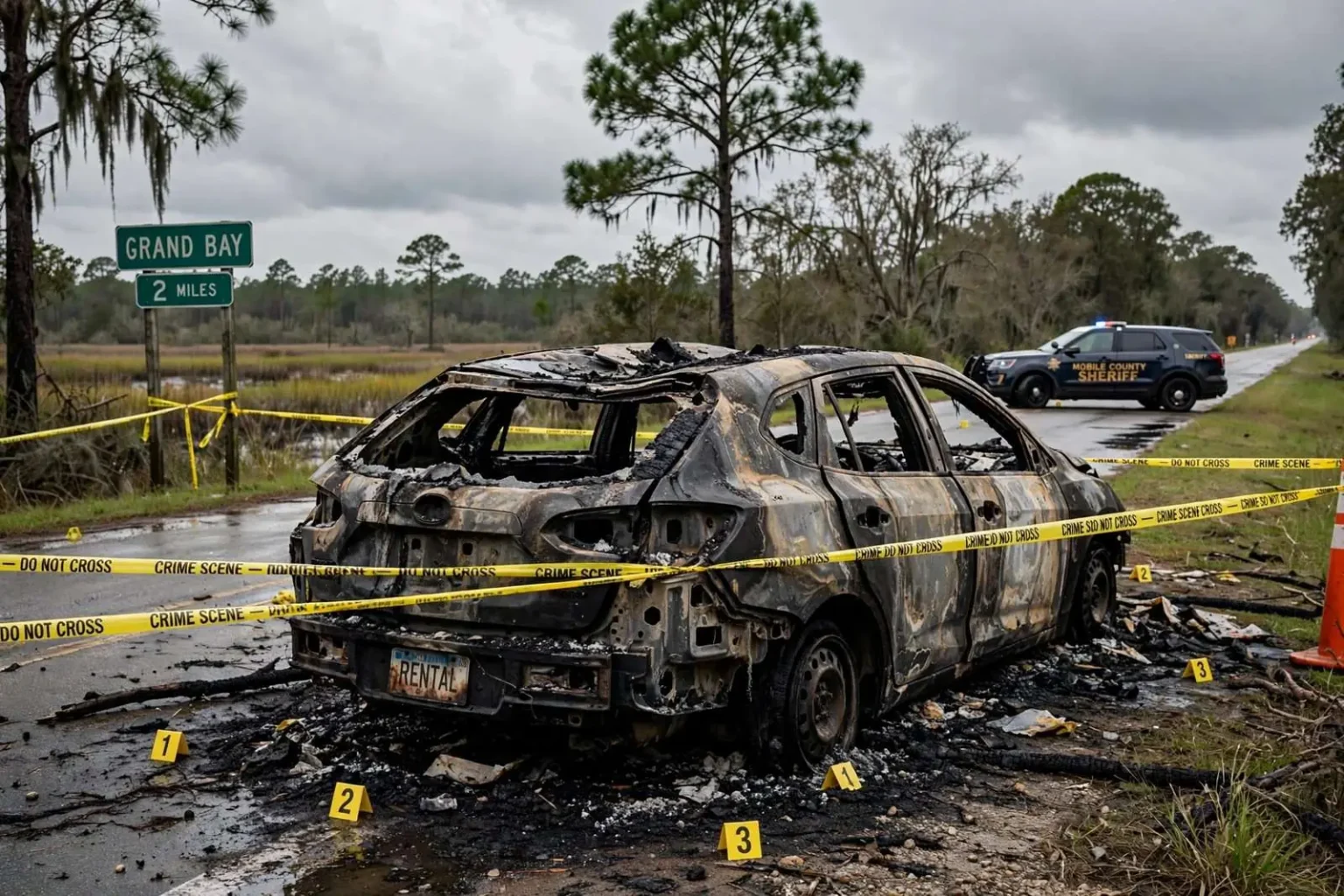
DNA testing has positively identified human remains found inside a burned-out rental car in Grand Bay earlier this year as those of Terri Sullivan, authorities said, closing one chapter of a case that has drawn attention across south Alabama while its legal proceedings continue. Sullivan, a nurse, was reported missing after she left her mother’s home in Tibbie one morning in January on her way to work at Springhill Medical Center in Mobile. Her husband, Samuel Sullivan, and his ex-wife, Jenny Sullivan, are charged with capital murder and kidnapping in connection with her death, and were expected to appear in court the month after the identification was announced.
The identification, confirmed through laboratory DNA analysis, gave investigators the formal certainty needed to advance the criminal case, and it gave Sullivan’s family — after months of uncertainty — an answer to the question that had hung over the search since January. Authorities noted that while the identification brings a measure of closure, the legal proceedings against the two suspects are ongoing and will continue in the courts of Mobile County.
A disappearance that became a capital case
Terri Sullivan’s disappearance began with an ordinary routine: leaving her mother’s home in Tibbie, a small community in Washington County north of Mobile, for the morning drive to her job as a nurse at Springhill Medical Center. When she failed to arrive or make contact as expected, the alarm was raised, and the search that followed spanned two counties and drew sustained public attention. The case took its darkest turn when human remains were discovered inside a burned rental car in Grand Bay, a community in southwestern Mobile County along the corridor between the Washington County line and the city.
Because the remains were burned beyond ready recognition, investigators turned to DNA analysis, the standard forensic method for identifying human remains when visual identification is impossible. Analysts compare recovered DNA either with reference samples from close relatives or with the missing person’s own medical or personal samples, and a positive match provides the scientific basis for a formal identification. In this case, authorities announced the results: the remains were Terri Sullivan’s.
The charges brought in the case elevated it to the most serious category in Alabama’s criminal code. Capital murder in Alabama applies to intentional killings committed in the course of certain enumerated felonies — among them kidnapping — and carries a potential sentence of life without parole or, after separate proceedings, the death penalty. Prosecutors in Mobile County, whose office handles some of the state’s heaviest caseloads of violent crime, charged Samuel Sullivan and Jenny Sullivan with capital murder and kidnapping, allegations that will be tested through pretrial hearings, and if the case proceeds, trial.
The geography of the case
The case’s geography traces a route familiar to thousands of south Alabama commuters. Tibbie lies in rural Washington County, one of the state’s least populous counties, where residents routinely drive south into Mobile County for work, medical care and shopping. Grand Bay sits just inside the Mobile County line, a rural community of farms, churches and scattered neighborhoods along U.S. 90 and the old rail line, a thirty-minute drive from downtown Mobile. Springhill Medical Center, the destination Sullivan never reached that January morning, is a full-service hospital in west Mobile, one of the major medical employers in the region and a place where Sullivan was known to colleagues as a nurse.
That corridor — Washington County’s rural crossroads, the Grand Bay stretch of U.S. 90, and the hospital districts of west Mobile — became the stage on which the investigation unfolded. Searches, roadblocks and tip lines in missing-persons cases draw heavily on community participation in south Alabama, where local news coverage and social media amplify appeals for information, and this case was no exception as it moved from a missing-persons report to a capital-murder prosecution.
How DNA identification works
The forensic path taken in the Sullivan case is the standard one for remains recovered in condition precluding visual identification. Samples recovered from the scene are submitted to a crime laboratory, where scientists extract DNA and attempt to develop a profile. That profile is then compared against known reference samples — most commonly cheek-swab samples from biological relatives, whose DNA shares identifiable markers with the missing person’s. When the comparison shows a consistent match, the laboratory issues a report that allows authorities to make a positive identification, which is then entered into the official record of the death investigation.
The process, while routine in forensic terms, takes time — weeks or months — because of the technical work involved and the laboratory queue. During that period, families of missing persons wait without certainty, and prosecutors build the rest of their case. In the Sullivan case, the eventual positive identification converted an investigation into a formal homicide prosecution: the remains found in the burned car in Grand Bay were Terri Sullivan’s, and the charges already filed against Samuel Sullivan and Jenny Sullivan now rested on a scientifically confirmed victim.
Rental vehicles often figure in such investigations because their use generates records — rental agreements, payment trails, tracking data — that can establish timelines and movements. The discovery of remains inside a burned-out rental car provided investigators both a scene to process and a documentary trail to follow, elements that in capital cases become part of the evidentiary foundation presented in pretrial proceedings.
Capital murder proceedings in Alabama
With capital charges filed, the case moved into the machinery of Alabama’s criminal justice system, where capital prosecutions follow a distinct and deliberate path. After arrest and initial appearances, defendants in capital cases face a preliminary process in which the state must show probable cause, followed by grand jury review where applicable, arraignment, and a long pretrial phase covering evidence discovery, motions and competency questions. Trials in capital cases are conducted in two stages — guilt, then sentencing — and the sentencing options in Alabama are life without the possibility of parole or death, with the penalty determined by a jury’s recommendation and the judge’s final judgment under state law.
The expectation that the two defendants would appear in court the month after the identification reflected that process at its early stage: initial and follow-up appearances before pretrial preparation begins in earnest. Capital cases routinely take a year or more from arrest to trial, given the volume of forensic evidence, the severity of the potential penalties and the heightened procedural protections required. For the family of the victim, that timeline means the search for accountability continues long after the identification that answered the question of what happened.
The involvement of two defendants — a husband and his ex-wife — added an unusual dimension to the case as it moved forward. Prosecutors handling multi-defendant capital cases must present the alleged roles of each participant, and the courts must manage the defendants’ cases in parallel, a structure that can extend proceedings further. Authorities’ public statements in this case stuck to the charges: capital murder and kidnapping, filed against Samuel Sullivan and Jenny Sullivan, with court appearances expected the following month.
A community reckons with the loss
Cases of this kind leave a mark on the communities they pass through — the Washington County crossroads where Sullivan’s morning journey began, the Grand Bay neighborhood where the burned car was found, and the west Mobile hospital where colleagues lost a coworker. The identification of the remains gave those communities a confirmed loss to mourn, and the capital charges gave them a legal process to follow in the months ahead. In south Alabama’s local-news landscape, where violent crime affecting nurses, teachers and other public-serving workers resonates deeply, the case remained in public view from the January disappearance through the DNA announcement.
The case also illustrated the two-part character of such resolutions. The scientific identification answers the human question — what became of the missing person — and allows a family to grieve with certainty. The criminal process, still in its early stages when the identification was announced, addresses the question of accountability. Authorities were careful to distinguish the two: the DNA result closed the identification chapter, while the capital murder and kidnapping charges against Samuel Sullivan and Jenny Sullivan remained allegations to be tested in court, with the defendants presumed innocent until proven guilty.
For investigators, the confirmation of the victim’s identity is a pivot point rather than an ending. Work continues after a positive ID — processing the scene where the remains were found, completing forensic examinations, reconciling the vehicle records, preparing expert witnesses for trial. The announcement that DNA testing had identified Terri Sullivan marked the transition from search to prosecution, the point at which the case passed from the realm of the missing to the realm of the courts.
The legal proceedings against Samuel Sullivan and Jenny Sullivan were ongoing at the time of the identification announcement, with court appearances expected the following month and the full course of the capital prosecution still to come. What the DNA results established — the identity of the woman found in the burned-out rental car in Grand Bay — stands as the confirmed foundation of that case: a nurse from Tibbie, missed on her morning drive to Springhill Medical Center, identified by science after months of uncertainty, and remembered across south Alabama as the search for justice continued.