Documentary aims to preserve interest in historic submarines, including Mobile’s USS Drum
A new documentary by John Russell highlights historic submarines including Mobile's USS Drum at Battleship Memorial Park and the USS Batfish in Oklahoma.
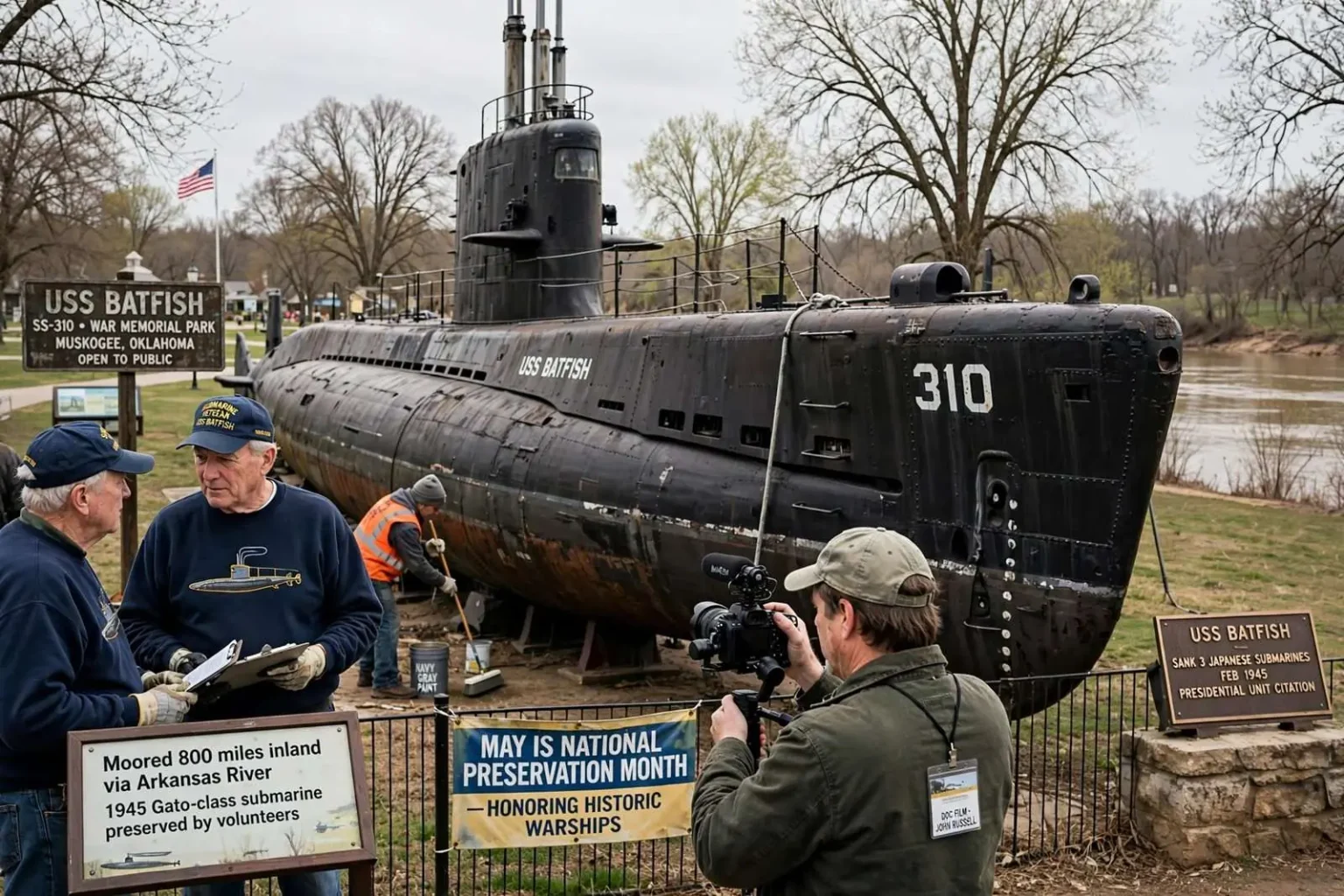
May is National Preservation Month, and the effort to protect history extends well beyond old buildings to historic warships — including the USS Drum at Battleship Memorial Park in Mobile. But there is another submarine museum that many locals may not know about, and it is the subject of a new documentary by filmmaker John Russell. His film focuses on the USS Batfish, whose final resting place is in Muskogee, Oklahoma — an unlikely home for a historic submarine museum, hundreds of miles from the nearest ocean.
The USS Drum, moored beside the battleship USS Alabama on the Mobile waterfront, has been the Gulf Coast’s window into the submarine service for generations of visitors. Park guests who walk her deck and squeeze through her hatches experience a taste of the cramped, hazardous world in which American submariners served during World War II. The Drum is one of a small number of fleet submarines preserved anywhere in the country, which makes every surviving sister boat — including the Batfish — part of a diminishing national collection that preservationists work to keep alive.
Several years ago, a group of devoted former submariners floated the Batfish up the Arkansas River to her permanent home in Muskogee. The journey took the vessel from the Gulf of Mexico up the inland waterway system, a slow passage handled by a crew of veterans determined to save a boat that had earned a distinguished combat record and faced the scrapping torch. Their effort turned an aging warship into the centerpiece of an Oklahoma museum, staffed largely by volunteers who maintain, restore and interpret her for visitors from across the region.
Russell, who passed the boat often while living in Oklahoma, decided to make a documentary about it. The project highlights the broader challenge of keeping public interest alive in these pieces of naval history, even when the submarines are far from the waters where they served.
The Batfish’s record of service
The USS Batfish earned her place in preservationists’ hearts through one of the most remarkable patrol records of the Pacific war. In February 1945 — during a single wartime patrol — she sank three Japanese submarines in a span of days, a feat virtually unmatched in naval history and one that earned the boat a Presidential Unit Citation. Those patrols came after earlier war patrols in which the Batfish survived depth-charge attacks and other perils that destroyed a large share of America’s submarine force, which suffered the highest fatality rate of any U.S. service branch during the war.
A Gato-class fleet submarine like the Drum, the Batfish embodied the design that carried the American submarine campaign across the Pacific: long range for patrols from Australia and Hawaii to the enemy’s home waters, ten torpedo tubes, and a hull built to endure punishing depth charges. Boats of her class sank the majority of Japanese merchant shipping lost during the war, strangling an island nation’s supply lines in a campaign that historians credit as decisive and that cost the submarine service terribly in the doing.
When the war ended, most of the fleet submarines that survived were scrapped within a few years. A handful were saved — by luck, by veterans’ lobbying, or by civic campaigns like the one that brought the Alabama to Mobile — and each survivor became a memorial to the thousands of submariners who did not come home. The Drum and the Batfish are two of that handful, which is why a documentary about one boat in Oklahoma resonates with the volunteers who keep her Mobile sister ship alive.
From the sea to the Arkansas River
The Batfish’s move inland was an epic in itself. After her Navy service ended, the boat passed through reserve and training roles before veterans and Oklahoma supporters secured her for preservation. Towed up the Mississippi River and then up the Arkansas, she traveled farther from salt water than any of her surviving sisters, arriving in Muskogee to become the centerpiece of the city’s War Memorial Park. The voyage required coordination with river authorities, careful handling through locks and narrow channels, and the kind of persistence that only a determined group of former submariners could supply.
Muskogee, a city of roughly 40,000 in eastern Oklahoma, might seem the least likely address imaginable for a World War II submarine. Yet the boat has drawn visitors to the Arkansas riverfront for decades, and her presence gave the region a tangible link to a naval war fought half a world away. School groups, veterans’ organizations and submarine veterans’ reunions have made the pilgrimage, and the volunteers who care for the boat have worked continuously against rust, weather and the slow decay that threatens any steel vessel left open to the elements.
Russell’s film documents that ongoing fight. Living in Oklahoma, he passed the boat often, and the question her presence raises — how does a submarine end up here, and how does she stay? — became the seed of the project. Documentaries of this kind serve a purpose beyond nostalgia: they record the stories of the aging volunteers who maintain the vessel, preserve footage of restoration work, and introduce the boat to audiences who will never travel to Muskogee.
Preservation Month and the warships among us
National Preservation Month, observed each May, traditionally spotlights historic buildings, districts and landmarks. Warships belong on the same list, and arguably present a harder case: a steel vessel is a machine as much as a monument, subject to corrosion, leaks and mechanical decay that no amount of good will can halt without sustained funding. Museums that operate preserved submarines and battleships fight a continuous battle against the elements, and public interest — expressed in visits, memberships and donations — is the resource that keeps that fight winnable.
Mobile knows this reality better than most cities. Battleship Memorial Park, which preserves the USS Alabama and the USS Drum along with aircraft and military equipment, operates as a self-sustaining attraction that survived a devastating hurricane and repeated financial strains through the support of the state, local government and generations of visitors. The Drum herself required a major restoration after Hurricane Katrina damaged her, and the park’s ongoing work on the boat continues today — the same blend of veteran passion and public support that keeps the Batfish above water in Oklahoma.
The parallel between the two boats is the heart of what the documentary offers Gulf Coast viewers. The Drum sits where she served, within sight of the sea; the Batfish sits 800 miles up a river in Oklahoma. Different settings, identical challenge: keeping the public interested enough in naval history to fund its preservation. Russell’s film, by telling the Batfish’s story — her combat record, her improbable journey, and the volunteers who stand watch over her — contributes to that effort, and it invites audiences in Mobile and beyond to consider the warships in their own harbor as members of a rare and shrinking family of survivors.
For locals who have walked the Drum’s passages, the film promises a familiar story told from a different riverbank — and a reminder that preservation, wherever it happens, depends on the people who keep showing up to do the work.
What a submarine museum teaches
Part of the Batfish documentary’s appeal is the educational weight these boats carry. A preserved fleet submarine is, in effect, a sealed textbook of the Pacific war: the torpedo room shows how attacks were pressed home, the control room demonstrates how a boat dove and steered under attack, and the cramped crew spaces — where dozens of men ate and slept in shifts — make the war’s human dimension immediate in a way no book can. Visitors come away understanding both the engineering achievement and the sacrifice, because the boat itself is the evidence.
For Mobile audiences, the Drum delivers exactly that experience, and the park’s staff and volunteers interpret her daily. Schools across the Gulf Coast schedule field trips to Battleship Memorial Park, scouts spend nights aboard, and veterans’ groups hold ceremonies on her deck. The Batfish serves the same role for Oklahoma, where a submarine in a landlocked state becomes for many rural students the first physical connection they ever make to the Navy’s war. Documentaries multiply that reach, carrying the guided-tour experience to viewers far from either boat.
Submarine veterans themselves — the men who actually served on boats like these — form the living link between the vessels and their stories, and their numbers shrink every year. The former submariners who brought the Batfish up the Arkansas River were performing, in the most literal sense, the work of saving their own history, and the volunteers aboard such museums today are often their successors. Recording their knowledge on film, as Russell’s project does, captures expertise and memory that will otherwise be lost within a generation.
The challenge of keeping warships alive
The practical problem every submarine museum faces is rust. A hull designed to resist ocean pressure for decades of wartime service was never designed to sit half out of water for half a century, and the waterline zone where air meets sea — or air meets river humidity — corrodes relentlessly. Museums respond with hull repairs, painting programs, interior climate work and dry-docking campaigns, each of which costs more than the last as the boats age. Fundraising never ends, and public interest is the fuel on which it runs.
That is why films and anniversary coverage matter to the institutions that preserve these vessels. A documentary sends new visitors to the boats, prompts veterans’ families to share artifacts and stories, and gives donors a narrative to invest in. National Preservation Month provides the seasonal occasion, and the timing of Russell’s project alongside May’s observance links the Batfish’s story to the broader campaign to keep historic places — ships included — in public memory.
Mobile’s own experience proves the stakes. The USS Alabama arrived in Mobile Bay in the 1960s through a statewide children’s fundraising drive that became legend, and the park built around her has since preserved the Drum, aircraft and memorials visited by millions. Without that sustained civic commitment, the state’s most visited military museum would not exist, and its lesson applies equally to a submarine resting on an Oklahoma riverbank: warships survive only where communities decide they should, and then only through continuous work.
Russell’s documentary, focused on the USS Batfish and the people who keep her, ultimately tells a story that Mobile audiences know by heart from their own waterfront. The Drum and the Batfish sailed the same oceans in the same war; they now rest in profoundly different places, guarded by the same kind of devotion. A film that keeps one boat in the public eye strengthens the cause of them all — the reason preservation, this month and every month, reaches beyond old buildings to the steel vessels that carry history’s most vivid lessons.