
Dog Brought to Mobile County Shelter in Dire Condition Is Euthanized
Charles, a dog brought to the Mobile County Animal Shelter in severe condition, was euthanized after veterinarians determined he could not be saved.
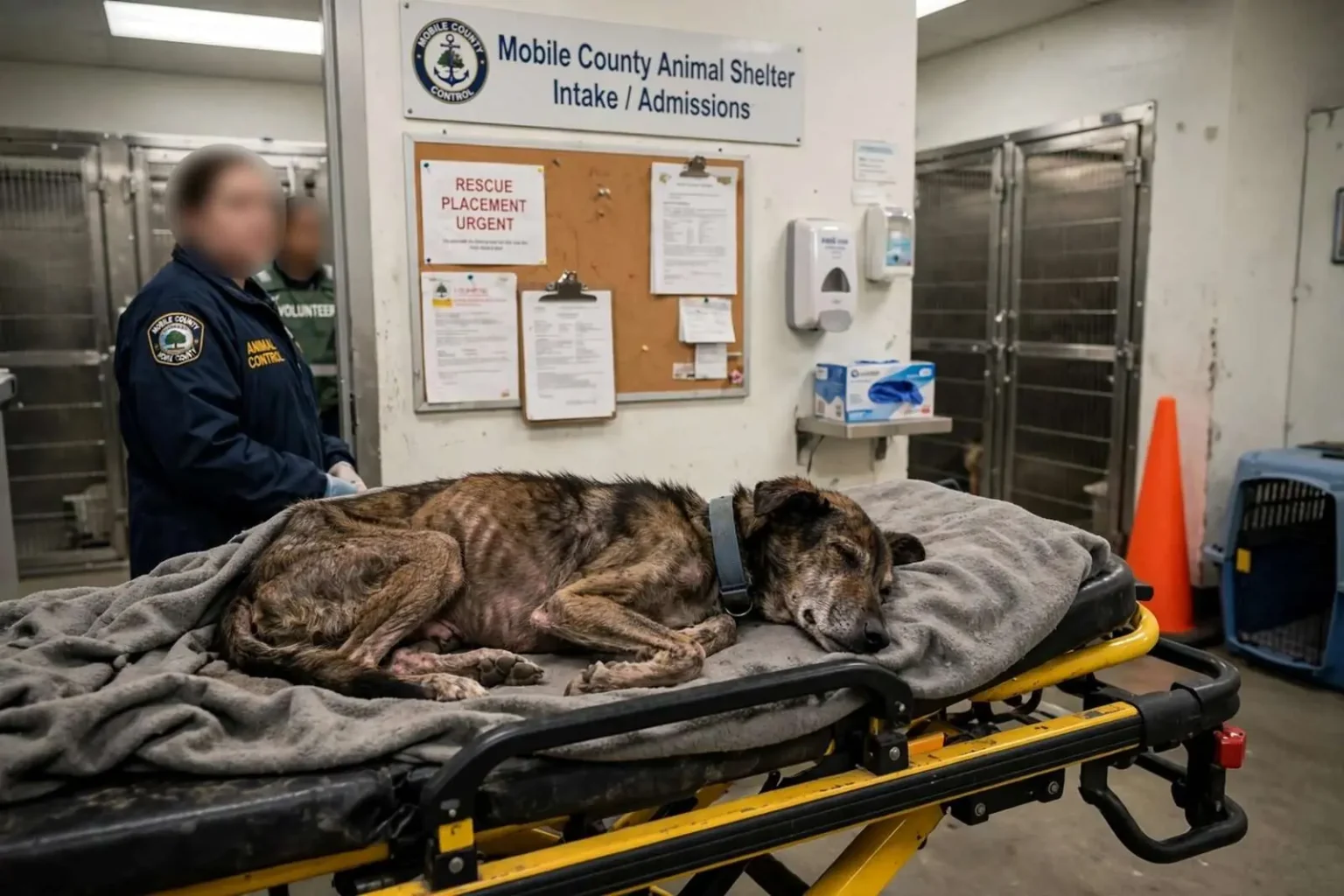
A dog carried into the Mobile County Animal Shelter on a stretcher after being found in severe distress has been euthanized, rescue volunteers say. The outcome, shared publicly by one of the volunteers who worked on his case, closed a short and sad chapter that began with one of the worst intake conditions the shelter’s partners say they have seen.
Animal control officers brought the dog — named Charles by those caring for him — to the shelter in early January after he was discovered in what rescuers described as an inexcusable state of neglect. A stretcher transport itself tells the story: dogs that can walk, eat, and stand on their own do not arrive that way, and the officers who carried Charles in were dealing with an animal whose body had been failing for some time before anyone found him.
The shelter moved quickly, arranging care through its rescue placement partners in under an hour and transferring him out for treatment. That speed matters in a county shelter. A municipal or county facility takes in a steady stream of animals every day it is open, and space, staff time, and medical resources are finite. Getting a critically ill animal into a rescue group’s care within an hour of intake is the shelter’s way of buying that animal the best possible chance — a foster home, a veterinarian’s attention, and treatment decisions made by people who can focus on one case instead of a kennel full of them.
‘Too far gone to help’
Days later, rescue volunteer Stacey Holland shared the outcome: Charles was euthanized the following Saturday morning. “We had to euthanize him because he was too far gone to help,” Holland said. “I have pulled a lot of dogs from the Mobile County Animal Shelter and this dog was, by far, in the worst shape I have ever seen.”
Those words carry weight coming from someone who spends her free time pulling dogs out of the county’s shelter system. Volunteers who do this work see animals in bad condition regularly — dogs that are underweight, matted, heartworm positive, or injured. For a rescuer with years of experience to describe a dog as the worst she has ever seen puts Charles’s condition in a category that regular shelter intake rarely reaches, and it explains why the people who fought for him ultimately had to let him go.
The shelter credited animal control officers, members of the public who report neglect cases, and its network of rescue partners for giving animals like Charles a chance at care. That three-part chain — a resident who notices and reports, officers who respond and transport, and rescuers who take the animal in — is how nearly every neglect case in Mobile County moves, and it worked as designed in Charles’s case even though the ending was not the one anyone wanted.
How the Mobile County Animal Shelter works
The Mobile County Animal Shelter serves residents across the county, taking in strays, surrendered animals, and animals seized or transported by animal control officers. Its rescue placement program is the mechanism by which animals leave the facility for nonprofit rescue organizations, which place them in foster homes and fund veterinary care that a county shelter budget cannot cover. For dogs with serious medical conditions, that handoff is often the difference between a shelter stay ending in adoption and ending in euthanasia — though, as Charles’s case shows, a transfer is a chance, not a guarantee.
Neglect cases of this severity do not appear overnight. A dog does not become unable to walk in a week. The conditions that leave an animal in need of a stretcher build over months — untreated illness, inadequate food, no veterinary care, and no one checking on the animal until the damage is beyond repair. That timeline is what makes public reporting so important, and it is the reason the shelter’s message about Charles pointed back at the people who report what they see.
Alabama law treats the intentional or negligent mistreatment of animals as a crime, with cruelty-to-animals provisions covering failing to provide necessary food, water, shelter, or veterinary care. Enforcement, however, almost always starts with a call. An animal suffering behind a fence or inside a yard is invisible to officers until a neighbor, a passerby, or a delivery driver picks up the phone and describes what they saw. In rural stretches of Mobile County, where properties are larger and animals are less visible from the road, those calls are often the only eyes on a neglected dog.
Animal control officers in the county handle a wide range of calls — loose livestock, bite investigations, strays, and welfare checks like the one that brought Charles in. When they find an animal in critical condition, their job is to get it to the shelter quickly and document what they found, and the shelter’s job is to move fast from there. The stretcher ride into the facility is the moment when an animal’s fate changes hands from whoever allowed the neglect to happen to the people trying to undo it.
Why rescues euthanize animals they have pulled
It can be difficult for the public to understand how a dog that was rescued can still be euthanized days later, but the rescue model does not change medicine. When a transfer rescue accepts a dog like Charles, it runs diagnostics, begins treatment, and evaluates whether the animal can recover with a quality of life worth having. In some cases, the answer is yes with time and money. In others, the animal’s organs, joints, or immune system have been damaged past the point where treatment can restore comfort, and the humane decision is to end the suffering.
Rescue volunteers absorb that decision personally. People like Holland invest hours in pulling dogs, transporting them, arranging vet visits, and posting their stories, and they do it knowing that some cases will end at a veterinary clinic instead of in an adopter’s living room. The alternative — leaving a dog like Charles in a kennel to decline without care — is not an option any of them will take, which is exactly why they keep pulling.
Charles’s story also illustrates what the phrase “rescue placement” actually costs. A critically ill dog arriving at a county shelter is a medical emergency the facility itself usually cannot fund, so the shelter’s partners take on veterinary bills that can run to hundreds or thousands of dollars for a single animal, supported by donations and volunteer labor. The system works because individuals keep saying yes to the next stretcher case, even after cases like this one.
What residents can do
The shelter’s closing message in the case was aimed squarely at the public: keep reporting. Signs of serious neglect — a dog that cannot stand, visible ribs, untreated wounds, no shelter from sun or rain, no water — warrant a call to animal control or the sheriff’s office rather than a post on social media. A report triggers an officer’s visit and creates a record, which is what animals like Charles need and what cases like his ultimately depend on.
For people who want to help animals like Charles directly, the county shelter’s rescue partners take donations, fosters, and volunteers, and the shelter itself needs adopters for the healthy animals that fill its kennels every week. Every dog pulled or adopted frees a kennel and a slice of staff attention for the next animal carried through the door. Charles arrived too late for any of that to save him, but the response to his case — officers, shelter staff, and rescuers moving within the hour — is the same response that saves others, and the people who ran it say that is worth continuing.
The shelter’s closing message in the case was aimed squarely at the public: keep reporting. Signs of serious neglect — a dog that cannot stand, visible ribs, untreated wounds, no shelter from sun or rain, no water — warrant a call to animal control or the sheriff’s office rather than a post on social media. A report triggers an officer’s visit and creates a record, which is what animals like Charles need and what cases like his ultimately depend on.
Timing was the cruelest element of the Charles case. The system moved as fast as it is built to move — officers on the scene, an hour from intake to transfer, rescues on the phone the same day — and the timeline still was not fast enough to undo months of deterioration. That is the hard arithmetic of neglect: every week a condition goes untreated makes the eventual rescue harder, and the only intervention that reliably works is the one that happens early, when a dog is still thin but standing, still sick but savable.
The case also says something about what the word “neglect” actually covers. It is not only deliberate cruelty; it is the passive kind — an animal that someone fed occasionally but never took to a veterinarian, a chain fence hiding a dog no one checked on through a long winter of skin infections and parasites. Cases like Charles’s tend to end the same way: no single dramatic act, just an accumulation of everything an owner did not do until a stretcher was the only way the dog was leaving the property.
For people who want to help animals like Charles directly, the county shelter’s rescue partners take donations, fosters, and volunteers, and the shelter itself needs adopters for the healthy animals that fill its kennels every week. Every dog pulled or adopted frees a kennel and a slice of staff attention for the next animal carried through the door. Charles arrived too late for any of that to save him, but the response to his case — officers, shelter staff, and rescuers moving within the hour — is the same response that saves others, and the people who ran it say that is worth continuing.


