Dothan Selected to Join International Music Policy Network
Dothan has been selected as the 16th U.S. city to join the global Music Policy Resilience Network, building on its recent Levitt AMP grant for free concerts in Porter Park.
The City of Dothan has been selected to participate in the Music Policy Resilience Network, a global community of cities working to strengthen local music ecosystems through research, policy development, knowledge exchange and collaboration. The designation places the Wiregrass region’s largest city alongside an international cohort of municipalities that treat music not as an afterthought but as an economic and cultural strategy worth studying and funding deliberately.
Dothan joins a total of 29 cities worldwide in the network and becomes the 16th U.S. location to be included. The network was launched by the Centre for Music Ecosystems to help member cities examine and support the businesses, venues and musicians that make up their local music scenes, from the clubs and festivals that book live acts to the instrument shops, studios, promoters and teachers that surround them.
City officials say the designation builds on several years of work to grow Dothan’s live music offerings, an effort that has included venue recruitment, event support and a deliberate push to make downtown a destination after dark rather than a business district that empties at five o’clock.
“For the past three years, we have worked to grow live music in Dothan, and we are beginning to see what is possible,” a city statement said. “We have touring artists coming through our venues, we have talented local and regional musicians, and we have people and organizations throughout our community who want to be part of what comes next. We have momentum. Now it is time to determine how we capitalize on it.”
Not Copying Anyone Else’s Playbook
Officials framed the effort as an attempt to build something distinct rather than copy other Alabama music cities, a point the city made explicitly in its announcement.
“This isn’t about trying to become Huntsville, Birmingham or any other music city,” the city said. “It’s about figuring out what Dothan can be. What makes sense for our community? What can we create here that is authentic, sustainable and uniquely ours? If we bring the right people together and develop a plan, I believe we have an opportunity to create something that gives people another reason to visit Dothan, stay in Dothan and experience Dothan.”
That distinction matters in a state where music identity is already spoken for in established markets. Huntsville has leaned into its venues and its rapidly growing population, while Birmingham carries decades of musical history from gospel and jazz to modern rock clubs. Dothan’s argument is that a mid-sized city in the state’s southeast corner can build its own scene around local talent, regional touring circuits and the Wiregrass’s own cultural traditions rather than chasing a formula imported from somewhere else.
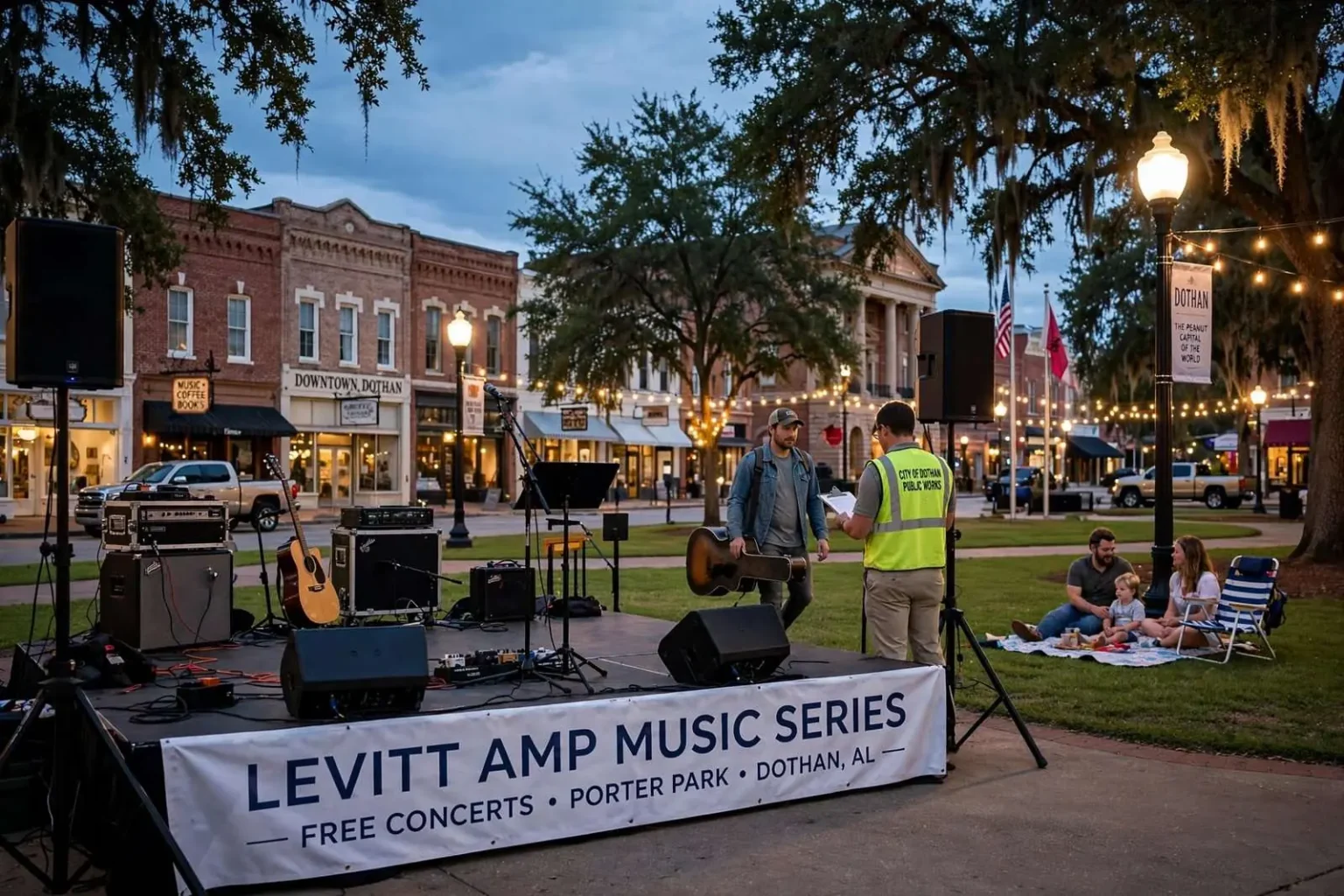
The network selection follows Dothan’s recent announcement that it was awarded a Levitt AMP Music Series Grant, which will fund a series of free live music performances in downtown Dothan’s Porter Park this fall. The two developments arrived in close succession, and city officials say together they reflect a growing commitment to making music a central part of Dothan’s cultural, economic and community development plans.
What the Network Actually Does
Membership in the Music Policy Resilience Network gives city officials access to something Dothan has never had in abundance: comparative data and peer experience. Member cities share research on how zoning, permitting, noise ordinances, grant programs and venue support affect whether local music scenes survive and grow. The Centre for Music Ecosystems convenes the group so that a city facing, say, a dying club district can learn directly from other cities that have reversed the same decline.
For a city of Dothan’s size, that access is the practical value of the designation. Policy work around music is specialized — it touches economic development, tourism, alcohol licensing, land use and arts funding all at once — and most mid-sized cities have no staff who specialize in it. The network exists precisely so that cities do not have to invent their approaches from scratch, and so that smaller markets have a seat at a table that has historically been dominated by big-city case studies.
The “resilience” in the network’s name reflects its founding concern: the pandemic years devastated music venues worldwide, and the cities that joined wanted to build scenes sturdy enough to survive shocks. Dothan enters at a moment when its own venues have just begun hosting regular touring acts, making the timing — officials argue — right for locking in the gains before they slip.
The Levitt Grant and Porter Park
The Levitt AMP Music Series Grant that Dothan won adds an immediate public face to the policy work. The grant program, funded by the Levitt Foundation, awards mid-sized cities funding for a season of free outdoor concerts in a public space, with the explicit goal of activating underused parks and making live music accessible to everyone regardless of income.
Porter Park, in downtown Dothan, will host the fall series, and the format is proven across dozens of American cities: lawn seating, food vendors, local openers and touring headliners, and a family audience that ordinary ticketed venues rarely draw. Cities that have run Levitt AMP series consistently report that the concerts bring foot traffic downtown on weeknights, give local musicians paid stage time, and build the audience habits that commercial venues depend on.
Why Dothan Is Betting on Music
Dothan’s push fits a wider pattern among mid-sized Southern cities that have watched talent and nightlife drain toward metros and decided to compete for it. The city anchors the Wiregrass region across southeast Alabama and the neighboring Florida panhandle, serving a broad rural trade area for healthcare, retail and industry. Its economy has traditionally rested on agriculture — the peanut festival that bears the region’s name remains a signature event — and on its role as the commercial hub for surrounding counties.
Cultural amenities, economic developers argue, are part of the competition for the same residents and visitors that retail and healthcare chase. A young professional deciding between Dothan and a larger city weighs what there is to do at night, and touring musicians plotting regional routes decide which markets can draw a crowd. A documented, supported music ecosystem answers both questions at once.
The three years of groundwork the city describes have included supporting local venues, growing the number of touring acts that stop in Dothan, and building relationships among the musicians, promoters and businesses that make up the scene. The network membership now gives that work a formal structure and an outside benchmark, and the Levitt AMP series gives it a public stage this fall in Porter Park.
City officials have not laid out specific policy changes that will follow the network membership, and the first year of participation is typically diagnostic — measuring the local scene’s economic footprint, surveying venues and musicians, and comparing findings with peer cities. The concrete outputs, from revised ordinances to new grant programs, tend to come in the years that follow.
What the designation guarantees for now is momentum with a structure behind it. Dothan’s music community, which has spent years playing the circuits through Dothan, Enterprise, Troy and the panhandle, suddenly has a city government treating the scene as infrastructure — and a global network of peer cities to call when the next question about how to build it comes up.
The Regional Context Behind the Strategy
Dothan’s timing is not accidental. Cities across the Southeast have spent the past several years competing for a slice of the touring economy as mid-level artists reroute their tours through secondary markets, and the cities that can promise reliable venues, cooperative local government and an audience that shows up have consistently won those stops. Dothan’s position along U.S. 231, between Montgomery and the Florida panhandle, places it naturally on regional touring routes between Atlanta, Tallahassee and the Gulf Coast.
The Wiregrass region’s own musical traditions give the effort something authentic to draw on. Southeast Alabama has produced country, gospel and Southern rock talent for generations, and the area’s festivals, church programs and school bands have long fed musicians into bigger markets. A local music policy that connects those roots to present-day venues is exactly the kind of project the Music Policy Resilience Network was designed to advise.
Officials also see the work through a downtown-revival lens. Dothan’s city center, like those of many mid-sized Southern cities, has spent decades working to keep storefronts filled as retail shifted to corridors along the highways. Evening activity is the hardest piece of that puzzle to solve, and music — from the Levitt AMP concerts in Porter Park to the touring acts now passing through local venues — is the tool the city has chosen to bring people downtown after business hours.
The fall concert series will be the first visible test. If the Porter Park shows draw the multigenerational crowds that Levitt AMP series typically produce, the city will have both the data and the public goodwill to support the next round of policy work. If the network’s membership teaches Dothan anything, officials say, it will be how to turn one good season of concerts into a permanent music economy — one that gives people another reason to visit Dothan, stay in Dothan and experience Dothan.