Double Red Flags Keep Swimmers Out of the Water in Gulf Shores as Hurricane Francine Churns Offshore
Double red flags closed the water at Gulf Shores beaches this week as Hurricane Francine stirred up dangerous surf and rip currents, with police patrolling to keep swimmers out of the Gulf.
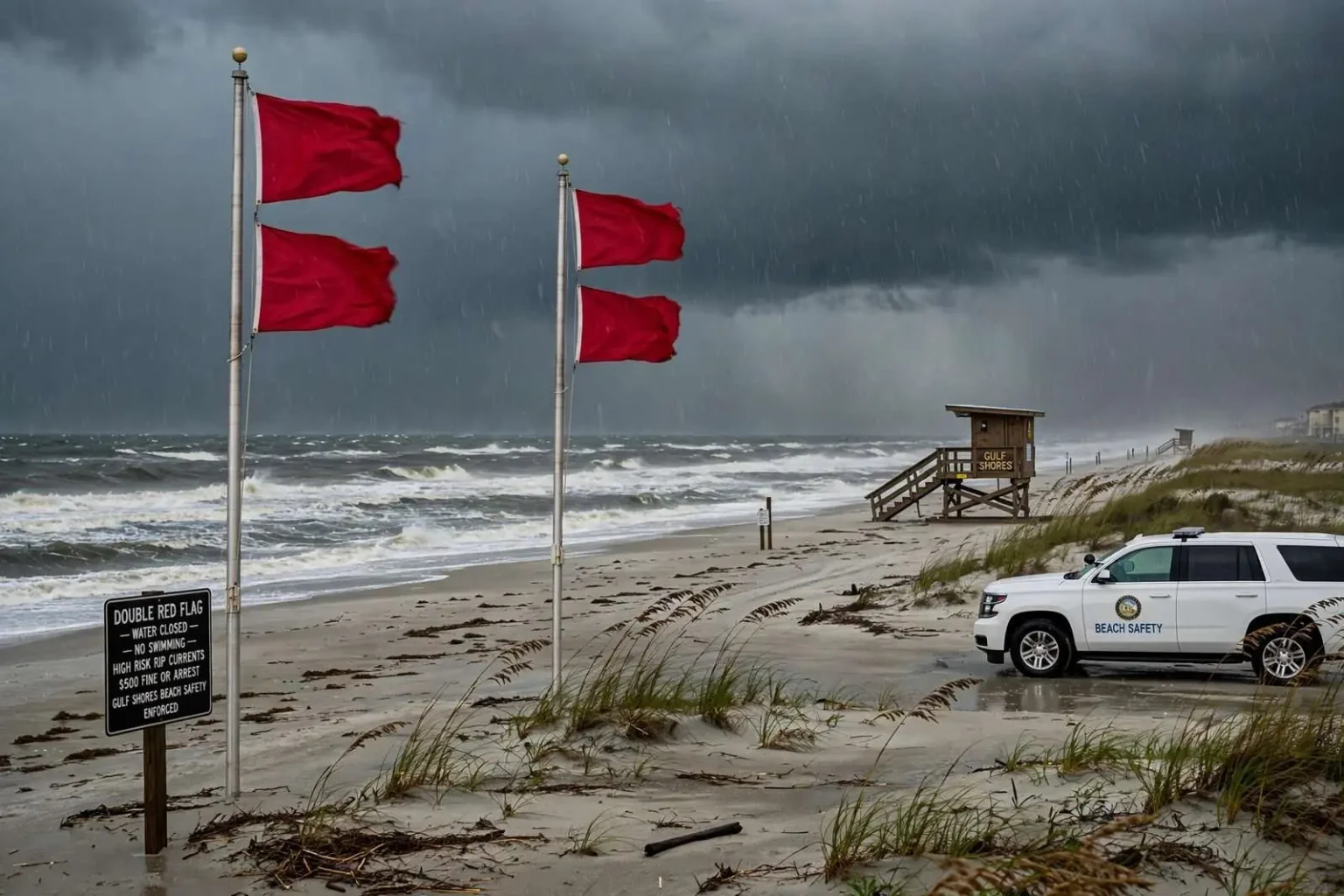
Double red flags flew over Gulf Shores beaches this week as Hurricane Francine moved through the Gulf of Mexico, keeping swimmers out of the water and pushing dangerous surf onto the Alabama coastline.
The warning flags, the most severe in Alabama’s beach flag system, mean the water is closed to the public because of a high risk of rip currents and rough seas. Under the double red flag advisory, anyone caught in the water can face a $500 fine or arrest. Gulf Shores police stepped up patrols along the beach to enforce the closure as rain bands from the storm moved through the area and churned up the surf.
The closure covers the city’s entire beachfront, and neighboring Orange Beach makes its own flag calls that often track Gulf Shores during tropical events. Together the two cities manage the bulk of Alabama’s guarded beach coastline, and their flag decisions are the single most visible safety signal the roughly seven million annual visitors to the island’s beaches will see during their stay.
Despite the rain and the closed water, some visitors made the best of the unsettled weather. Mike Maner, who was vacationing in Gulf Shores when the flags went up, said he did not mind the wet forecast. “A rainy day at the beach is better than a sunny day at the office,” Maner said.
Compliance, Not Citations
City officials said the message about staying out of the Gulf appeared to be getting through to beachgoers. Gulf Shores Beach Safety Chief Joethan Phillips said his officers had not needed to issue any citations as of midweek, in part because the storm itself was keeping crowds thin. “To my knowledge, the police department hasn’t had to write any tickets. Right now, with the rain coming in, the beach really isn’t too busy. Everybody seems to be abiding,” Phillips said.
That cooperation is the norm during most tropical closures, but it is never taken for granted. Beach patrol officers and lifeguards repeat the same message at every access point: a double red flag is an order, not a suggestion, and the fine exists because swimmers who enter churned-up surf during a tropical event do not just endanger themselves but the rescuers who would have to go in after them.
Storm-driven closures of this kind have become a familiar rhythm along the Alabama coast, where the Gulf’s warm waters produce both the tourism economy and the tropical weather that occasionally interrupts it. Lifeguards and beach patrol officers spend the peak of hurricane season watching surf forecasts as closely as any meteorologist, knowing that a system hundreds of miles away can generate deadly currents on an otherwise sunny afternoon.
The flags themselves are only part of the safety net. Gulf Shores staffs lifeguard towers during the busy season, maintains emergency call boxes along the beach, and works with rental agencies and hotels to push flag updates to visitors as conditions change. During tropical events, city crews also clear debris from the sand and secure equipment, since unsecured chairs and umbrellas become hazards once sustained winds arrive.
The name Francine follows the 2024 Atlantic hurricane season’s alphabetical list, one of the designations forecasters rotate each year for storms that reach tropical storm strength. For Gulf Coast residents, the name on the flag decision matters less than the forecast cone, and the routine of watching one approach has become as much a part of coastal life as the beach itself.
How the Flag System Works
Alabama’s beach warning system ranges from green, indicating calm conditions, up through yellow, single red and double red, the highest level, which closes the water entirely to swimmers. The system also uses purple flags to warn of dangerous marine life such as jellyfish or stingrays, and the flags fly at lifeguard towers and public access points along the coast.
A yellow flag means swimmers should use caution, a single red flag warns of high hazards such as strong surf or currents, and a double red means the Gulf is off limits. The distinctions matter because conditions can escalate quickly during a tropical event, moving from yellow to double red within hours as wind and swell build ahead of a storm’s approach.
Forecasters warned that the elevated risk of rip currents was expected to continue through the end of the week, with double red flags likely to fly again as Francine continued to influence conditions in the Gulf. Beach safety officials said they would reassess the flag status daily based on the storm’s track and intensity. “We’ll continue to monitor and maybe go to single red on Friday, but it just all depends on what the storm does,” Phillips said.
Rip currents are among the leading causes of beach-related deaths along the Gulf Coast, and officials routinely urge visitors to check flag conditions before entering the water, swim near a lifeguard when possible, and know how to escape a rip current by swimming parallel to shore if caught in one. The narrow channels of fast-moving water pull swimmers away from the beach, and exhaustion, rather than the current itself, is usually what turns an escape into a drowning.
The science of a rip current is simple but unforgiving. Water pushed ashore by wind and waves has to find its way back out, and it does so through narrow channels where the return flow runs strongest, often near sandbars, piers and jetties. From the beach, a rip can appear deceptively calm, a gap in the wave pattern rather than a wall of white water, which is why officials emphasize education as much as enforcement.
Escaping one requires the counterintuitive move of not fighting it. Swimmers who try to power straight back to shore against a rip current burn through their strength in minutes; those who stay afloat and swim parallel to the beach exit the channel within a few strokes and can then ride the waves back in. Safety officials also urge anyone caught in one to signal for help early rather than late, and to keep children within arm’s reach whenever surf is elevated.
Hurricane Season on Alabama’s Beaches
Hurricane season runs from June through November, and the peak of the season in August and September coincides with the height of the Gulf Coast tourism calendar. That overlap makes flag awareness a routine part of a beach vacation here: tropical systems can form in the Gulf or the Caribbean with only a few days’ warning, and their outer bands can double surf sizes and current speeds long before any landfall.
Francine’s approach followed that familiar pattern, sending bands of rain onshore while generating the surf that forced the closures. For coastal Alabama, storms that pass to the west or east often do their damage through water rather than wind, flooding streets, eroding beaches and producing exactly the dangerous currents that keep flags red for days after the clouds clear.
Visitors planning trips to Gulf Shores and Orange Beach during hurricane season are encouraged to monitor local forecasts and beach safety announcements, since flag conditions can change quickly as tropical systems pass through the Gulf. The cities post daily flag status through their websites, social media and on-beach signage, and hotels and rentals generally relay current conditions to arriving guests.
Safety officials repeat a short list of advice every season. Check the flags before you get wet. Swim in front of a lifeguard tower when one is staffed. If caught in a rip current, do not fight it directly; swim parallel to the beach until free, then angle back to shore. And when the water is closed under a double red flag, the only safe place to enjoy the Gulf is from the sand.
For this week at least, the sand was where nearly everyone stayed. With the storm offshore, the beach quiet and the flags flying red, Gulf Shores got through a tropical interruption the way beach towns try to: no tickets written, no rescues needed, and a community of rain-soaked vacationers agreeing that a rainy day at the beach still beats the office.
Local businesses watch the flags too. Surf shops, rental companies and beach vendors adjust their operations when the water closes, and restaurants and indoor attractions typically see a bump in traffic when a storm confines visitors to dry land. A double red week is not a total loss for the tourism economy, but it is a reminder of how quickly the Gulf can take back the front row of the region’s main attraction.
For residents, the same warnings apply that tourists hear. Locals who surf, fish or exercise along the waterline during storm weeks are among the most frequent rescues on the Gulf Coast, because familiarity breeds a false sense of confidence in surf that no swimmer should trust. The advice beach safety officials give visitors applies equally to anyone who lives a few blocks from the water: the flag at the access point is the final word.