Doug Jones to Host Public Town Hall in Dothan This Week
Doug Jones, the Democratic nominee for Alabama governor, will hold a public town hall in Dothan on Wednesday as part of his statewide tour taking unscreened questions from voters.
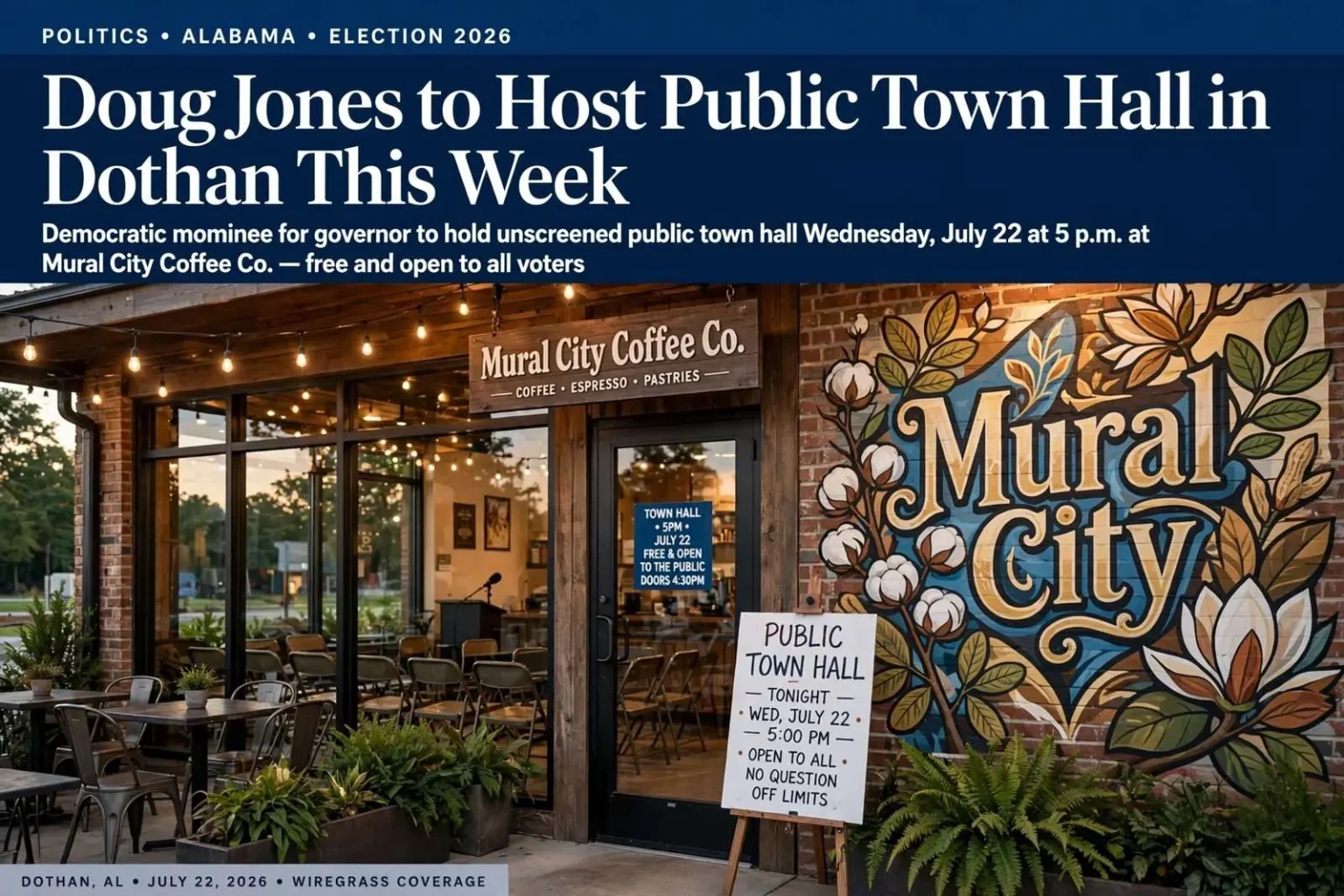
Doug Jones, the Democratic nominee for governor, will hold a public town hall at 5 p.m. Wednesday, July 22, at Mural City Coffee Co. in Dothan.
As he has at each stop on his statewide town hall tour, Jones will take unscreened questions from attendees regardless of party affiliation. “No question is off limits,” his campaign said in a news release.
The Dothan stop carries particular weight in this year’s political map. New congressional district lines have reshaped Alabama’s political landscape, making the Wiregrass one of the state’s most competitive regions ahead of the November election — and candidates in both parties have been following the voters into territory that recent statewide maps had largely written off as settled.
With competitive races for governor and Congress on the ballot, Jones said voters deserve candidates who show up, answer questions and earn their trust.
The Town Hall Format
The unscreened format is the signature of Jones’ tour. Town halls have faded from American political life in recent decades, replaced by scripted town squares and curated livestreams, and a candidate who promises questions from anyone — regardless of registration or persuasion — is betting that direct engagement still moves voters in a state where his party remains in the minority.
For attendees, the mechanics are simple. The event at Mural City Coffee Co. is free and open to the public, with no party affiliation required to attend or ask. Coffee shops have become the venue of choice for this kind of retail politics precisely because of their informality: no lectern distance, no ticket gate, just a candidate and a room of neighbors.
July’s date also lands mid-campaign, when name recognition is still forming and a strong town hall can generate the local coverage and word-of-mouth that paid advertising cannot buy. Word travels fast in a market Dothan’s size, and a candidate who handles a tough unscreened question well earns more than the moment — he earns the retelling.
The format carries risks as well as rewards. Unscreened questions mean hostile questions, interruptions and the possibility of an unflattering moment — and campaigns that run them accept that trade in exchange for authenticity. Jones’ campaign has framed the gamble as the point: if a candidate cannot answer an Alabamian’s question in person, the argument goes, he should not be asking for their vote in November.
“If you’re asking Alabamians to trust you as their governor, the least you can do is answer their questions,” Jones said. “That’s what these town halls are about.”
Why Dothan Matters
Dothan sits at the center of the Wiregrass, the peanut-country corner of Alabama that reaches toward the Georgia and Florida lines, and it functions as the regional capital of the state’s southeastern corner. Houston County’s largest city anchors a media market and retail hub that draws shoppers and workers from across the tri-state borderlands, and its political habits have long made it a stop every statewide candidate must schedule.
The region’s electorate is a study in the balance a Democrat must strike. The Wiregrass votes Republican in most statewide contests, but its voters split their loyalties on personalities and issues, turning out for candidates who invest time in the region regardless of party label. Campaign veterans describe southeast Alabama as a place where door-knocking and town halls still move numbers — which is exactly the terrain Jones’ tour is built for.
The redrawing of Alabama’s congressional districts made that stop count for more this cycle. The Wiregrass lands inside a reconfigured region where partisan margins have tightened, and the competitive gubernatorial and congressional contests on the November ballot mean votes in Dothan, Enterprise, Ozark and the surrounding counties could decide outcomes they would not have influenced under older maps.
Campaigns read that shift in travel schedules. Candidates who once flew over southeast Alabama between Birmingham and the Panhandle now work it precinct by precinct, and a midweek evening town hall in Dothan reflects a calendar built around persuasion rather than base mobilization alone.
The Fort Novosel Connection
The campaign said that approach defined Jones’ time in the U.S. Senate, where he worked across the aisle and helped lead the bipartisan repeal of the military “widow’s tax.” The repeal restored full survivor benefits to thousands of military families nationwide, including many with ties to Fort Novosel, according to the campaign.
The widow’s tax — the offset that reduced survivor benefits for military families who also received survivor benefit plan annuities — was a grievance military advocacy organizations carried to Congress for years before the repeal passed with bipartisan support. For districts near Army installations, the issue was personal: surviving spouses saw their benefits reduced by the very offset that had been promised to protect them.
Fort Novosel, the Army aviation installation just north of Enterprise, gives that record a direct local audience. Thousands of active-duty families, retirees and civilian workers in the Wiregrass trace their livelihoods to the post, and military-related policy — pay, benefits, survivor protections — registers with voters there in a way few other issues do. A candidate citing survivor-benefit work in a Dothan town hall is speaking to one of the region’s core constituencies on its own terms.
Jones’ Senate tenure, which ran from his 2017 special election win through early 2021, built its reputation on precisely this kind of cross-party work, and his campaign has made the record a centerpiece of the governor’s race pitch: a Democrat who argues he can win over the same Republican-leaning voters who will dominate a November statewide electorate.
The gubernatorial bid gives that record a second life. Senate service offers a governor’s-race candidate a paper trail of votes, bills and bipartisan moments to campaign on, and the widow’s tax repeal is among the easiest such records to explain: a wrong that was fixed, with benefits restored to families who had earned them. In military-heavy communities, that story lands with a specificity abstract policy talk rarely reaches.
What Voters Can Expect
The 5 p.m. start puts the town hall in the after-work window, the slot campaigns use to catch shift workers, teachers and commuters alongside the retirees who fill midday political events. Wednesday, July 22, lands in the heart of summer — Dothan’s heat makes an air-conditioned coffee shop an easier ask than a courthouse square — and the venue’s size means early arrival is the practical price of a good seat.
Attendees can expect the question format to run the full range of state government: schools and rural hospitals, roads, taxes, economic development and whatever topics the room raises. Unscreened town halls reward preparation, and candidates on this kind of tour typically spend the drive between stops boning up on the local issues each community is living with.
The free admission and open door are deliberate. Campaigns that charge for entry or require registration filter out exactly the skeptical voters a candidate claiming bipartisan appeal most needs to reach. An open room in a Republican-leaning region is itself the message: the tour is designed to be seen, shared and attended across party lines.
Dothan’s Place in Statewide Politics
Dothan has a long memory for candidates. Statewide hopefuls who work the Wiregrass in July find voters who remember who showed up in past cycles and who called it in from Montgomery — and Houston County’s civic groups, churches and radio stations keep that scorecard informally. A town hall rather than a fundraiser signals the kind of attention local voters respond to.
The coffee shop setting is also part of Dothan’s own story. The city has leaned into its “Mural City” branding in recent years, commissioning downtown murals that have drawn visitors and rebranded the historic district as a destination. Hosting a gubernatorial town hall downtown puts the candidate in front of that revitalized backdrop, and puts Dothan’s reinvestment story in front of a statewide audience.
For the Wiregrass, the broader stakes run beyond one candidate’s itinerary. Competitive races mean advertising dollars, candidate visits and policy attention flow into a region that settled maps had dried up, and local officials have long argued the area’s issues — rural health care, Fort Novosel’s future, agricultural economy, water resources — deserve statewide attention whether or not the margins demand it.
One Evening, No Filter
The town hall is free and open to the public, starting at 5 p.m. Wednesday, July 22, at Mural City Coffee Co. in Dothan. No question is off limits, per the campaign — the same rule that has governed every stop on the tour.
Whether the format persuades Wiregrass voters will be settled in November. For one Wednesday evening in July, though, the campaign is putting its premise to the test in the most direct way available: a candidate, a room, and whatever the audience chooses to ask.